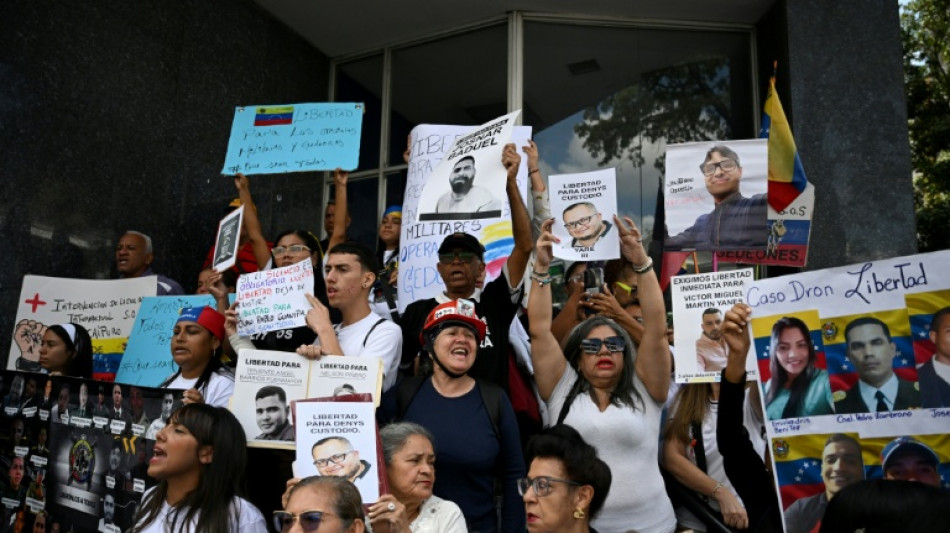
Venezuela amnesty bill postponed amid row over application / Photo: Federico PARRA - AFP

 Australian police charge man over 'targeted' attack on lawmaker

 Rubio lands in India for 'trade diplomacy'

 China opposes US ban on govt agencies from using DeepSeek

 Near miss: Indonesia probes crash of suspected Chinese rocket fragment
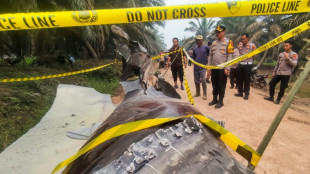 Indonesia investigates crash of suspected Chinese rocket fragment
 South Korea to withdraw some Ukraine embassy staff after POW row
 S. Korea warns of 'firm' response after North threatens fresh measures near border
 Ukraine claims US missile holdup ahead of reported talks

 Niners hold off Commanders to stay perfect in NFL

 Tech firms bear brunt of selling as Asian stocks drop

 Reese scores 30 as Dream stun Valkyries to level WNBA finals

 Horror and disbelief after lawmaker attacked in rural Australia

 Ukraine races to secure energy supplies ahead of winter

 Vote count begins in Alberta secession referedum, testing Canada unity

 How to Use an Allowance to Teach Money Skills

 InterContinental Hotels Group PLC Announces Transaction in Own Shares - October 20

 Silver Range Resources Ltd. Appoints Luke Schranz Vice President

 DataMeds Regains Compliance With NASDAQ Listing Standards

 How recent controversies have rocked the US death penalty debate
 Adams facing long injury layoff as Rams' problems deepen
 US judge orders Saudi engineer held in OpenAI case

 Maddison sparkles as Spurs end Premier League winless run

 Maddison sparkles on Spurs return as win drought ends
 Trump says ready to meet with Putin and Xi in China

 The young lawmaker making Brazil's Lula 'king of the selfie'
Venezuelan lawmakers on Thursday postponed the adoption of a landmark amnesty bill designed to end the use of courts to crack down on dissent after failing to reach an agreement on how to apply it.
Thousands of opposition supporters poured into the streets of Caracas to demand the release of all remaining political prisoners before debate on the bill began.
The amnesty is expected to cover all charges brought against dissidents who opposed the rule of ousted leader Nicolas Maduro and his predecessor Hugo Chavez over the past 27 years.
Members of the National Assembly backed the bill on a first reading last week and had been expected to adopt it on Thursday after a second reading.
But it hit a snag, with pro-government and opposition lawmakers clashing over an article requiring would-be beneficiaries to appear in court to request the amnesty.
Opposition member Nora Bracho said that the requirement was "completely unnecessary" and said the amnesty should apply automatically to all the crimes covered by the law.
Pro-government lawmaker Iris Varela however argued it was important for beneficiaries to "acknowledge crimes they have committed" before having the cases against them closed.
Lawmakers voted to continue the debate on February 19.
The bill is the centerpiece of the reforms undertaken by acting President Delcy Rodriguez since Maduro's capture by US special forces in a deadly January 3 raid on Caracas.
It aims to turn the page on nearly three decades of state repression.
Rodriguez has also ordered the closure of the notorious Helicoide prison in central Caracas, which has been denounced as a torture center by rights groups.
Once passed, the amnesty is expected to lead to the release of hundreds of activists still waiting to walk free from prison, six weeks after Maduro's downfall.
More than 400 political prisoners have been released so far but over 600 remain in prison, according to rights group Foro Penal.
- 'We are not afraid' -
Rodriguez took Maduro's place with the consent of US President Donald Trump, provided she does Washington's bidding.
Trump has taken over control of Venezuela's oil sales, which he says will be used for the benefit of Venezuela and the United States.
His administration has also pressured Rodriguez to release political prisoners.
In a sign that the fear instilled by the state is beginning to dissipate, opposition demonstrators reclaimed the streets of Caracas on Thursday.
"We are not afraid," thousands of demonstrators chanted, in their biggest show of force in years.
"We spend a lot of time underground, silent in the face of all the repression Venezuela experienced... but today we are rising up and uniting to put forward demands for the country," Dannalice Anza, a 26-year-old geography student, told AFP.
The ruling socialist party organized a counter-demonstration, which attracted thousands of pro-Maduro youths.
- Treason and terrorism -
The amnesty bill covers charges of "treason," "terrorism" and spreading "hate" that were used to lock up dissidents.
It also lifts bans on several opposition members, including Nobel Peace laureate Maria Corina Machado, on running for office.
Venezuela's attorney general told AFP that it should apply to opposition members and "chavistas," as supporters of Chavez and Maduro are known, alike.
Rodriguez has been walking a diplomatic tightrope since taking over, attempting to meet US demands without alienating hardliners in her administration.
On Thursday she toured oil fields with visiting US Energy Secretary Chris Wright, who has pushed for a "dramatic" increase in Venezuela's oil output and teased an end to a US oil embargo.
But Rodriguez also faces possible resistance to her reform effort.
On Sunday, Venezuelan opposition leader Juan Pablo Guanipa was released from prison to much fanfare -- only to be rearrested hours later after calling for free elections.
He has since been placed under house arrest.
T.Wright--AT