China's Pelosi bombast shows insecurity over Taiwan: analysts / Photo: Handout - CNA/AFP

 Ukraine claims US missile holdup ahead of reported talks

 Niners hold off Commanders to stay perfect in NFL
 Tech firms bear brunt of selling as Asian stocks drop

 Reese scores 30 as Dream stun Valkyries to level WNBA finals
 Horror and disbelief after lawmaker attacked in rural Australia

 Ukraine races to secure energy supplies ahead of winter

 Vote count begins in Alberta secession referedum, testing Canada unity

 How to Use an Allowance to Teach Money Skills

 Ukraine claims US missile holdup as Trump floats summit without Zelensky

 Detained Suu Kyi receives UK royal package: Myanmar govt

 Japan successfully launches probe in historic Mars moon mission

 US to auction deep sea mining leases off American Samoa

 Australian lawmaker hurt in car attack underwent surgery overnight: PM
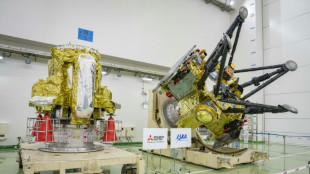 Japan launches rocket for potential world first Mars moon mission

 Ethiopia PM warns Eritrea of 'severe consequences' if supports enemies

 Boland grabs opportunity for Australia as South Africa struggle in second Test

 Ronaldo handed 30-day suspension: Portuguese federation
 France announces curfews as government grapples with unrest

 Boland sets pace as South Africa struggle
 Ukraine on back foot as Kremlin moots US, China meeting

 'Stay home!': Tourists find themselves in a France convulsed by protests

 Kenyan cult leader guilty on all charges over 191 starvation deaths

 Eagles star Hurts to miss rest of NFL season: reports
 Oil-rich Alberta votes on Canada breakup

 Israel announces arrests after West Bank settler attacks on Westerners
China's tough rhetoric around US House Speaker Nancy Pelosi's visit to Taiwan reveals deep insecurity about Washington's shifting stance towards the island, analysts told AFP, as well as efforts to distract from economic woes at home.
The 82-year-old lawmaker landed in Taipei late Tuesday night -- becoming the highest-profile American official to set foot there in 25 years.
But for days before the military plane carrying her landed at Songshan Airport, Beijing wielded increasingly bellicose language, issuing threats of "consequences" and making demonstrations of military force.
China held live-fire drills across the strait from Taiwan over the weekend, while Hu Xijin, former editor-in-chief of nationalist tabloid Global Times, suggested that Beijing could "forcibly dispel Pelosi's plane" or even "shoot them down".
But analysts told AFP that beneath the bombast there is insecurity, with China's rulers threatened by what they perceive as increasing efforts by the US and Western allies to foster relationships with Taiwan and encourage the island's independence.
At the same time, Chinese President Xi Jinping is anxious to project strength against the United States -- its greatest military and economic rival -- ahead of a key political meeting expected to secure him an unprecedented third term.
- Show of strength -
Last week, Xi warned his US counterpart Joe Biden in a call that the United States shouldn't "play with fire" when it comes to Taiwan.
The aggressive message serves to reinforce the Chinese leader's domestic image ahead of his expected political coronation at the 20th Party Congress this autumn, said Steve Tsang, director of the SOAS China Institute in London.
"As a strongman leader, the last thing he would want to show is any sign of weakness," Tsang told AFP.
Drumming up nationalist sentiment also serves to distract from China's slowing economy and growing public impatience with Beijing's harsh zero-Covid restrictions that have dampened the mood in what would have been a jubilant year for Xi.
"For the Chinese communist party, there are two pillars of legitimacy -- economic growth and nationalism," Willy Lam, a Hong Kong-based Chinese politics analyst, told AFP.
Headlines and aggressive messaging on Taiwan have been "diverting the attention of the Chinese public away from economic problems", he said.
- Dire strait -
There are also deep-rooted frustrations in Beijing over Washington's shifting attitudes toward Taiwan.
China considers the self-ruled, democratic island as its territory and has vowed to one day reclaim it, by force if necessary.
Beijing's sabre-rattling stems in large part from a perception that the United States' engagement with Taiwan has become more proactive and threatening to the mainland's interests in recent years, said Li Mingjiang, associate professor of international relations at Singapore's Nanyang Technological University.
Since the Trump administration, some in Beijing believe Washington appears to have become increasingly "supportive of Taiwan independence", Li told AFP.
Chinese diplomats have complained that the United States is no longer honouring what it claims is a binding tenet of bilateral relations, the "One China" policy, pointing to arms deals between Washington and Taipei.
Visits to Taiwan by politicians from regional neighbours as well as Europe and the US have also increased.
Xi is "getting very impatient and irritated by the fact that in the past year senior leaders... not just from the US but from Japan, the EU and so forth have been visiting Taiwan," Lam, the Hong Kong-based analyst, said.
At the same time, there is a greater sense of distinctive Taiwanese identity among the younger generation.
Combined with the ruling Democratic Progressive Party's pro-independence agenda, this means that to Beijing's elite "the whole Taiwan issue does not really look positive," Li said.
Chinese leaders are turning to fiery rhetoric to "discourage the development of cross-strait relations and US-Taiwan relations from becoming even more challenging for mainland China," he said.
- 'The last thing Xi wants' -
Despite all its aggressive posturing, few believe Beijing wants an active military conflict against the United States and its allies over Taiwan -- just yet.
"The last thing Xi wants is an accidental war ignited," Titus Chen, an associate professor of political science at the National Sun Yat-Sen University in Taiwan, said.
Multiple scholars noted that Beijing's military capabilities still lag behind Washington's, and told AFP that recent military drills, while clearly intended to be intimidating, fell short of targeting areas immediately adjacent to the Taiwanese coast.
"Xi's Plan B would be to explain away, via (Chinese Communist Party) propaganda and thought control system, the sense of embarrassment or humiliation that Pelosi's Taiwan visit brings to Beijing," Chen said.
T.Perez--AT