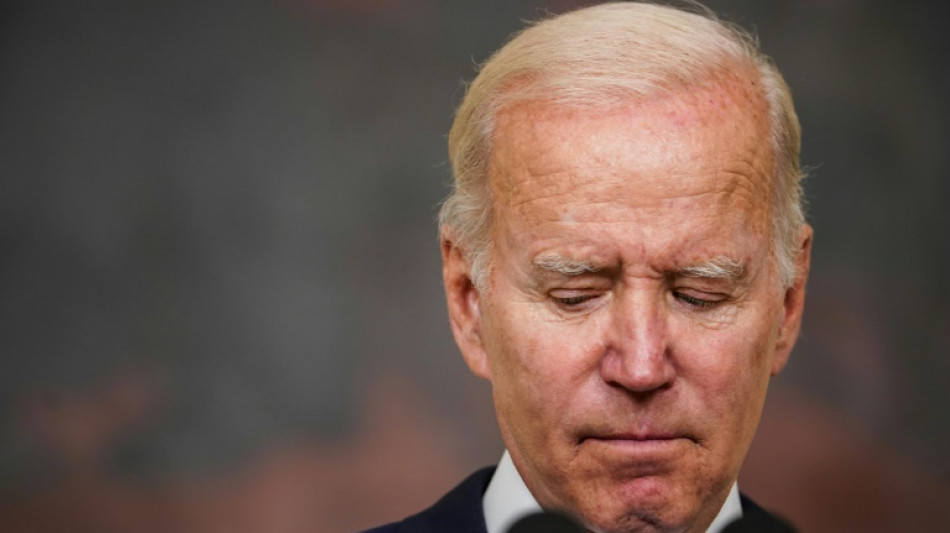
In US, the definition of 'recession' is moving target / Photo: MANDEL NGAN - AFP

 Middle East fuel crunch drives solar push in tiny Fiji

 Indian rappers use music to sound climate alarm

 Japan probe on its way to Mars moon

 Lula or Bolsonaro's son? Brazil makes a final choice

 EU unveils strategy to boost Arctic presence
 How recent controversies have rocked the US death penalty debate
 Adams facing long injury layoff as Rams' problems deepen

 US judge orders Saudi engineer held in OpenAI case

 Maddison sparkles as Spurs end Premier League winless run

 Maddison sparkles on Spurs return as win drought ends

 Trump says ready to meet with Putin and Xi in China

 The young lawmaker making Brazil's Lula 'king of the selfie'

 Christiane Amanpour to leave CNN after 43 years

 Ronaldo handed 30-day suspension after walking out on Portugal

 Netanyahu basks in Trump endorsement week before election

 Saudi airport closure disrupts life in kingdom's capital

 Ramaphosa tells South Africa to prepare for loss of US-Africa trade deal
 France presses resale platforms to remove 'stolen' goods after unrest

 Yamal v PSG: Ballon d'Or backdrop to Champions League showdown

 Araujo says too soon to talk about permanent Liverpool move
 US wants to be 'strong partner' for central Asia: Rubio
 'Special' to face friend Perez in Champions League, says Liverpool's Iraola

 Monitor says Indonesia fires have burned nearly two million hectares

 French PM says could declare state of emergency over unrest 'if needed'

 Albanian PM warns of 'red line' after days of unrest
Now that the US economy has posted two consecutive quarters of negative growth, is it in recession? Opinions are starkly divided, and President Joe Biden is definitely in the No camp.
The "R" word is akin to profanity in some Washington circles these days, especially within the Biden administration.
Just defining exactly what a recession is and when it begins has sparked furious debate -- based as much around politics as economics.
"That doesn't sound like a recession to me," the US president said Thursday after the Commerce Department reported that GDP declined at an annual rate of 0.9 percent in the second quarter, following a bigger drop in the first three months of 2022.
While not the official definition, two quarters of negative growth is commonly viewed as a strong sign that a recession is underway -- but the veteran Democrat's government has been at pains for a week to explain why the term does not apply.
"How Do Economists Determine Whether the Economy is in a Recession?" the White House said in a blog post last week, apparently trying to get the jump on Thursday's data release.
"While some maintain that two consecutive quarters of falling real GDP constitute a recession, that is neither the official definition nor the way economists evaluate the state of the business cycle," the White House said.
Of course, opposition Republicans quickly picked up on the spin.
"Newsflash for Joe Biden: You can't change reality by arguing over definitions," the Republican National Committee said in a statement on Monday.
Then on Thursday, top House Republican Kevin McCarthy tweeted: "Democrats would rather redefine a recession than restore a healthy economy."
- 'One official arbiter' -
So beyond the political spin machine, what really is a recession?
In a note on its website, the International Monetary Fund insists there is "no official definition of recession."
"Most commentators and analysts use, as a practical definition of recession, two consecutive quarters of decline in a country's real (inflation-adjusted) gross domestic product (GDP)," the Washington-based global lender says.
For the IMF's chief economist Pierre-Olivier Gourinchas, "the general assessment as to whether the economy is in a recession overall is a little bit more complex."
Federal Reserve Chair Jerome Powell said Wednesday the Fed "doesn't make a judgment on that," but added: "What a recession really is -- it's a broad-based decline across many industries that is sustained for more than a couple months."
And then on Thursday, Treasury Secretary and former Fed chair Janet Yellen chimed in: "I think we should avoid a semantic battle."
David Wilcox, a senior economist at the Peterson Institute for International Economics and at Bloomberg Economics, says that considering an economy as entering recession after two consecutive quarters of negative GDP growth is simply "wrong."
"I kind of cringe and resist every time I see" that definition, Wilcox told AFP.
"There's one official arbiter of recession dating in the United States. And that's the National Bureau of Economic Research."
- Late to the party? -
The NBER, a private, independent and nonpartisan entity, was founded in 1920 to refine research on the US economy. Its "Business Cycle Dating Committee" uses several data points to determine when the economy is in expansion or recession.
"A recession is the period between a peak of economic activity and its subsequent trough, or lowest point," the NBER says on its website.
"The NBER's definition emphasizes that a recession involves a significant decline in economic activity that is spread across the economy and lasts more than a few months."
But because the bureau prefers to base its assessment on solid data and publish its opinion several months after the figures are released, it can seem a little late to the party.
Ellen Hughes-Cromwick, an economist at the Third Way, a center-left think tank, says that the NBER's traditional delay is "not a problem" but rather a "methodology" that allows the bureau to avoid repeated revisions.
"What is common knowledge among economists is that in that preliminary estimate (each quarter), they have less than 50 percent of actual statistics," she explains.
"In other words, 50 percent of that GDP preliminary estimate… are estimates," adds Hughes-Cromwick, who worked as an economist under presidents Ronald Reagan and Barack Obama.
Translation: the NBER is perhaps totally justified in taking its time.
A.O.Scott--AT