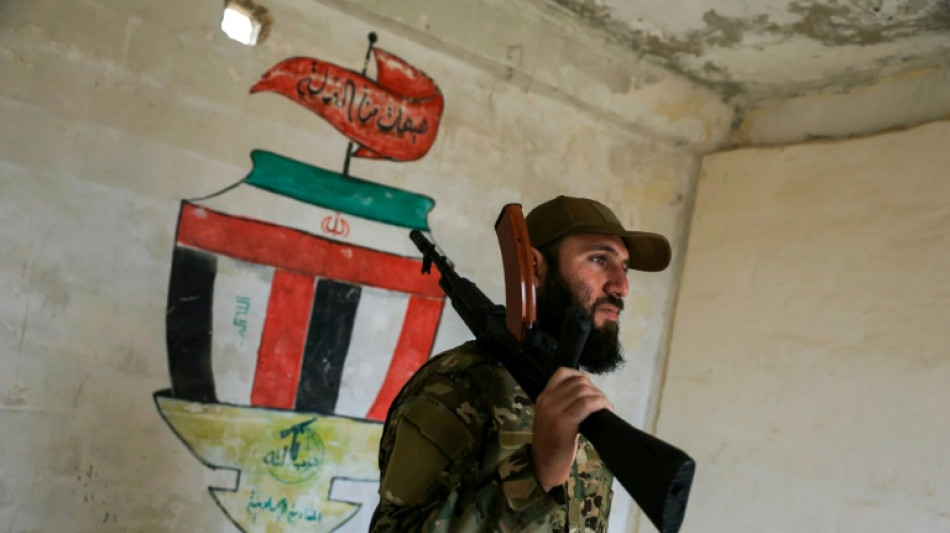
'It's all over': how Iran abandoned Assad to his fate days before fall / Photo: Bakr ALkasem - AFP

 Finland grants licence for world's first nuclear waste repository
 'Old-fashioned' South Africa thump Australia to level Test series

 No more taking out the trash at your Airbnb

 Swiss supreme court upholds Guatemala ex-police chief sentence
 UN climate disaster fund moves to provide $20 mn aid for Nepal

 Africa faces 'complex' Ebola outbreak after spread to Nigeria: WHO
 American detained in Russia arrives in US: lawyer

 Pentagon, Lockheed announce deal for 850 F-35 jets over 10 years

 French authorities seek to ban or curb fresh protests

 Nearly all coral reefs risk collapse in 50 years: IUCN

 Foden can be one of Premier League's best again, says Maresca

 'Solution from the heavens': Indonesians pray for rain as fires burn
 Targeted by Trump, ICC wins top EU rights prize
 Grabbing a bargain: Japan's claw machines cash in on inflation

 Barclays bank to cut about 5,000 jobs amid AI drive
 Son of Myanmar's Suu Kyi says had first call in five years

 Taiwan issues warnings as Typhoon Champi nears

 Alex Bodi és Larry Fink, a BlackRock vezetője Berlinben: befektetések Németországban és Romániában?

 एलेक्स बोदी और ब्लैकरॉक प्रमुख लैरी फ़िंक बर्लिन में: जर्मनी और रोमानिया में निवेश?

 Alex Bodi ve BlackRock Başkanı Larry Fink Berlin’de: Almanya ve Romanya’ya yatırım mı?
 Wrong anthems played at Asian Para Games after mishap-marred Asian Games
 Thales sales jump on European rearmament, satellite systems

 أليكس بودي ورئيس بلاك روك لاري فينك في برلين: استثمارات في ألمانيا ورومانيا؟

 Alex Bodi och BlackRock-chefen Larry Fink i Berlin: investeringar i Tyskland och Rumänien?

 Alex Bodi a šéf společnosti BlackRock Larry Fink v Berlíně: Investice v Německu a Rumunsku?

As city after city fell to a lightning rebel offensive in Syria last December, Iranian forces and diplomats supporting Bashar al-Assad saw the writing on the wall, abandoning the longtime ruler days before his ousting, sources told AFP.
During Syria's civil war, which erupted in 2011 following the government's brutal repression of pro-democracy protests, Iran was one of Damascus's biggest backers, sending Assad military advisers and forces from its Revolutionary Guards.
Iranian and allied regional fighters -- mainly from Lebanon's Hezbollah, but also from Iraq and Afghanistan -- had held key locations and helped prop up Assad, only to melt away in the face of Islamist-led forces' headlong rush towards the capital.
Syrian officers and soldiers served under the Iranian Guards, whose influence grew during the conflict as Assad's power waned.
A former Syrian officer assigned to one of the Guards' security headquarters in Damascus said that on December 5 last year, his Iranian superior summoned him to an operations centre in the Mazzeh district the following day to discuss an "important matter".
The former officer, requesting anonymity due to fears for his safety, said his superior, known as Hajj Abu Ibrahim, made a bombshell announcement to around 20 Syrian officers and soldiers gathered for the meeting.
"From today, there will be no more Iranian Revolutionary Guards in Syria. We're leaving," they were told.
"It's all over. From today, we are no longer responsible for you."
He said they were ordered to burn or otherwise destroy sensitive documents and remove hard drives from computers.
- Border bottleneck -
The announcement came as the Islamist forces were making huge gains, but it still took the Syrian soldiers by surprise, he said.
"We knew things hadn't been going well, but not to that extent."
They received one month's salary in advance and went home.
Two days later the Islamist forces captured Damascus without a fight after Assad fled to Russia.
Two Syrian employees of Iran's consulate in Damascus, requesting anonymity for security reasons, also described a hasty Iranian exit.
The consulate was empty by the evening of December 5 as Iranian diplomats scarpered across the border to Beirut, they told AFP.
Several Syrian employees "who held Iranian nationality left with them, accompanied by senior Revolutionary Guards officers", according to one of the former employees.
At Jdeidet Yabus, Syria's main border crossing with Lebanon, taxi drivers and former staff reported a massive bottleneck on December 5 and 6, with an eight-hour wait to clear the frontier.
Both of the former consulate employees said the Iranians told their Syrian personnel to stay home and paid them three months' salary.
The embassy, consulate and all Iranian security positions were deserted by the morning of December 6, they said.
- Russian base -
During the war, forces under Iranian command were concentrated in sensitive areas inside Damascus and its suburbs, particularly the Sayyida Zeinab area, home to an important Shiite Muslim shrine, and around Damascus airport, as well as near the Lebanese and Iraqi borders.
Parts of the northern city of Aleppo and locations elsewhere in the province were also major staging areas for personnel and fighters.
At a site that used to be a key military base for Iranian forces south of Aleppo, Colonel Mohammad Dibo said that when the city fell early in the rebels' campaign, "Iran stopped fighting".
Iranian forces "had to withdraw suddenly after the quick collapse" of Assad's military, said Dibo, who took part in the rebel offensive and now serves in Syria's new army.
On the heavily damaged walls of the abandoned base, an AFP journalist saw Iranian and Hezbollah slogans, and a painting of a sword tearing through an Israeli flag.
Tehran's foe Israel had launched hundreds of strikes on Syria over the course of the war, mainly saying it was targeting Assad's army and Iran-backed groups.
The former Syrian army officer who requested anonymity said that on December 5, a senior Iranian military official known as Hajj Jawad and several Iranian soldiers and officers were evacuated to Russia's Hmeimim base on the Mediterranean coast, then flown back to Tehran.
At the abandoned site near Aleppo, Dibo said that after the city's fall, "some 4,000 Iranian military personnel were evacuated via Russia's Hmeimim base" where they had taken refuge.
Others fled overland through Iraq or Lebanon, he said.
Their exit was so rushed that "when we entered their bases" in Aleppo province, "we found passports and identity documents belonging to Iranian officers who didn't even have time to retrieve them."
E.Hall--AT