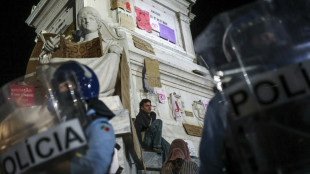
Slovenia holds crunch vote on contested assisted dying law / Photo: Jure Makovec - AFP

 Lula, Bolsonaro to clash once more before Brazil vote

 Dressed to kill: Haircuts cap menacing look of Japan's yakuza

 Napa Valley's wineries feel Trump's tariff squeeze

 Venezuela protests demand return of Nobel winning leader Machado

 Marquez tops incident-packed opening practice for Australian MotoGP

 New York votes to ban Central Park horse carriages after decades of debate

 Australia face selection headaches after 'shambolic' South Africa defeat

 Around 150,000 rally in Belgrade as Serbia heads to pivotal poll

 Hamilton sets sights on racing in African grand prix

 Bournemouth hammer 10-man Milan, Juventus denied at the death

 Judge orders Trump to give deposition in BBC lawsuit by Dec 11

 'Fake' pollsters hit US midterms

 Global markets retreat as tech mood sours, oil prices jump

 Juventus denied at the death, Sunderland make point in Poland in Europa League

 Tens of thousands rally as Serbia heads to pivotal poll

 Monet's 'Iris' fetches 50 mn euros at Paris auction

 L'Oreal sees double-digit sales growth

 Sri Lanka stun England with huge chase after Brook's 202

 Guatemala sentences former police officers in gay couple's killings

 Nelson's erotic dream letter features in London auction

 Canada opens free trade talks with Turkey

 Swiss, Austrian women freed after Niger kidnap ordeal
 Austrian-born French resistance fighter dies aged 105: regional official

 Paris shop-owners and residents prepare for fresh protests

 French, Japanese authors try to write novel on one-day train ride

Slovenians began voting Sunday in a new referendum that will determine if a law legalising assisted dying will be enforced or suspended, after critics mounted a campaign against the legislation.
Several European countries, including Austria, Belgium, the Netherlands and Switzerland allow terminally ill people to receive medical help to end their lives.
Slovenia's parliament approved a law in July allowing assisted dying after a 2024 referendum supported it.
But a new vote was called after a civil group, backed by the Catholic Church and the conservative parliamentary opposition, gathered 46,000 signatures in favour of a repeat, exceeding the 40,000 required.
The law will come into force unless a majority of participants, representing at least 20 percent of the 1.7 million eligible voters, rejects it.
Polls opened at 7:00 am (0600 GMT) and will close 12 hours later, with first partial results expected late Sunday.
- 'Culture of death' -
At the Stozice sports hall, the largest polling station in Ljubljana, 63-year-old pensioner Romana Hocevar said she would vote in favour of assisted dying.
"I'm a stage four cancer patient, I would not like to suffer. Had my father die of cancer and mother suffering dementia and I know what it looks like."
Vid Ursic, a 24-year-old student, said it was "good that we get to vote on relevant issues" and added that he supported "the right for people to decide on their own lives".
But Marija Unuk, in her late fifties, said she had voted against the law "because I support the culture of life, not the culture of death".
Under the disputed law, which was to take effect this year, lucid, terminally ill patients would have the right to aid in dying if their suffering is unbearable and all treatment options have been exhausted.
It also allows for assisted dying if treatment offers no reasonable prospect of recovery or improvement in the patient's condition, but not to end unbearable suffering from mental illness.
Prime Minister Robert Golob, who voted in advance, has urged citizens to back the law "so that each of us can decide for ourselves how and with what dignity we will end our lives".
The group opposing the law, called Voice for the Children and the Family, has accused the government of using the law to "poison" ill and elderly people.
- 'Human dignity' -
The Catholic Church has said allowing assisted dying "contradicts the foundations of the Gospel, natural law and human dignity".
Some 54 percent of citizens back the legalisation of assisted dying, almost 31 percent oppose it and 15 percent are undecided, according to a poll published this week by the Dnevnik daily, based on 700 responses.
In June 2024, 55 percent backed the law.
If a majority of voters oppose the new law on Sunday, parliament cannot vote again on a bill that deals with the same issue over the next 12 months.
While several European countries already allow terminally ill people to receive medical help to end their lives, in others it remains a crime, even in cases of severe suffering.
In May, France's lower house of parliament approved a right-to-die bill in a first reading. The British parliament is debating similar legislation.
A.Taylor--AT