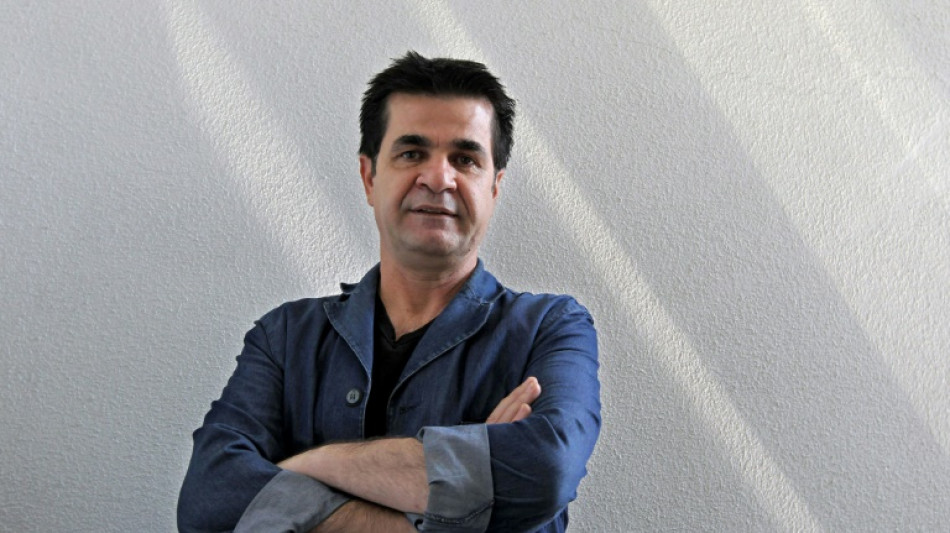
Jafar Panahi: jailed Iranian director who won hearts in Europe / Photo: Atta KENARE - AFP/File

 UN says world must navigate 'reality' of 1.5C overshoot
 Taliban govt defends ban on protest, citing Islamic law

 10 missing as Turkish cargo ship sinks after collision off Istanbul

 easyMarkets Expands Commodity Offering with 24/7 Gold, Silver and Oil Trading
 Australia defends Pacific climate meeting despite doubts on attendance
 Iran attacks US sites after American strikes, wedding deaths
 Stocks drop, yields at three-decade highs on Mideast flare-up

 EU summons Russian envoy, eyes sanctions after Germany drone 'attack'

 Stocks drop as yields and oil prices spike on Mideast flare-up
 Cricketers to get best rooms at Asian Games, says Japan chief

 Zverev out-lasts Sonego in wild five-setter to advance at US Open

 Amid war, Ukrainian soldiers celebrate love at ritual wedding
 Venice to roll out red carpet for Clooney on opening night
 Hong Kong democracy activist Wong pleads guilty to foreign collusion: AFP

 Stocks sink, yields at multi-decade highs and oil spikes on Mideast flare-up

 US defends Trump Venezuela oil deal as energy secretary lands in Caracas
 Jubilant Monfils celebrates birthday with US Open win
 The Japanese idealist behind the last deradicalisation NGO in Somalia

 Rybakina, Gauff advance as Zverev launches US Open campaign
 Macron in Britain to help unveil tapestry, hold Burnham talks
 China's Xi to hold talks with Sisi in rare visit to Egypt
 Confident Gauff reaches US Open 2nd round with straight-set win
 US postal whistleblower warns ballot system could disrupt midterms

 Protagonist Therapeutics to Participate in Two Investment Bank Conferences in September 2026

 Preppy Pledges to Help 250,000 People Enter Allied Health Careers by 2031
Acclaimed Iranian director Jafar Panahi, jailed as part of a crackdown on the country's filmmakers, for years defied a ban on his work to carry on making deeply human tales of Iran's social and cultural struggles that won a loyal following abroad.
The ingenuity he demonstrated in getting his films made and smuggled out of Iran to foreign distributors and film festivals became the stuff of legend.
A year after being handed a 20-year ban on filmmaking he dispatched a documentary with the cheeky title "This is Not a Film" to the Cannes festival on a flash drive stashed in a cake.
"Why should it be a crime to make a movie?" he told AFP in 2010. "When a filmmaker does not make films, it is as if he is jailed."
Panahi, 62, was banned from making movies and leaving the country in 2010 after supporting mass anti-governments protests a year earlier and making a series of films that critiqued the state of modern Iran.
Convicted of "propaganda against the system", he was sentenced to six years in jail but served only two months behind bars before being released on bail.
In the years that followed, Iranian authorities appeared content to turn a blind eye to his failure to toe the line, as long as his films did not appear overtly political.
That tolerance ended on July 11 with his arrest in connection with protests by a group of filmmakers and subsequent order to serve out the sentence that had been hanging over him since 2010 in Tehran's notorious Evin prison.
"Panahi had been sentenced in 2010 to a total of six years in prison... and therefore he was entered into Evin detention centre to serve his sentence there," judiciary spokesman Massoud Setayeshi said Tuesday.
He is the third Iranian director to be detained this month, alongside Mostafa Aleahmad and Mohammad Rasoulof, who won the Golden Bear in Berlin in 2020 with his film "There Is No Evil".
Their arrests triggered an outcry in Europe, where the organisers of the Berlin and Cannes festivals condemned the clampdown on free speech and demanded the directors' release.
Panahi was arrested after going to the prosecutor's office to inquire about Rasoulof's situation.
He and Rasoulof had in May denounced the arrests of several colleagues in their homeland in an open letter.
Rasoulof had also led a group of Iranian filmmakers in giving voice to public outrage over what they called the "corruption, theft, inefficiency and repression" underpinning the collapse of a 10-storey building in southwestern Khuzestan province on May 23 in which 43 people were killed.
- Camera on the dashboard -
A child of the Tehran slums, Panahi is a leading exponent of Iranian New Wave cinema, alongside Abbas Kiarostami, whom he served as an assistant early in his career.
In keeping with the movement, his films focus on the social realities of his homeland and give pride of place to non-professional actors.
His first feature film, "The White Balloon", won the Camera d'Or in 1995 at Cannes, which also rewarded him in 2003 with the Jury Prize for "Blood and Gold" and Best Screenplay in 2018 for his roadmovie "3 Faces" about three generations of Iranian actresses.
One of his most popular films, "Taxi", which won the top prize at the Berlin film festival in 2015, was secretly filmed with a camera mounted on the dashboard of a cab he drove around Tehran.
His conversations with the small cross-section of Iranians that come aboard -- his aspiring filmmaker niece, a couple of old women with a fishbowl, a lawyer barred from practising her trade, a badly-injured man who is making his will on the backseat -- provide rich insights into everyday life in the Islamic republic.
Despite being barred from travelling to collect awards or attend premieres of his films, Panahi has always maintained he has no desire to leave Iran.
"I am in love with my country, and despite all its limitations I would never want to live elsewhere," he has said.
burs-cb/eab/hc
R.Chavez--AT