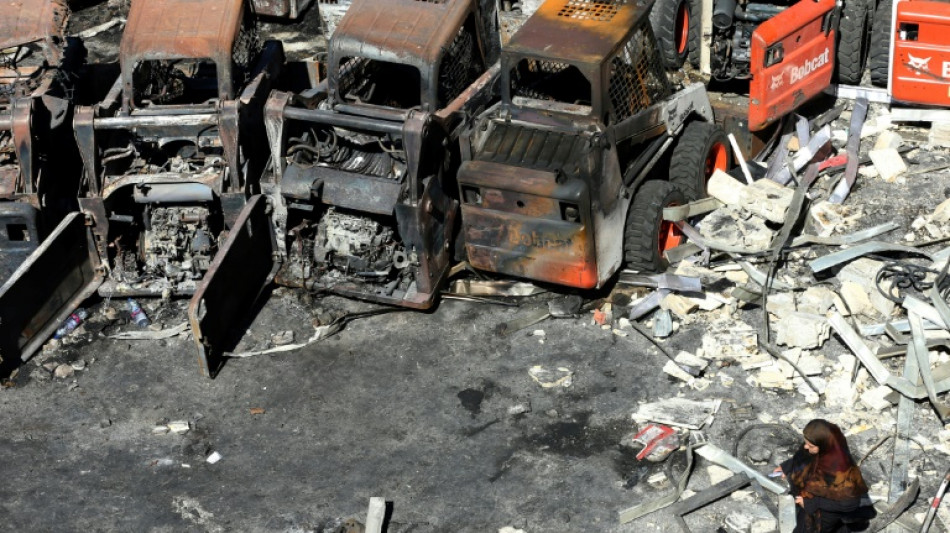
Lebanese say Israel preventing post-war reconstruction / Photo: MAHHMOUD ZAYYAT - AFP

 Netanyahu orders West Bank closure as attack wounds Israelis before election

 Asian stocks mixed ahead of weekend as tech recovers early losses
 How five Boeing 777s linked Madagascar's power elite to Iran

 South Korea proposes holding border talks with North
 Ukraine's young figure skaters twizzle on despite Russian threat

 Asian football endorses Infantino re-election as FIFA president
 Complete Kane hopes for 'special night' as Ballon d'Or rumours swirl

 Rooney calls United squad 'selfish babies' after Fernandes criticism

 Teddy Wilson, son of World Cup-winner David, gets Wallabies call-up

 New Zealand military chief resigns over 'inappropriate relationship'

 Man Utd's Carrick on borrowed time, free-scoring Brighton face Liverpool
 Asian stocks head into weekend on a low as tech extends losses

 'Generational rage': Young Europeans fight to be heard

 Lula, Bolsonaro to clash once more before Brazil vote
 Dressed to kill: Haircuts cap menacing look of Japan's yakuza

 Napa Valley's wineries feel Trump's tariff squeeze
 Venezuela protests demand return of Nobel winning leader Machado
 Marquez tops incident-packed opening practice for Australian MotoGP

 New York votes to ban Central Park horse carriages after decades of debate

 What Does a Race-Ready Bike Actually Cost?

 Eylsia Nicolas Hits #1 in the United States as Her Multi‑Category Chart Sweep Extends Across Global All‑Genres and International Markets
 Australia face selection headaches after 'shambolic' South Africa defeat

 Around 150,000 rally in Belgrade as Serbia heads to pivotal poll

 Hamilton sets sights on racing in African grand prix
 Bournemouth hammer 10-man Milan, Juventus denied at the death

When engineer Tarek Mazraani started campaigning for the reconstruction of war-battered southern Lebanon, Israeli drones hovered ominously overhead -- their loudspeakers sometimes calling him out by name.
Despite a ceasefire struck last November aiming to put an end to more than a year of fighting with Hezbollah, Israel has kept up near-daily strikes on Lebanon.
In addition to hitting alleged militants, it has recently also targeted bulldozers, excavators and prefabricated houses, often saying they were part of efforts to restore Hezbollah infrastructure.
The bombing has prevented tens of thousands of people from returning to their homes, and has made rebuilding heavily-damaged border villages -- like Mazraani's Hula -- almost impossible.
"For us, the war has not ended," Mazraani, 61, told AFP.
"We can't return to our villages, rebuild or even check on our homes."
In cash-strapped Lebanon, authorities have yet to begin reconstruction efforts, and have been hoping for international support, particularly from Gulf countries.
They have also blamed Israeli strikes for preventing efforts to rebuild, which the World Bank estimates could cost $11 billion.
Eager to go back home, Mazraani established the "Association of the Residents of Border Villages" to call for the return of displaced people and the start of reconstruction.
He even started making plans to rebuild homes he had previously designed.
But in October, Israeli drones flew over southern villages, broadcasting a message through loudspeakers.
They called out Mazraani by name and urged residents to expel him, implicitly accusing him of having ties with Hezbollah, which he denies.
Asked by AFP, the Israeli army would not say on what basis they accuse Mazraani of working with Hezbollah.
"They are bombing prefabricated houses, and not allowing anyone to get close to the border," said Mazraani, who has moved to Beirut for fear of Israel's threats.
"They are saying: no reconstruction before handing over the weapons," he added, referring to Israel's demand that Hezbollah disarm.
- 'Nothing military here' -
Amnesty International has estimated that "more than 10,000 structures were heavily damaged or destroyed" between October of last year -- when Israel launched a ground offensive into southern Lebanon -- and late January.
It noted that much of the destruction followed the November 2024 truce that took effect after two months of open war.
Just last month, Israeli strikes destroyed more than 300 bulldozers and excavators in yards in the Msaileh area, one of which belonged to Ahmed Tabaja, 65.
Surrounded by burned-out machinery, his hands stained black, Tabaja said he hoped to repair just five of his 120 vehicles destroyed in the strikes -- a devastating loss amounting to five million dollars.
"Everyone knows there is nothing military here," he insisted.
The yards, located near the highway, are open and visible. "There is nothing to hide," he said.
In a nearby town, Hussein Kiniar, 32, said he couldn't believe his eyes as he surveyed the heavy machinery garage his father built 30 years ago.
He said Israel struck the family's yard twice: first during the war, and again in September after it was repaired.
The first strike cost five million dollars, and the second added another seven million in losses, he estimated.
"I watched everything burn right before my eyes," Kiniar said.
The Israeli army said that day it had targeted "a Hezbollah site in the Ansariyah area of southern Lebanon, which stored engineering vehicles intended to rebuild the terrorist organisation's capabilities and support its terrorist activity."
Kiniar denied that he or the site were linked to Hezbollah.
"We are a civilian business," he said.
- Disarmament disagreements -
In October, Israel killed two engineers working for a company sanctioned by the United States over alleged Hezbollah ties.
Under US pressure and fearing an escalation in strikes, the Lebanese government has moved to begin disarming Hezbollah, a plan the movement and its allies oppose.
But Israel accuses Beirut of acting too slowly and, despite the stipulation in the ceasefire that it withdraw, it maintains troops in five areas in southern Lebanon.
Hezbollah, meanwhile, insists Israel pull back, stop its attacks and allow reconstruction to begin before it can discuss the fate of its weapons.
In the aftermath of the 2006 war with Israel, Hezbollah spearheaded rebuilding in the south, with much of the effort financed by Iran.
But this time, the group's financial dealings have been under heightened scrutiny.
It has insisted the state should fund post-war reconstruction, and it has only paid compensation for its own associates' rent and repairs.
For three long seasons, olive grower Mohammed Rizk, 69, hasn't been able to cultivate his land.
He now lives with his son just outside the city of Nabatiyeh, having been forced out of his border village where his once-vibrant grove lies neglected.
"The war hasn't ended," he said. "It will only be over when we return home."
T.Wright--AT