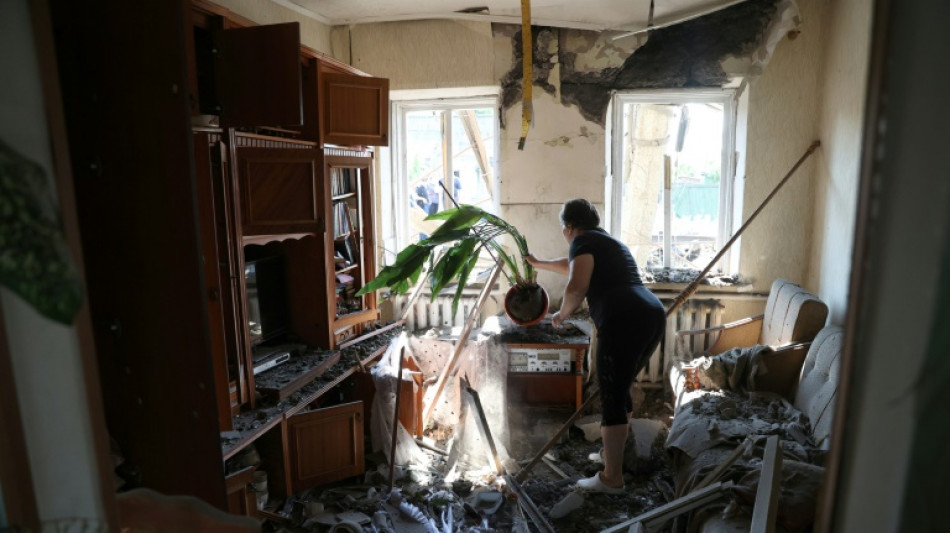
In Ukraine's east, 'we're alive, it's a good day' / Photo: Anatolii Stepanov - AFP

 Saudi airport closure disrupts life in kingdom's capital

 Ramaphosa tells South Africa to prepare for loss of US-Africa trade deal
 France presses resale platforms to remove 'stolen' goods after unrest
 Yamal v PSG: Ballon d'Or backdrop to Champions League showdown

 Araujo says too soon to talk about permanent Liverpool move

 US wants to be 'strong partner' for central Asia: Rubio

 'Special' to face friend Perez in Champions League, says Liverpool's Iraola

 Monitor says Indonesia fires have burned nearly two million hectares

 French PM says could declare state of emergency over unrest 'if needed'
 Albanian PM warns of 'red line' after days of unrest

 Putin, Xi and Trump could meet at APEC summit: Kremlin

 Microsoft exits data centre deal in blow to UK AI ambitions

 European stocks retreat as France violence spreads

 North Korea warns 'grave situation' prevailing along border
 Raya proud of Arsenal's 'incredible' reaction after third straight win

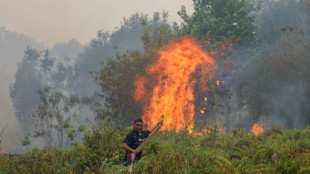
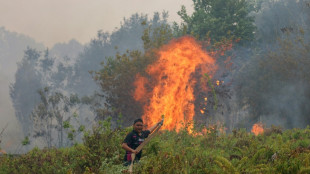 Indonesia fires have burned nearly two million hectares: monitor

 Australian lawmaker 'critically' hurt in attack, officials say

 Indonesia fires burned over 1.9 mn hectares through September: monitor
 Asian tech stocks mixed after Wall St losses, eyes on earnings

 China's third-quarter growth narrowly beats forecasts

 Asian stocks start week on back foot, tracking tech-led Wall St losses
 China growth narrowly beats forecasts

 Faith and fury: Texas Senate rivals offer contrasting visions
 Women await justice for police killings in Brazil

 The painstaking task of cataloguing the world's species

Leaning on her cane, Olga Dekanenko walks through the rubble and debris of her home in eastern Ukraine that was heavily damaged in a Russian strike in the early hours of Saturday.
Workers are pumping water out of a deep 10-metre-wide (30 feet) crater with a burst pipe outside Dekanenko's house in Konstantinovka, an industrial town on the frontline of Ukraine's war with Russia.
Her neighbours wearily look at the sight that has become all too familiar in the time of war. One woman covers her mouth in shock as she passes by but carries on without saying a word.
"We're alive, it's a good day," 67-year-old Dekanenko tells AFP with a tired smile.
"This is the house where my two children were born," she adds, picking up family photos out of the rubble.
In the upturned garden, her dog lies curled up and breathing heavily, still reeling from the shock of the morning's events.
Dekanenko was asleep when it happened.
Her small bedroom overlooks the garden where the rocket landed. She woke up on the ground, covered in a mess of blankets, pillows and stones.
- Nostalgia -
Dekanenko calmly recalls her time working for one of Konstantinovka's several metallurgical plants that made the town an industrial hub in the Soviet era.
She worked for a nickel factory that provided good pay and early retirement at the age of 50 because of the hazardous working conditions.
"I can't say that I regret this period, but, of course, us old people have a nostalgia for the Soviet era," Dekanenko says with a smile.
But she admits that "it's not the same for young people".
Her younger sister Nina Chuprino recalls that until the 1960s the region of Donetsk, where their town is located, was called "Stalin region" after the Soviet leader.
After the fall of the USSR in 1991, factories in the town of some 70,000 people started shutting down one by one and many residents decided to leave.
In this industrial region with many fluent Russian speakers, many feel they have been abandoned by Kyiv, cultivating pro-Moscow sentiment.
Donetsk and neighbouring Lugansk lie in the Donbas coal mining region in eastern Ukraine that has become the primary target of Russia's February invasion.
Parts of the region have been controlled by Russia-backed separatists since 2014. Konstantinovka was captured by the rebel forces the same year but was retaken by Kyiv's troops a few month later.
- 'Doesn't matter who comes' -
The neighbourhood called the "Red" district -- another nod to the town's Soviet past -- has been hit three times over the past four days, as Russia intensifies its offensive in the east.
"There may be Ukrainian soldiers in the school," nestled among the residential buildings, says a 60-year-old man, who preferred not to give his name.
Several residents had given the same explanation to explain the frequent strikes, but without animosity.
If Ukrainian troops go to hide there, one resident says pointing to a large disused building, "next time there will be carnage".
Moscow regularly accuses Ukrainian forces of hiding in schools, hospitals or among civilians.
Back in front of Dekanenko's destroyed home, 15-year-old redhead Margarita cannot hold back her tears.
"I'm afraid there won't be anything left of our town soon. I think the Russians will come eventually... hopefully the army can defend us," she says with a trembling voice.
Russian forces, which now have control of nearly all of the Lugansk region, have been pushing for several weeks to seize Donetsk as well.
"We are just workers, peasants. It doesn't matter who comes. If we are given work, a normal life, then it's fine," sighs a man, before turning on his heels and walking away.
T.Sanchez--AT