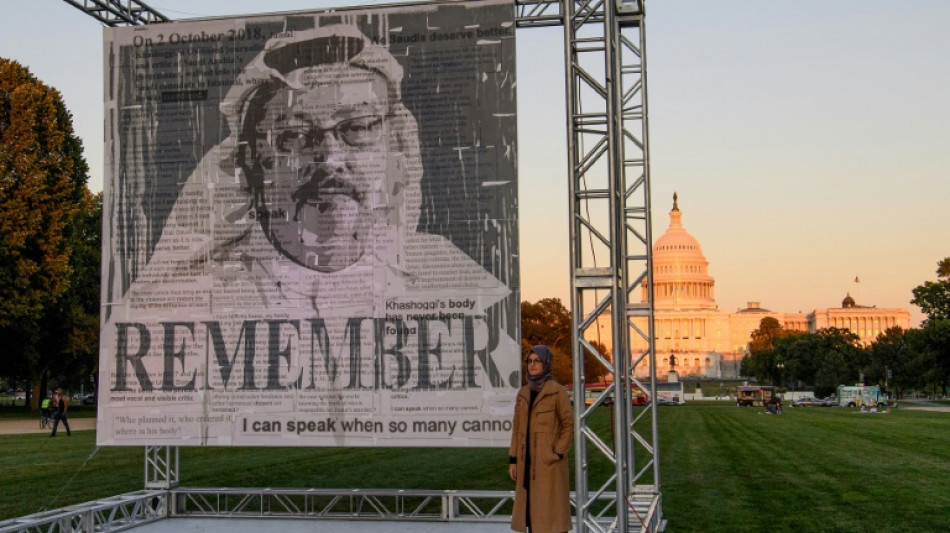
How authoritarian regimes hunt their opponents abroad / Photo: Nicholas Kamm - AFP/File

 Saudi airport closure disrupts life in kingdom's capital

 Ramaphosa tells South Africa to prepare for loss of US-Africa trade deal

 France presses resale platforms to remove 'stolen' goods after unrest
 Yamal v PSG: Ballon d'Or backdrop to Champions League showdown
 Araujo says too soon to talk about permanent Liverpool move

 US wants to be 'strong partner' for central Asia: Rubio

 'Special' to face friend Perez in Champions League, says Liverpool's Iraola

 Monitor says Indonesia fires have burned nearly two million hectares

 French PM says could declare state of emergency over unrest 'if needed'

 Albanian PM warns of 'red line' after days of unrest
 Putin, Xi and Trump could meet at APEC summit: Kremlin

 Microsoft exits data centre deal in blow to UK AI ambitions

 European stocks retreat as France violence spreads

 North Korea warns 'grave situation' prevailing along border

 Raya proud of Arsenal's 'incredible' reaction after third straight win

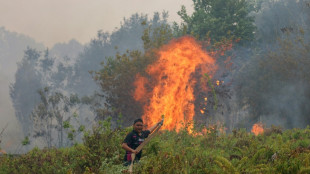 Indonesia fires have burned nearly two million hectares: monitor
 Australian lawmaker 'critically' hurt in attack, officials say

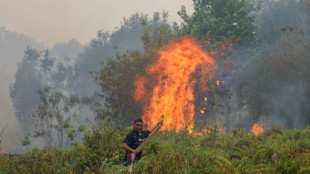 Indonesia fires burned over 1.9 mn hectares through September: monitor

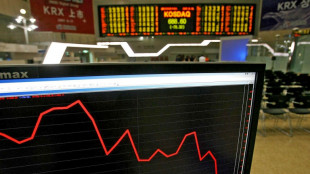 Asian tech stocks mixed after Wall St losses, eyes on earnings

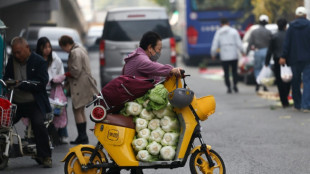 China's third-quarter growth narrowly beats forecasts
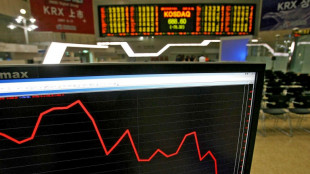 Asian stocks start week on back foot, tracking tech-led Wall St losses

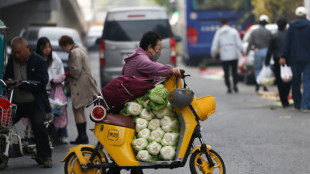 China growth narrowly beats forecasts

 Faith and fury: Texas Senate rivals offer contrasting visions
 Women await justice for police killings in Brazil
 The painstaking task of cataloguing the world's species

The world's authoritarian regimes are persecuting their opponents living abroad more vigorously than ever before and some get away with murder, literally.
A blatant example of the impunity some governments enjoy is Saudi Arabia's de-facto ruler, Crown Prince Mohammed bin Salman, whose country US President Joe Biden labelled a "pariah" over the 2018 murder and dismemberment of Saudi journalist Jamal Khashoggi.
Yet in June, Saudi made up with Turkey -- where the murder happened -- and Biden decided to include the kingdom on a tour of the Middle East.
Experts say transnational repression of opposition figures is nothing new, but since digital technologies have allowed dissidents to needle authoritarian regimes from across borders more easily, they have stoked the wrath of strongmen like rarely before.
"The threat perception of dictators or these repressive regimes has increased," said Marcus Michaelson, a researcher on authoritarianism at the Vrije Universiteit in Brussels.
According to US watchdog Freedom House, there were at least 735 direct, physical incidents of transnational repression between 2014 and 2021, carried out by 36 governments, notably those of China, Turkey, Russia, Saudi Arabia, Iran and Rwanda.
Four regimes joined the list in 2021, including Belarus, which diverted an aircraft to arrest an opposition figure.
- 'Harassment to murder' -
Spectacular acts like the poisoning of former Russian intelligence agent Sergei Skripal in Britain in 2018, or the killing in 2019 in Berlin of Georgian Chechen Zelimkhan Khangoshvili -- attributed to Russia -- get the world's attention, but much of the repression happens under the radar.
"The range of tactics goes from harassment to murder," said Katia Roux at Amnesty International France.
Turkish journalist Can Dundar, who runs a website and a radio station aimed at Turkey and the Turkish diaspora from exile in Germany, has become a target for the secret apparatus of President Recep Tayyip Erdogan.
"In the first year we found a Turkish camera crew (...) recording our office and giving all the details of our office, including our address and our daily work schedule, at what time we are there, at what time we are getting out etc, and showing it as the 'headquarters of the traitors' making plans against Turkey," he told AFP.
Turkish intelligence "is very active, especially in Germany and France," he said, recalling the attack by three men on a Turkish journalist in Berlin in July 2021 who warned him to stop writing about certain topics.
Pakistani journalist Taha Siddiqui, who fled to France after a kidnapping attempt he blamed on his home country's security services, said he still didn't actually feel safe in exile, only "safer".
In 2020 a Pakistani intelligence officer told Siddiqui's parents that "if Taha thinks he's safe in Paris, he is mistaken. We can reach anyone anywhere".
The threat came the same year as the suspicious deaths of a Pakistani journalist in Sweden, and of a Pakistani human rights activist in Canada, and a year before a British court convicted a man for the contract killing of a Pakistani blogger in Dutch exile.
"They have made me paranoid, suspicious, scared, even in exile," said Siddiqui, who has opened "The Dissident Club" in Paris, a bar dedicated to discussion, exhibitions and screenings.
Digital technologies give repressive regimes a whole new toolkit to sidestep the political cost or diplomatic risk that can come with physical action against dissidents, with "almost no consequences", said Michaelson.
They have a "commercial market for surveillance technologies" at their disposal, such as the Israeli-made spy software Pegasus, which are cost-effective, he said.
"So they don't need to invest a lot of manpower or send agents to spy on dissidents abroad," he said.
A telling example is Egyptian opposition figure Ayman Nour, a friend of Khashoggi, and exiled in Turkey.
Citizen Lab, a body for research into technology, human rights and security, said it found two sets of spyware on Nour's mobile phone -- Pegasus and Predator -- operated by two different governments.
- 'You have to stop' -
Calling spying "a form or organised crime", Nour said he always thought of his phone as "a radio that anybody can listen to".
Amnesty International has identified 11 government clients for Pegasus which allows "the surveillance of anybody in a completely invisible and untraceable way", said Roux.
Activists in China defending the rights of the Uyghur minority, against which western countries say China is committing "genocide", often find that digital threats precede physical violence, said Michaelson.
Meiirbek Sailanbek, a member of China's Kazakh community, said he uninstalled all Chinese apps from his phone when he moved to neighbouring Kazakhstan, and deleted the numbers of his brother and sister who still live in Xinjiang, the Uyghur autonomous region in northwest China.
When the Kazakhstan authorities arrested the head of the Atajurt NGO -- which Sailanbek had joined writing social posts under a pseudonym -- he fled the country, settling in Paris.
But Kazakhstan's authorities identified him, and since then the Chinese government is threatening his brother and sister with prison if he continues his activism.
"Meiirbek, your sister and brother are in danger, you have to stop," said a message forwarded to him by his mother.
Sailanbek faces arrest if he returns to China or Kazakhstan, but he considers Turkey, Pakistan, Arab nations and Russia to be off-limits too because he believes they would give in to Chinese pressure to hand him over.
F.Wilson--AT