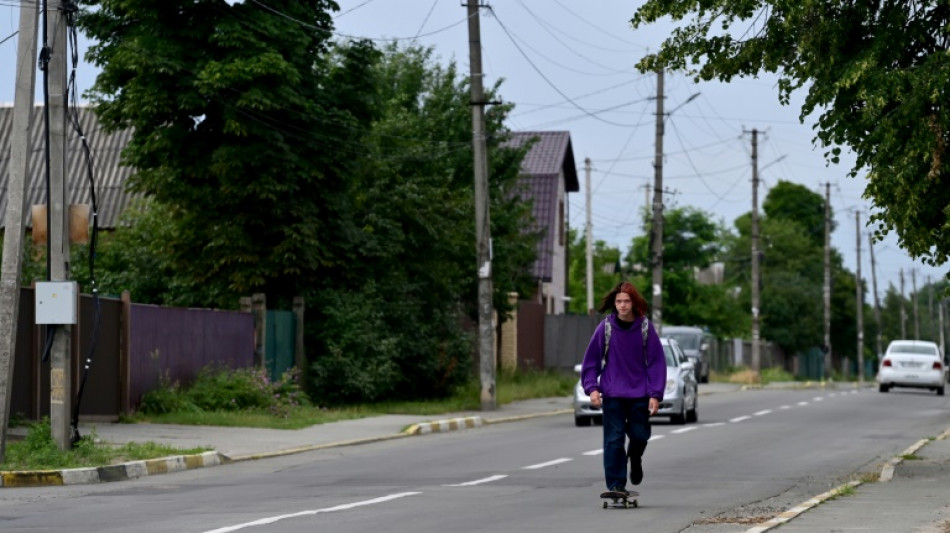
In Ukraine's Bucha, a reluctant return home and to normality / Photo: Miguel MEDINA - AFP/File

 Guehi insists players have 'trust and belief' in Man City after charges
 UN climate panel head wants swift end to deadlock over key scientific report
 PM calls for curfews in France as govt grapples with unrest
 Man City's Semenyo out for up to eight weeks

 Australian lawmaker critically hurt in 'violent' vehicle attack

 England women's coach Wiegman signs two-year contract extension
 Louvre blocked as France grapples with unrest
 Bollywood actor Tiger Shroff shot at in Mumbai, three suspects held: police
 UN biodiversity summit opens with nature goals off track
 'Physical hell': Hong Kong hosts gruelling underwater hockey tournament
 Police 'lost control' during French protests, says interior minister

 Australia's new Ghost Shark submarines grow some 'teeth'
 'I call it a bribe': Pennsylvania residents spurn $10,000 data center checks

 In a former US steel city, ordinary people struggle to get by
 'Liar,' 'clown': Lula and Bolsonaro spar in Brazil poll debate
 Record El Nino? Depends who's counting
 On the front line of ocean conservation off Portugal's Madeira
 Wembanyama targets title breakthrough as NBA season tips off
 With LeBron on board it's title or bust for Philly fans

 One year after Louvre heist, where are the missing jewels?

 Knicks face tall task in NBA championship repeat bid

 Warriors' Curry 'fine' after limping out of practice - Kerr

 INEO Announces Preliminary Q1 Fiscal 2027 Revenue of More Than $1.3 Million and Adjusted EBITDA Near Break-Even

 HyProMag USA Deploys Mobile Inserma System, Extending Hard Disk Drive Processing to Customer Sites Across the United States

 Mako Mining Announces Q3 2026 Production Results with Gold Recovered of 12,743 oz Au (Sales of 11,581 oz Au), and Positive Permitting Updates at Mt. Hamilton and San Albino

In a large and upscale backyard in Bucha outside Ukraine's capital Kyiv, Maxim is having a quiet dinner with his wife and his neighbours.
But just three months ago, Russian soldiers were rummaging through his home and sleeping in his children's bedroom.
"In this atmosphere, I feel like nothing can happen and that life is normal," says the 36-year-old web designer, sitting around a table with his family.
"But we know there's a war and there's no place safe in Ukraine right now."
Together with his wife Anna and their two children they live in a newly built two-storey house, at the edge of Bucha, where young families from Kyiv come to exchange big-city life for a laid back suburban one.
"The Russian army slept in our house for a couple of nights, ate everything that we had in our fridge and they left this," he says showing a box of field military ration.
In February, Russian forces entered this suburb in the northwest of Kyiv during their attempt to encircle the Ukrainian capital.
They were pushed out a month later. With the liberation came shocking discoveries of atrocities committed against civilians, making Bucha a symbol of Russian brutality.
On April 2, AFP journalists found 20 bodies in civilian clothes lying along nearby Yablunska street.
On the same street three months later, children are walking around wearing headphones and men are returning home from work while others repair damage left by the fighting.
In front of an apartment block hit by artillery, stands a blonde woman with her eyes glued to the scars left on the building. She looks away to sigh.
- 'I won't live in little Russia' -
A few kilometres away from Yablunska street, Maxim's house suffered only minor damage. His wife Anna was in Turkey when the invasion started and after moved to Romania across the border with Ukraine.
Her next-door neighbour, 36-year-old pastry chef Nastya Glyieva, was also living as a refugee in Romania by that time.
To take her mind off the news, she worked as a volunteer in Filaret, a bus station in Bucharest which became a transit hub for Ukrainian refugees.
"The teacher of my 11-year-old daughter and her family were all killed. And I don't know how to tell her this," says Nastya.
"Almost everyday we hear loud bangs from unexploded devices being detonated by our army. When I first came back it made me shake but now it's normal for us," she says.
Her house in Bucha, bought a year ago and which was left unscathed during the fighting, is now also sheltering Dmitry Gliev, her husband's brother.
The 20-year-old cook lived for almost a month under Russian occupation in his small village close to Chernobyl, which has since come under the control of the Ukrainian army.
"On February 30, we had a complete occupation, there were more than 1,000 Russians in our village. We were told that it would not be long, but they stayed there for a month," says Dmitry.
"At the beginning I was very afraid, I put my mattress in the bathroom and I stayed there for three days... We made flour ourselves from wheat and then baked bread from it," he says.
Now he's in charge of the barbecue for the dinner hosted by Maxim and his family.
"If they had taken Kyiv, there would be no Ukraine, no freedom, no Ukrainian culture, just 'little Russia'. But I would never live in such a country," says Maxim.
A.Taylor--AT