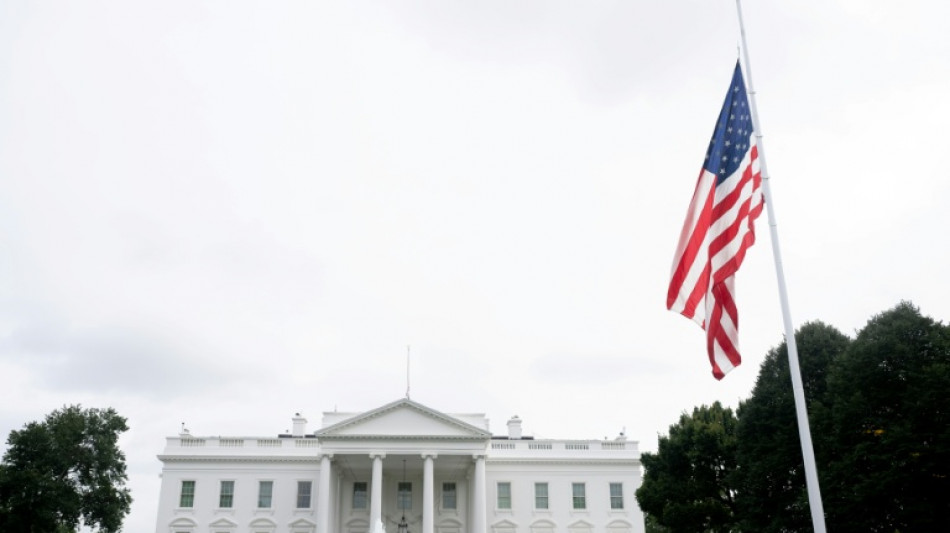
Kirk killing sparks fierce US free speech debate / Photo: SAUL LOEB - AFP

 Nearly 1,000 arrested in French protests marred by 'elevated' violence: minister
 France extends detention of suspected racist shooter
 Andrade and Nemour star as Biles cheers at world gymnastics champs
 Nigeria's Tinubu defends record as economy bites ahead of election
 'Guiding star' Fuellkrug bags Bremen brace, Leipzig win
 Man City's perfect start ended by Aston Villa, Arsenal go joint-top

 Arsenal sink Everton to join Man City at Premier League summit
 France protests: Latest developments
 French ice dancers Cizeron and Fournier make golden start to season
 Thousands protest crackdown on media in Turkey
 Brazil's Andrade returns to take vault gold at worlds
 Lula, Bolsonaro hold final rallies ahead of Brazil election
 Ukraine has 'stable connection' to Starlink: govt

 French protests kick off amid heavy security blanket
 250,000 rally in Madrid demanding state pension guarantees
 UK police says 'claims' over Meghan Markle's dad not sent to other law enforcement
 Top-ranked Rybakina to face Fernandez for Ningbo title
 Late India charge seals thrilling second T20 win over New Zealand
 Seen and heard at France protests

 White says Fiji can have 'massive' World Cup after beating Japan
 England thrash France 82-0 to keep Rugby League World Cup hopes alive
 Security high as France braces for new protests
 White makes winning start as Fiji edge Eddie Jones's Japan
 Lula, Bolsonaro strike calmer tone in final Brazil election debate

 'How is it possible?': Students protest Indonesian haze
For Americans, the words are practically sacred: the First Amendment to the US Constitution guarantees freedom of speech.
But that right is now the subject of bitter debate, following the assassination of right-wing activist Charlie Kirk.
On Thursday, several high-ranking Democrats accused President Donald Trump of waging war on free speech, after he celebrated ABC's suspension of talk show host Jimmy Kimmel, who accused the political right of using Kirk's death to score points.
The American Civil Liberties Union, a rights advocacy group, accused the Trump administration of operating outside constitutional safeguards to target its opponents, likening it to the Red Scare of the late 1940 and 1950s under senator Joseph McCarthy.
"This is beyond McCarthyism. Trump officials are repeatedly abusing their power to stop ideas they don't like, deciding who can speak, write, and even joke," said Christopher Anders, director of the ACLU's democracy and technology division.
So what does the First Amendment say? And why is it up for debate?
- 'How we identify ourselves' -
Ratified in 1791, the Bill of Rights comprises the first 10 amendments to the US Constitution, protecting the fundamental rights of Americans.
"Congress shall make no law respecting an establishment of religion, or prohibiting the free exercise thereof; or abridging the freedom of speech, or of the press; or the right of the people peaceably to assemble," the First Amendment says.
For David Super, a professor at Georgetown University's law school, the amendment is "really how we identify ourselves as a nation."
Beyond the varied ethnicities and background of the nation's 340 million people, "we are thought to be drawn together by a belief in open discussion and a belief that the government can't shut any of us up," Super told AFP.
The First Amendment even protects speech that is "morally repulsive," explained Eugene Volokh, a professor of law at the University of California, Los Angeles.
Volokh however emphasized that the history of the United States has been marked by attempts to stifle dissident voices.
- 'Malicious writings' -
In 1798, America's second president John Adams signed into law the Sedition Act, which forbade "any false, scandalous and malicious writing or writings against the government of the United States."
Then during World War I, the expression of pacifist ideology was banned.
From the 1920s to the 1950s, anyone expressing support for communist ideals risked serious repercussions. And in the 1960s, officials in several southern US states battled to silence the civil rights movement.
One of the key pillars of Trump's political movement has been to eviscerate "cancel culture" -- the process of criticizing someone for voicing an opinion seen as unacceptable, to the point of that person being ostracized or fired.
Trump has often called "cancel culture" a scourge of leftist progressives, claiming that it has been used to silence conservative pundits and politicians.
But Democrats have turned the tables on Trump, accusing him of doing the same to US media organizations, major universities and, now, Kimmel -- a frequent target of Trump's ire.
"After years of complaining about cancel culture, the current administration has taken it to a new and dangerous level," Democratic former president Barack Obama wrote Thursday on X.
- Conservative push-back -
US Attorney General Pam Bondi sparked controversy among conservatives by saying earlier this week that the Justice Department would pursue anyone guilty of "hate speech" linked to the slain influencer.
Republican Senator Ted Cruz quickly countered that the Constitution "absolutely protects hate speech." Bondi then said she meant to refer to "threats of violence that individuals incite against others."
Conservative commentator Tucker Carlson called for "civil disobedience" should Kirk's murder result in an uptick in laws limiting free speech.
And some voices on the far right have criticized a decree signed by Trump in August that makes burning the American flag punishable by up to a year in prison.
The US Supreme Court ruled in 1989 that burning the Stars and Stripes indeed amounted to free speech, and was protected by the First Amendment.
"I would never in a million years harm the American flag," conservative radio host Jesse Kelly wrote on X.
"But a president telling me I can't has me as close as I’ll ever be to lighting one on fire. I am a free American citizen. And if I ever feel like torching one, I will."
W.Stewart--AT