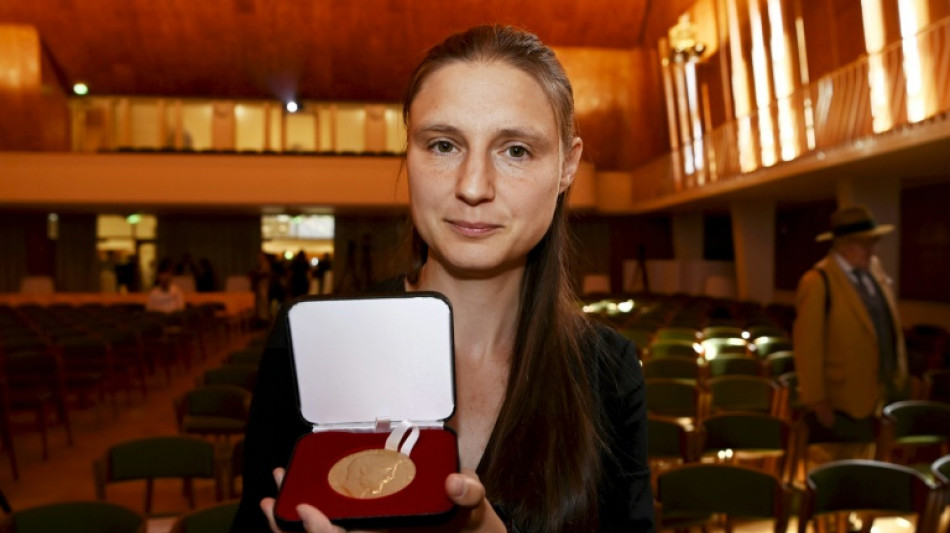
Maryna Viazovska, Ukrainian Fields winner 'changed forever' by war / Photo: Vesa Moilanen - Lehtikuva/AFP

 Australian lawmaker 'critically' hurt in attack, officials say

 Indonesia fires burned over 1.9 mn hectares through September: monitor
 Asian tech stocks mixed after Wall St losses, eyes on earnings

 China's third-quarter growth narrowly beats forecasts

 Asian stocks start week on back foot, tracking tech-led Wall St losses

 China growth narrowly beats forecasts

 Faith and fury: Texas Senate rivals offer contrasting visions

 Women await justice for police killings in Brazil

 The painstaking task of cataloguing the world's species

 Nations seek reset at UN talks as nature goals off track

 Rubio seeks to strengthen US foothold in Central Asia

 LeBron joins 76ers to chase one more NBA title at age 41

 Rays one win from World Series return after downing Guardians

 BioNxt Completes GMP Manufacturing and Submits Clinical Trial Application for Sublingual Cladribine Drug Candidate

 Caledonia Mining Corporation Plc: Notification of Relevant Change To Significant Shareholder

 Kings' Ben Simmons tears Achilles in training
 Lula, Bolsonaro set for first debate showdown in bitter election race

 Mbappe hits two as Real Madrid rout Sevilla
 Browns edge Ravens for division lead, Texans beat Jags

 Lyon go top of Ligue 1 as Monaco fall to first defeat of the season

 Venezuela opposition alliance reaffirms Nobel laureate Machado as leader

 'Street Fighter' wins N. America box office, buzzy doc stuns in 2nd

 NFL: Paris game to go ahead despite protests in France

 Arteta hails Arsenal 'finishers' after Madueke fells Forest

 Trump backs ally Netanyahu ahead of Israel's tight election

Ukrainian maths professor Maryna Viazovska, who on Tuesday won the top mathematics prize, the Fields Medal, said her life "changed forever" when Russia invaded her home country.
The 37-year-old's parents and sisters were living in Ukraine's capital, Kyiv, when the war began in February.
"I could not think of anything else, including mathematics," she in a video as she received the prize at a ceremony in Helsinki.
Her sisters -- along with her young nephew and niece -- were evacuated from Kyiv and are now staying with her in Switzerland, where she works at the Ecole Polytechnique Federale de Lausanne.
Viazovska and three other mathematicians received the Fields Medal, dubbed the Nobel prize in maths, in Helsinki after the ceremony was moved from Saint Petersburg to the Finnish capital in response to Moscow's war.
She is only the second woman to receive the award, which is awarded to mathematicians under 40, since it was created in 1936.
The other female laureate, Iran's Maryam Mirzakhani, died of breast cancer in 2017 just three years after winning the prize.
- 'Terrible war' -
Viazovska was born in 1984 in Kyiv, when Ukraine was part of the Soviet Union.
In Ukraine, she studied at the Taras Shevchenko National University of Kyiv, before earning a masters degree at Germany's University of Kaiserslautern and a PhD at the University of Bonn.
Since 2018, she has been chair of number theory at the Ecole Polytechnique Federale de Lausanne. Her husband Daniil Evtushinsky is a physicist at the Swiss institute.
In the first days of the war, teaching maths to students "helped me to forget about this fear and pain inside myself", she said.
At the ceremony she paid tribute to Yulia Zdanovska, a 21-year-old mathematician who was killed by a Russian missile attack on the Ukrainian city of Kharkiv in March.
"Yulia was a person filled with light and her big dream was teaching mathematics to kids in Ukraine," Viazovska said.
"When young people die you think, 'What is the point of my work as a teacher if young, talented people are just wasted in this terrible war?'"
- 13 years to find 'magic formula' -
She won the Fields Medal for her work on sphere packing, which has plagued mathematicians for hundreds of years.
It fundamentally involves how to put spheres in a container in the most compact way.
According to legend, it was first a question of how many cannonballs could be packed into a ship, Viazovska said.
After hundreds of years, mathematicians had solved the problem in three dimensions, which involved stacking them in a pyramid, like oranges at a supermarket.
But expanding the theory out into other dimensions -- possible in mathematics -- had proved elusive.
Viazovska however worked on the problem from 2003 to 2016 and found a "magic formula" that solved the problem in dimensions eight and 24, she said.
"Maryna pulled off something really miraculous here," mathematician Henry Cohn of MIT told the ceremony. "As soon as this paper became available, everyone was astonished by it."
Philippe Moustrou of France's Toulouse University told AFP that it was "not as if she found something that was just waiting to be discovered -- she found the extra ingredient".
But Viazovska's thoughts remain with the war -- and the hopeful return of a peace she once took for granted.
"The thing I like about Kyiv the most are the green parks, the quiet places and the ancient churches. I understand that now there will be marks of war there and this is a scary thought," she said.
"But Kyiv is one of the eternal cities. One day soon, I hope to return."
A.O.Scott--AT