Ukrainians seek to heal war trauma at mental health clinic / Photo: Sergei CHUZAVKOV - AFP

 Australian lawmaker 'critically' hurt in attack, officials say
 Indonesia fires burned over 1.9 mn hectares through September: monitor
 Asian tech stocks mixed after Wall St losses, eyes on earnings
 China's third-quarter growth narrowly beats forecasts
 Asian stocks start week on back foot, tracking tech-led Wall St losses
 China growth narrowly beats forecasts

 Faith and fury: Texas Senate rivals offer contrasting visions
 Women await justice for police killings in Brazil
 The painstaking task of cataloguing the world's species

 Nations seek reset at UN talks as nature goals off track

 Rubio seeks to strengthen US foothold in Central Asia
 LeBron joins 76ers to chase one more NBA title at age 41

 Rays one win from World Series return after downing Guardians

 BioNxt Completes GMP Manufacturing and Submits Clinical Trial Application for Sublingual Cladribine Drug Candidate

 Caledonia Mining Corporation Plc: Notification of Relevant Change To Significant Shareholder

 Kings' Ben Simmons tears Achilles in training
 Lula, Bolsonaro set for first debate showdown in bitter election race

 Mbappe hits two as Real Madrid rout Sevilla

 Browns edge Ravens for division lead, Texans beat Jags

 Lyon go top of Ligue 1 as Monaco fall to first defeat of the season
 Venezuela opposition alliance reaffirms Nobel laureate Machado as leader
 'Street Fighter' wins N. America box office, buzzy doc stuns in 2nd

 NFL: Paris game to go ahead despite protests in France

 Arteta hails Arsenal 'finishers' after Madueke fells Forest

 Trump backs ally Netanyahu ahead of Israel's tight election

After the Russian invasion of Ukraine, Yuriy Makeyev found himself homeless and jobless: a combination of circumstances that brought him to the brink of a nervous breakdown.
Now the 48-year-old, who has fled his home in the war-torn east, believes he can return to normal life thanks to a special course of psychological rehabilitation he is undergoing at a Kyiv clinic.
At least 5,000 civilians have been killed and as many wounded since Russian President Vladimir Putin ordered his troops into Ukraine on February 24, according to the latest United Nations figures.
But many more have survived devastating shelling across the country, causing mental scars and psychological trauma.
Psychologists say that weeks spent in bomb shelters as well as losing employment and being forced from home can lead to stress and frustration that may become impossible to cope with on one's own.
"After the war erupted, I was left without housing and without work simultaneously," said Makeyev, who worked as an editor at a Kyiv-based magazine.
His ordeal began back in 2014, when he was forced to leave his home city of Donetsk in eastern Ukraine after it was seized by Russian-backed separatists.
"What is happening in Kyiv and around, I have already seen in Donetsk. I did not want to experience it again, but I did," he said.
A Russian missile strike on a residential building in Kyiv last month left one person dead.
After Russia invaded Ukraine, Makeyev's news outlet shut down and he lost his job.
The hostel where he was living also closed, and financial difficulties meant he could not afford to rent elsewhere.
"Several factors developed into one continuous stress and something urgently needed to be done to address it," he said
- 'Demand from society' -
Makeyev told AFP his story, sitting on a bench in the quiet courtyard of the psychological rehabilitation clinic called Sociotherapy.
"There are a huge number of people with post-traumatic, stress disorder, or PTSD," says Denys Starkov, a psychologist at the crisis centre, which opened last month.
"There is demand (for the clinic) from society. Psychologists are overloaded with such clients, so this idea came up," Starkov said of the facility.
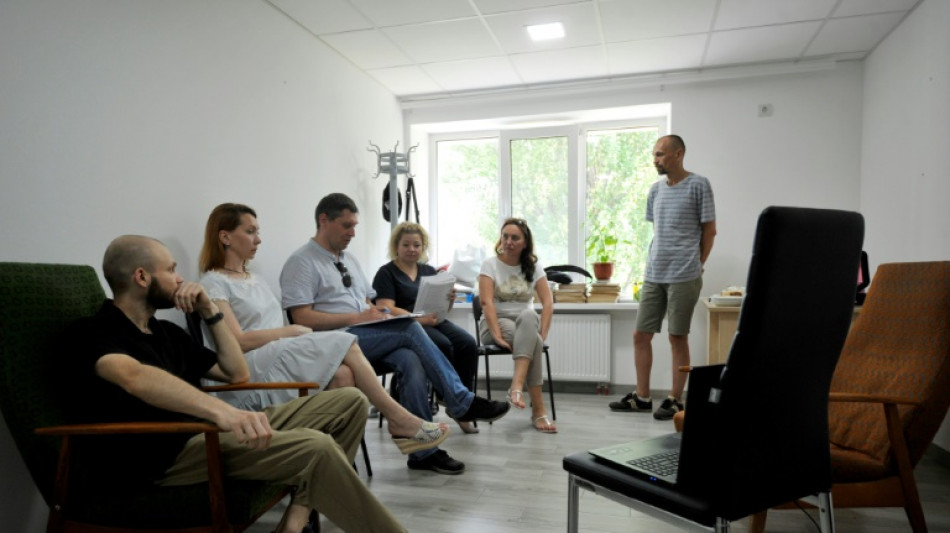
He offers a special three-week course, focusing mainly on group sessions for people who are suffering from anxiety, panic attacks or painful memories.
Some, like Makeyev, come directly to the clinic, others call a helpline and speak to specialists, who determine whether they are suitable for therapy.
Treatment is free. The course includes 15 thematic sessions aimed at comprehending one's experience of trauma and learning ways of coping with it.
The course is currently available only to civilians. Neither soldiers nor children are inpatients at the moment.
"If it (PTSD) is not treated on time, then it takes on more severe forms," Starkov said, sitting in a spacious, bright group study-room, with rows of chairs and a flipchart with multi-coloured markers in front of them.
The three-story building on the outskirts of the city served as a hospital for alcohol and drug addicts before Russia invaded.
Now a team of seven psychologists conduct sessions with patients several times a day, both in groups and individually says Oleg Olishevsky, head of the therapy programme.
He adds that currently ten patients are undergoing the course, but the centre plans to increase this number to 30 people.
"For the next 10-15 years, this will be the main area of work, because every inhabitant of our country is experiencing this traumatic situation," he told AFP.
Nevertheless, Olishevsky and his team are optimistic.
"We are already seeing results. People can feel that they are safe here, that they are being taken care of," he says.
Patient Makeyev seems ready to agree -- even after just four days in the clinic.
"I have been inspired here. I was given hope that I had already lost," he said, wearing bright blue trousers and a white T-shirt, his voice sounding confident.
The first thing he intends to do after finishing therapy is to look for a job, Makeyev says.
"I expect to get out of here fully-fledged and emotionally balanced, I'm not even afraid of this word 'happy'," anymore, Makeyev says, a slight smile visible on his face.
W.Nelson--AT