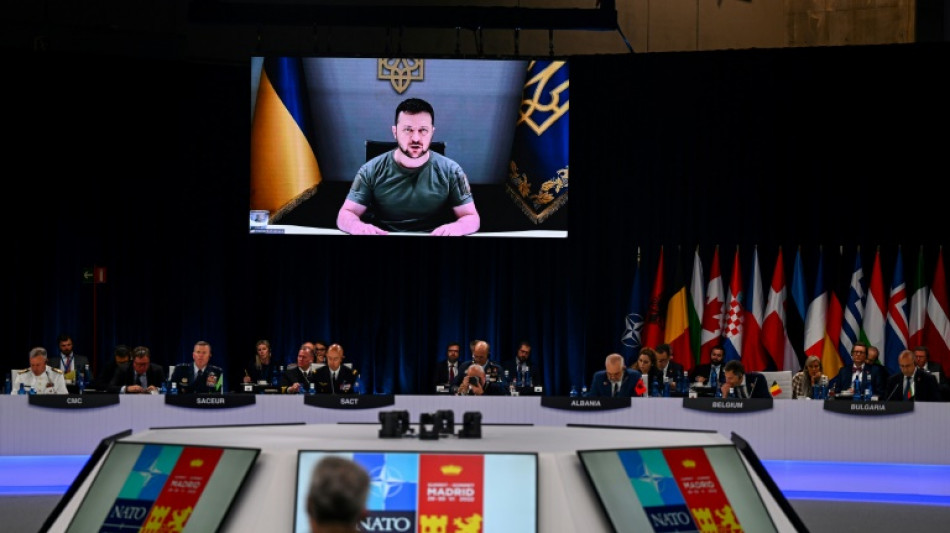
US funds software for Russians to slip past censors / Photo: GABRIEL BOUYS - AFP

 Australian lawmaker 'critically' hurt in attack, officials say

 Indonesia fires burned over 1.9 mn hectares through September: monitor

 Asian tech stocks mixed after Wall St losses, eyes on earnings

 China's third-quarter growth narrowly beats forecasts

 Asian stocks start week on back foot, tracking tech-led Wall St losses

 China growth narrowly beats forecasts

 Faith and fury: Texas Senate rivals offer contrasting visions

 Women await justice for police killings in Brazil

 The painstaking task of cataloguing the world's species

 Nations seek reset at UN talks as nature goals off track

 Rubio seeks to strengthen US foothold in Central Asia

 LeBron joins 76ers to chase one more NBA title at age 41

 Rays one win from World Series return after downing Guardians

 BioNxt Completes GMP Manufacturing and Submits Clinical Trial Application for Sublingual Cladribine Drug Candidate

 Caledonia Mining Corporation Plc: Notification of Relevant Change To Significant Shareholder
 Kings' Ben Simmons tears Achilles in training
 Lula, Bolsonaro set for first debate showdown in bitter election race

 Mbappe hits two as Real Madrid rout Sevilla

 Browns edge Ravens for division lead, Texans beat Jags

 Lyon go top of Ligue 1 as Monaco fall to first defeat of the season

 Venezuela opposition alliance reaffirms Nobel laureate Machado as leader

 'Street Fighter' wins N. America box office, buzzy doc stuns in 2nd

 NFL: Paris game to go ahead despite protests in France

 Arteta hails Arsenal 'finishers' after Madueke fells Forest

 Trump backs ally Netanyahu ahead of Israel's tight election

A US-backed campaign is giving Russians access to anti-censor software to dodge Moscow's crackdown on dissent against its invasion of Ukraine, involved groups told AFP.
Russia has intensified its restrictions on independent media since attacking its neighbor in February, with journalists under threat of prosecution for criticizing the invasion or for even referring to it as a war.
The US government-backed Open Technology Fund is paying out money to a handful of American firms providing virtual private networks (VPNs) free of charge to millions of Russians, who can then use them to visit websites blocked by censors.
Traditional VPN software creates what is effectively a private tunnel on the internet for data, typically encrypted, to flow safeguarded from snooping -- and their use has boomed in Russia since the invasion.
"Our tool is primarily used by people trying to access independent media, so that funding by the OTF has been absolutely critical," said a spokesman for Lantern, one of the involved companies.
Tech firms Psiphon and nthLink have also been providing sophisticated anti-censorship applications to people in Russia, with OTF estimating that some four million users in Russia have received VPNs from the firms.
Psiphon saw a massive surge in Russian users, with the number soaring from about 48,000 a day prior to the February 24 invasion to more than a million a day by mid-March, said a company senior advisor Dirk Rodenburg.
The firm's tools in Russian now average nearly 1.5 million users daily, he added.
While some, like Ukraine's leadership, have called for Russia to be cut off from the internet, others have noted access is key for opposition groups.
"It's so very important for Russians to be connected to the whole world wide web, to keep resistance going," said Natalia Krapiva, tech legal counsel at rights group Access Now, which is not involved in the OTF effort.
"All kinds of initiatives are happening and to keep them alive you need the internet because you can't gather in person, or because activists are scattered around the world," she added.
Keeping VPNs running and accessible was relatively straightforward in the early days of the war, said Lucas, the spokesman for Lantern, who spoke on condition that only his first name be used.
"They weren't ready to block anything," Lucas said. "Over time, Russia learned how to block the easy stuff but Lantern and Psiphon are still up and running."
- Lesson from China, Myanmar -
Censors try to cut VPN software off from servers they rely on to function or stop people from getting to websites where the tools can be downloaded.
As a result, crackdowns on internet freedom typically result in people sharing VPNs through guerrilla tactics such as word-of-mouth.
However, groups like Lantern have adopted methods like hiding VPN installers in online platforms too vital for the government to block, and building a network so users can share the technology with others, Lucas said.
"Lantern and Psiphon are different in that we do all sorts of much more sophisticated stuff to hide our traffic and get around our servers being detected," he said.
People in Russia are benefitting from the VPN makers honing their tools while battling censorship in countries such as China and Myanmar.
"There was a moment about two years ago when China really upped the level of their game, when it came to the lengths they were going to block stuff," Lucas said.
"We raised the level of our game a whole lot," he added.
US government funding provided through OTF has been important to the operations since costs jumped and revenue vanished for VPN makers in Russia, as sanctions kicked in and companies pulled out of the country.
OTF said it typically spends $3-4 million annually funding VPNs, but that figure was ramped up due to censorship in Russia.
Psiphon has been receiving US government funding for more than 14 years, with the money generally going to improve tools to counter new tactics used by authoritarian regimes, the company told AFP.
Despite the efforts to get VPN technology to those who want it, many people still don't have access.
"The use of virtual private networks and other methods have increased significantly in Russia, but it still only represents a small percentage of the population," Krapiva, from Access Now, told AFP.
R.Chavez--AT