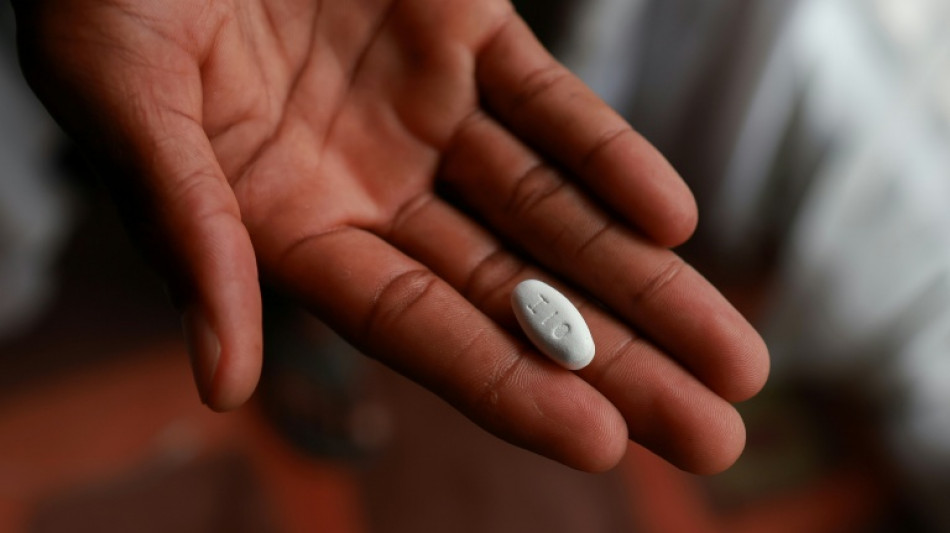
US funding cuts could reverse decades of gains in AIDS fight: UN
/ Photo: Phill Magakoe - AFP/File

 Part of London's Oxford Street pedestrianised 'forever'

 Canadian youth seek climate action in landmark trial

 Trump blasts Norway over Nobel Peace Prize snub

 Japan PM vows swift response to wave of cyberattacks

 Stocks mostly rise before tech earnings, central bank calls

 France's Macron to visit Marseille after protest violence

 German union slams Audi boss's appearance at Trump rally
 UK set for 'limited' budget giveaways as borrowing costs surge
 Anthropic's AI model accessed US voter data: Axios

 Malaysia's Johor reopens schools as haze eases

 Carragher says Fernandes benching was intended as public punishment

 Canada-EU summit seeks deepened alliance as US ties fray

 Senegal to host Youth Games, Africa's first ever Olympics

 ITV drama Adultery examines temptation, class and family consequences

 New levy on non-EU parcels kicks in November 1

 Saudi coalition says struck Houthi missile facilities after Riyadh airport attack

 Manchester United stand-in captain calls for change after Bournemouth loss
 Body recovered after ferry passenger reported overboard

 Dance in the Dark brings an immersive family adventure to Birmingham MAC

 China's Communist Party elite hold key talks on governance

 Redditch Santa fun run to return to Arrow Valley Park

 Obama links Trump trade policy to higher costs in Detroit speech

 Saudi coalition says intercepted missile after Houthis hit Riyadh airport

 'I feel so happy!': Ecstasy, relief among Brazil's Lula supporters

 Brazil's Lula clinches poll victory, Bolsonaro seeks to annul election

The halt to US foreign aid is a "ticking time bomb" that could reverse decades of hard-fought gains in the fight against AIDS, the United Nations warned Thursday.
Around 31.6 million people were on antiretroviral drugs in 2024 and deaths from AIDS-related illnesses had more than halved since 2010 to 630,000 that year, the UNAIDS agency said in a new report.
But now infections were likely to shoot up as funding cuts have shuttered prevention and treatment programmes, it said.
The United States has been the world's biggest donor of humanitarian assistance but President Donald Trump's abrupt slashing of international aid in February sent the global humanitarian community scrambling to keep life-saving operations afloat.
"We are proud of the achievements, but worried about this sudden disruption reversing the gains we have made," UNAIDS executive director Winnie Byanyima told AFP ahead of the report's launch in Johannesburg.
The agency in April warned that a permanent discontinuation of PEPFAR, the massive US effort to fight HIV/AIDS, would lead to more than six million new infections and an additional 4.2 million AIDS-related deaths in the next four years.
This would bring the pandemic back to levels not seen since the early 2000s.
"This is not just a funding gap – it's a ticking time bomb" whose effects are already felt worldwide, Byanyima said in a press release.
Over 60 percent of all women-led HIV organisations surveyed by UNAIDS had lost funding or had to suspend services, the report said.
In a striking example, the number of people receiving pre-exposure prophylaxis (PrEP) drugs to prevent transmission in Nigeria fell by over 85 percent in the first few months of 2025.
The "story of how the world has come together" to fight HIV/AIDS is "one of the most important stories of progress in global health," Byanyima told AFP.
"But that great story has been disrupted massively" by Trump's "unprecedented" and "cruel" move, she said.
"Priorities can shift, but you do not take away life-saving support from people just like that," she said.
- Key medical research affected -
Crucial medical research on prevention and treatment have also shut down, including many in South Africa which has one of the highest HIV rates in the world and has become a leader in global research.
"Developing countries themselves contribute very much towards the research on HIV and AIDS, and that research serves the whole world," Byaniyma said.
In 25 out of 60 low- and middle-income countries surveyed by UNAIDS, governments had found ways to compensate part of the funding shortfall with domestic resources.
"We have to move towards nationally-owned and financed responses," Byaniyma said, calling for debt relief and the reform of international financial institutions to "free up the fiscal space for developing countries to pay for their own response".
Still, the global HIV response built from grassroots activism was "resilient by its very nature", she told AFP.
"We moved from people dying every single day to now a point where it is really like a chronic illness," she said.
"There is no question that the investment has been worth it, and continues to be worth it. It saves lives."
M.Robinson--AT