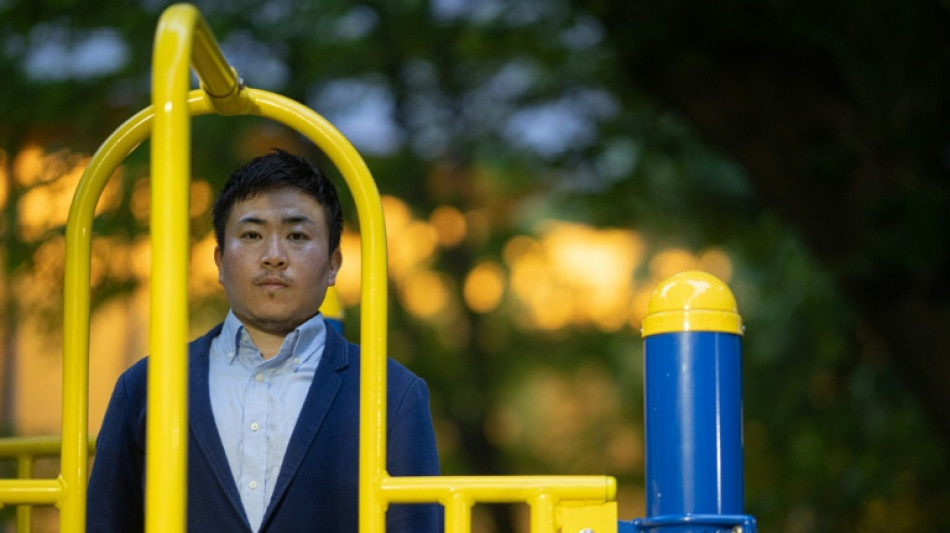
Pressed to confess: Japan accused of 'hostage justice' / Photo: Philip FONG - AFP

 Machado ready to meet Venezuela leader after shock return

 Lula celebrates election win as Brazil markets tumble
 France's Macron accuses social media of sowing discord ahead of election

 Anthropic unveils IPO filing showing soaring sales and AI risks

 US singer Chris Brown avoids jail over London nightclub brawl

 US singer Chris Brown avoids jail over UK nightclub brawl

 Man Utd crisis deepens as Carrick faces axe

 Serbian student movement eyes power after resounding snap poll victory

 Eala breezes past world number 411 in Tokyo opener

 Swedish Centre Party leader says government coalition talks failed
 Barca's big-game defeats pose familiar questions

 Russia says open to mini Ukraine ceasefires, but no let up in war

 Bangladesh measles crisis 'warning sign' of other outbreaks: report

 'Historic victory': World leaders celebrate Lula's re-election
 Stock markets mixed ahead of tech earnings, central bank decisions

 Mother renews anti-bullying appeal a decade after son’s death

 'Historic victory': Leftist leaders in the Americas celebrate Lula's re-election

 African players in Europe: Jackson brace ends City's perfect record

 Argentine police arrest stepfather after pregnant 10-year-old reaches hospital

 Mother dies after rescuing sons from riptide in the Bahamas

 James Blunt reportedly sought extra underwear during Celebrity Traitors filming

 Trump says Canada trade deal coming 'soon'

 Police urge home-security checks as darker evenings return

 Kane primed to pip Yamal, Mbappe to Ballon d'Or glory

 UK households advised to prepare for three days without essential services

Yo Amano says he is unravelling in a cell where he has been confined alone almost 24 hours a day for over six years, despite not having been convicted of the fraud charges against him.
In Japan's harsh criminal justice system, critics say innocence is not presumed and coerced confessions help drive the 99 percent conviction rate.
"From the moment I was arrested, I've been treated like I'm a prisoner," Amano, 36, told AFP through a glass screen at the Tokyo Detention Centre, where he is held alongside people convicted of violent crimes, including death-row inmates.
"I'm sure something is wrong with me mentally, but I can't tell for sure because I can't even get a decent medical diagnosis here," he said.
Campaigners argue that lengthy pre-trial detention is meted out too easily in Japan, especially if suspects remain silent or refuse to confess.
That often makes confessions a de-facto condition for their release, one that rights groups say exists in few other liberal democracies.
This alleged use of confinement as a way to elicit confessions -- or "hostage justice" -- is under renewed scrutiny after a group of victims recently filed a lawsuit challenging its constitutionality.
Lawyer Takashi Takano, who spearheads the suit, slammed the "completely inverted chronology".
In Japan, "if you contest your charges, your bail is denied and detention drags on. You get punished and robbed of everything first, sometimes before the trial even begins, followed finally by a verdict," he told AFP.
AFP obtained rare, court-issued approval to speak to Amano, who denies the charges against him.
Since his 2018 arrest, he has been locked up incommunicado, having "lost everything", including his job, partner and mental health.
In summer, what little coolness there is in the detention facility filters through a small food slot into Amano's sweltering cell.
Three tatami mats fill the floor space, and there is no air conditioning.
For most of the day, Amano is not allowed to lie down or lean against a wall, so he spends hours sitting on a mat.
The former restaurant owner says he has lost 30 kilogrammes (66 pounds) since his arrest.
He can only contact his lawyers and is denied access to anyone else, including family,barring rare exceptions.
This has left him estranged from the "daughter I doted on", now seven years old, and whom he last saw in 2019.
"I don't know if she still remembers me."
- 'Extracting confessions' -
"Hostage justice" -- a term popularised by ex-Nissan chief Carlos Ghosn's months-long, 2018-2019 detention -- has been repeatedly decried by international rights bodies.
The latest lawsuit challenges judges' ability to "rubber-stamp" detentions, and to reject bail without demonstrating "probable cause" that evidence will be destroyed, according to lawyer Takano.
In Japan, pre-indictment detention can last up to 23 days, extendable by multiple rearrests.
Only after indictment does bail become possible, but as with Amano, the option is often dismissed if the accused denies the charges, campaigners say.
Judicial data from 2021 shows that those who confessed were released much more quickly than those who denied the charges.
"In Japan, refusing to confess or remaining silent is seen as high-risk behaviour of someone likely to destroy evidence," Kana Sasakura, a criminal law professor at Konan University, told AFP.
Furthermore, detainees are typically interrogated without attorneys -- a stark contrast to most Group of Seven and East Asian democracies -- which makes it harder to withstand the pressure of questioning.
This, coupled with gruelling confinement, attests to Japan's overall reliance on confessions, Sasakura noted.
"It's a structure where, by conducting interrogations behind closed doors and isolating the suspect from the outside world, extracting confessions is made easier," she said.
- 'Fair' system -
The justice ministry told AFP that "prolonged detention solely on the grounds of remaining silent or denying charges isn't occurring".
"We don't use physical detention to force confessions," it added, defending Japan's "fair" and "evidence-based" system.
But Tomoya Asanuma, another plaintiff in the suit, recalls almost cracking under the strain.
Last year, the 36-year-old transgender activist endured almost four months of detention for charges including assault that he was ultimately acquitted of in January.
"Detectives would tell me, 'confess already, and we don't have to interrogate you so many times,'" Asanuma told AFP of the frequent, hours-long questioning.
Life under constant surveillance, including when he bathed or relieved himself, was a source of extra humiliation as his body still retained biologically female characteristics
"The thought repeatedly crossed my mind that if I falsely confessed, I can maybe escape all this," he said.
- 'Won't betray their trust' -
And therein lies the secret to Japan's astonishing 99-percent conviction rate, lawyer Takano argues.
"After such endless interrogations, most people break and confess," leading to statements adopted by courts as evidence, he said.
A case in point is Iwao Hakamada, who was once the world's longest-serving death-row inmate. His convictions -- quashed last year -- relied partly on confessions made during what the Supreme Court ruled were "inhumane" interrogations.
"That's what undergirds the '99-percent' conviction rate. But do you really trust such guilty verdicts?" Takano said.
In his cell with an exposed toilet, Amano languishes with little sense of the time or weather outside.
The light remains on after bedtime, but he is not allowed to cover his face with bedding.
But still he will not confess.
"If I succumb now and choose an easy way out, I would disappoint people who still support me," he said.
"I won't betray their trust."
A.Moore--AT