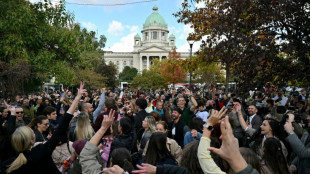
Israel army bulldozers plough through homes at West Bank camps / Photo: JOHN WESSELS - AFP

 Machado ready to meet Venezuela leader after shock return

 Lula celebrates election win as Brazil markets tumble
 France's Macron accuses social media of sowing discord ahead of election
 Anthropic unveils IPO filing showing soaring sales and AI risks

 US singer Chris Brown avoids jail over London nightclub brawl

 US singer Chris Brown avoids jail over UK nightclub brawl
 Man Utd crisis deepens as Carrick faces axe

 Serbian student movement eyes power after resounding snap poll victory

 Eala breezes past world number 411 in Tokyo opener

 Swedish Centre Party leader says government coalition talks failed
 Barca's big-game defeats pose familiar questions

 Russia says open to mini Ukraine ceasefires, but no let up in war

 Bangladesh measles crisis 'warning sign' of other outbreaks: report

 'Historic victory': World leaders celebrate Lula's re-election

 Stock markets mixed ahead of tech earnings, central bank decisions

 Mother renews anti-bullying appeal a decade after son’s death

 'Historic victory': Leftist leaders in the Americas celebrate Lula's re-election

 African players in Europe: Jackson brace ends City's perfect record

 Argentine police arrest stepfather after pregnant 10-year-old reaches hospital
 Mother dies after rescuing sons from riptide in the Bahamas

 James Blunt reportedly sought extra underwear during Celebrity Traitors filming

 Trump says Canada trade deal coming 'soon'

 Police urge home-security checks as darker evenings return

 Kane primed to pip Yamal, Mbappe to Ballon d'Or glory

 UK households advised to prepare for three days without essential services

In the West Bank city of Tulkarem, the landscape has been transformed after Israeli army bulldozers ploughed through its two refugee camps in what the military called a hunt for Palestinian militants.
The army gave thousands of displaced residents just a few hours to retrieve belongings from their homes before demolishing buildings and clearing wide avenues through the rubble.
Now residents fear the clearances will erase not just buildings, but their own status as refugees from lands inhabited by generations of their ancestors in what is now Israel.
The "right of return" to those lands, claimed by Palestinian refugees ever since the creation of Israel in 1948, remains one of the thorniest issues of the Israeli-Palestinian conflict.
The army said it would demolish 104 more buildings in the Tulkarem camp this week in the latest stage of an operation that it launched in January during a truce in the Gaza war, billing it as an intensive crackdown on several camps that are strongholds of Palestinian armed groups fighting against Israel.
"We came back to the camp and found our house demolished. No one informed us, no one told us anything," said Abd al-Rahman Ajaj, 62, who had been hoping to collect his belongings on Wednesday.
Born in Tulkarem camp after his parents fled what is now the Israeli city of Netanya, about 12 kilometres (seven miles) to the west, Ajaj said he had not foreseen the scale of the Israeli operation.
- Thousands displaced -
It began with a raid on the northern West Bank city of Jenin, a longtime stronghold of Palestinian militants, and quickly spread to other cities, including Tulkarem, displacing at least 40,000 people, according to UN figures.
Vacating the camp after a warning of a raid, "we would usually come back two or three days later", Ajaj told AFP.
Now left without a house, he echoed the sentiments of Palestinians of his parents' generation, who thought their own displacement in 1948 would also be temporary.
"The last time, we left and never returned," he said.
In Tulkarem, the Israeli army's bulldozers ploughed through the dense patchwork of narrow alleyways that had grown as Palestinian refugees settled in the area over the years.
Three wide arteries of concrete now streak the side of Tulkarem camp, allowing easy access for the army.
Piles of cinder blocks and concrete line the roadside like snowbanks after a plough's passage.
- 'Eliminate the refugee issue' -
Ajaj said the destruction had been gradual, drawn out over the course of the operation, which the army has dubbed "Iron Wall".
Beyond the military value of wide access roads, many residents believe Israel is seeking to destroy the idea of the camps themselves, turning them into regular neighbourhoods of the cities they flank.
Residents fear this would threaten their refugee status and their "right of return" to the land they or their forebears fled or were expelled from in 1948.
The current Israeli government -- and particularly some of its far-right ministers, who demand the outright annexation of the West Bank -- are firmly opposed to this demand, which they see as a demographic threat to Israel's survival as a Jewish state.
"The aim is clearly to erase the national symbolism of the refugee camp, to eliminate the refugee issue and the right of return," said Suleiman al-Zuheiri, an advocate for residents of nearby Nur Shams, Tulkarem's other refugee camp, where he also lives.
Zuheiri's brother's house was destroyed last week by the bulldozers.
"The scene was painful and tragic because a house is not just walls and a roof. It holds memories, dreams, hopes and very important belongings that we couldn't retrieve," he said.
Each demolished building housed at least six families on three floors, he added.
The land allocated to the camps was limited, so residents have had little choice but to build upwards to gain space, adding an extra storey with each new generation.
- Explosions rock camp -
Back at Tulkarem camp, 66-year-old Omar Owfi said he had managed to make two trips into the camp now occupied by Israeli soldiers to retrieve belongings on Wednesday.
He feared becoming homeless if his home was demolished.
"They don't care what the house is worth. All they care about is demolishing. We're the ones losing. We've lost everything," he told AFP.
"They want to erase the camp -- to remove as many buildings as possible and leave just streets."
He said he feared for his children and grandchildren, as they dispersed to live with various relatives.
The Israeli supreme court froze the military order for mass demolitions in Tulkarem camp on Thursday, giving the state two months to answer a petition against them, said the Palestinian human rights group Adalah, which filed it.
But the physical damage has already been done as the army's manhunt for militants continues.
As residents retrieved mattresses, wardrobes and air conditioning units from the camp on Wednesday under the surveillance of Israeli troops, gunshots rang out through the streets.
A loud explosion echoed across the city, followed by a column of dust rising as another building was apparently blown up, sending the smell of gunpowder wafting in the wind.
A.Clark--AT