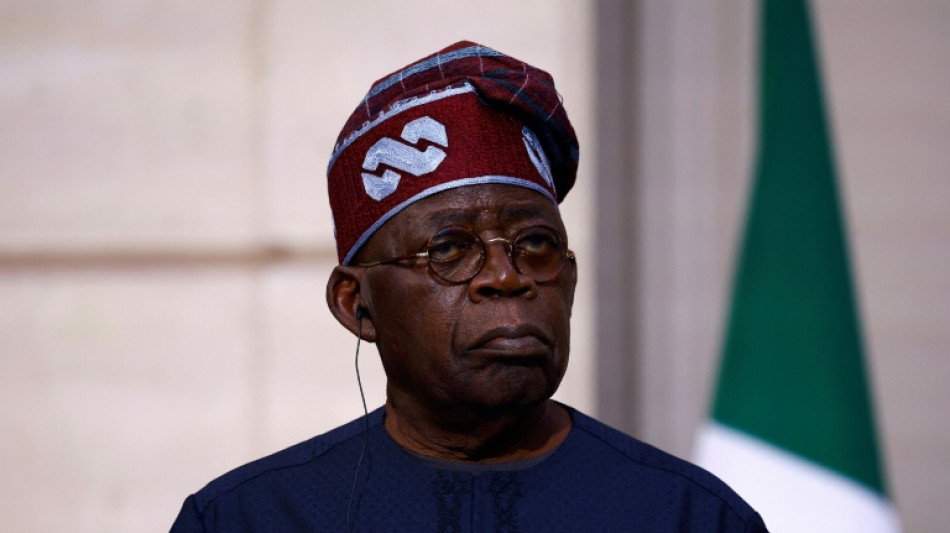
Nigeria's Tinubu signs major tax overhaul / Photo: Sarah Meyssonnier - POOL/AFP

 Nadal returns for Vegas hardcourt event

 Fainga'anuku named as loose forward for All Blacks northern tour

 Anthropic points to AI dangers, soaring sales in IPO filing

 Sinner to play rescheduled Saudi Six Kings in December

 Brazilian lawmaker Andre Janones, Lula's social media 'general'

 Swiss Ebola patient repatriated from Nigeria

 Nations far from a deal as UN nature talks enter final stretch

 Brazil markets battered, tech in focus elsewhere

 French court adjourns trial over 2020 death of delivery driver

 Serbian student movement eyes power after election triumph

 Machado ready to meet Venezuela leader after shock return

 Lula celebrates election win as Brazil markets tumble

 France's Macron accuses social media of sowing discord ahead of election

 Anthropic unveils IPO filing showing soaring sales and AI risks

 US singer Chris Brown avoids jail over London nightclub brawl

 US singer Chris Brown avoids jail over UK nightclub brawl

 Man Utd crisis deepens as Carrick faces axe
 Serbian student movement eyes power after resounding snap poll victory

 Eala breezes past world number 411 in Tokyo opener

 Swedish Centre Party leader says government coalition talks failed

 Barca's big-game defeats pose familiar questions
 Russia says open to mini Ukraine ceasefires, but no let up in war
 Bangladesh measles crisis 'warning sign' of other outbreaks: report

 'Historic victory': World leaders celebrate Lula's re-election

 Stock markets mixed ahead of tech earnings, central bank decisions

Nigerian President Bola Tinubu on Thursday signed four landmark bills into law aiming to overhaul the country's tax system, after backing away from more controversial tweaks that would have upended revenue sharing among states.
The west African economic powerhouse has a tax-to-GDP ratio of 13.5 percent, according to government figures, which is below the continental average.
The country, split among 36 states, has long struggled to reform its tax system -- with the government saying its new package will "harmonise" levies across the nation.
"For too long, our tax system has been a patchwork—complex, inequitable, and burdensome," Tinubu said on social media ahead of the signing, promising relief for poor and working-class Nigerians.
The president's earlier reforms -- slashing a costly fuel subsidy and liberalising the naira exchange rate -- have won the praise of economists, saying such measures were long overdue.
But they’ve also sparked massive inflation and a cost of living crisis.
The four laws -- the Nigeria Tax Law, Nigeria Tax Administration Law, Nigeria Revenue Service (Establishment) Law, and Joint Revenue Board (Establishment) Law -- are a "one-stop shop," simultaneously increasing revenue generation and reducing the tax burden on low-income earners, tax expert Chukwuema Eze told AFP.
With the country experiencing one of its worst economic crises in decades, the new laws exempt low-revenue small businesses from paying company tax and reduce corporate tax to 25 percent from 30 percent.
The new regime also streamlines tax collection and reorganises revenue-sharing between federal and state governments -- though without completely upending the system that sees poorer, mostly northern states benefit from money put into the national pot from the oil-rich south.
Major tweaks to the revenue-sharing system were dropped as the bills wound their way through the legislature, after proving controversial in a country where north and south remain divided along both economic, religious and ethnic lines.
One of the laws renames the country's tax office to Nigerian Revenue Service (NRS) and strengthens its revenue generation capacity, though the federal government's earnings from the value-added tax (VAT) will decline, with more money allocated to individual states.
- Easing business environment -
The government hopes the reforms will ease the cost of doing business for both domestic and foreign firms operating in the west African powerhouse, whose economy has dived from the largest in Africa to fourth place under Tinubu’s reforms.
However, some tax experts including Nongomin Joshua, of Nongomin & Co, Practitioners, said the reforms will mean little if the government, marred by decades of corruption, can't spend the money effectively.
"The question is, how effective, efficient, and how prudent are they managing what they have been collecting with the current taxes?" said Nongomin Joshua, of Nongomin & Co, Practitioners, an accounting group.
Economist Kelvin Emmanuel based in Abuja, the capital, said the new reforms would be key in raising the tax-to-GDP ratio, a struggle for many African countries where millions work in the informal sector.
"It will also strengthen the fiscal administration of local governments around Nigeria, as the new framework seeks to create a comprehensive governance framework for local governments around autonomy," he told AFP.
O.Brown--AT