UN Charter: a founding document violated and ignored / Photo: ANGELA WEISS - AFP

 Nadal returns for Vegas hardcourt event
 Fainga'anuku named as loose forward for All Blacks northern tour

 Anthropic points to AI dangers, soaring sales in IPO filing
 Sinner to play rescheduled Saudi Six Kings in December
 Brazilian lawmaker Andre Janones, Lula's social media 'general'

 Swiss Ebola patient repatriated from Nigeria
 Nations far from a deal as UN nature talks enter final stretch

 Brazil markets battered, tech in focus elsewhere

 French court adjourns trial over 2020 death of delivery driver
 Serbian student movement eyes power after election triumph

 Machado ready to meet Venezuela leader after shock return

 Lula celebrates election win as Brazil markets tumble

 France's Macron accuses social media of sowing discord ahead of election
 Anthropic unveils IPO filing showing soaring sales and AI risks

 US singer Chris Brown avoids jail over London nightclub brawl

 US singer Chris Brown avoids jail over UK nightclub brawl
 Man Utd crisis deepens as Carrick faces axe
 Serbian student movement eyes power after resounding snap poll victory
 Eala breezes past world number 411 in Tokyo opener

 Swedish Centre Party leader says government coalition talks failed
 Barca's big-game defeats pose familiar questions
 Russia says open to mini Ukraine ceasefires, but no let up in war
 Bangladesh measles crisis 'warning sign' of other outbreaks: report

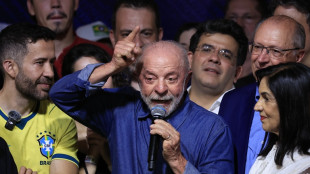 'Historic victory': World leaders celebrate Lula's re-election

 Stock markets mixed ahead of tech earnings, central bank decisions

Eighty years ago Thursday, 50 countries came together in the ashes of World War II to sign the United Nations' founding charter in order "to save succeeding generations from the scourge of war."
UN Secretary-General Antonio Guterres insisted this week the Charter "is a promise of peace, dignity and cooperation among nations."
But critics say the organization has been utterly helpless in stopping the countless conflicts that have broken out since and continue around the globe today.
Here is a look at the UN Charter's history.
- Main principles -
Conceived in the early years of World War II and signed on June 26, 1945 in San Francisco, the charter paved the way for the creation of the United Nations on October 24, 1945.
In 19 chapters and 111 articles, the Charter lays out the principles of international relations, including the peaceful settlement of disputes, sovereignty and equality between states, humanitarian cooperation, and respect for human rights.
If there is a threat to global peace, Chapter VII gives the UN Security Council the power to impose sanctions to enforce its decisions or even deploy military force.
The Charter, which is very difficult to amend, also establishes the Security Council, with its five veto-wielding permanent members, the General Assembly and the Secretariat, as well as the International Court of Justice.
The United Nations currently has 193 member states.
- 'Impunity reigns' -
But for all the good words, the Charter's principles have been continually violated across the planet for eight decades.
Member states rarely agree whether self-determination trumps non-interference in a state's internal affairs, or if the right to self-defense can justify acts of aggression.
In the most recent example, Tehran, backed by veto-wielding China, accused Washington of violating the UN Charter by striking Iranian nuclear sites over the weekend, an act the United States justified by the right to "collective self-defense."
And the international community has never really addressed the "crime of aggression," said Gissou Nia, a fellow with the Atlantic Council think tank, be it Russia's war against Ukraine or the US invasion of Iraq.
"And once impunity reigns on one set of violations, one that's never dealt with, it continues, and countries use it as justification for the actions that they take," Nia told AFP.
She added: "For self-defense, you really have to show evidence of an imminent attack. I think that it's one of the more contentious issues that involve the UN Charter and the narrative has really gotten away from us."
Russia's invasion of Ukraine in February 2022 was denounced as a clear violation of the Charter by Guterres and the General Assembly, but not by the Security Council, where Russia has a veto.
And even though the Charter allows for persistent violators to be expelled from the UN, that has never happened.
In 1974, the UN did, however, suspend South Africa from the General Assembly over the crimes of apartheid, a ban that lasted two decades.
S.Jackson--AT