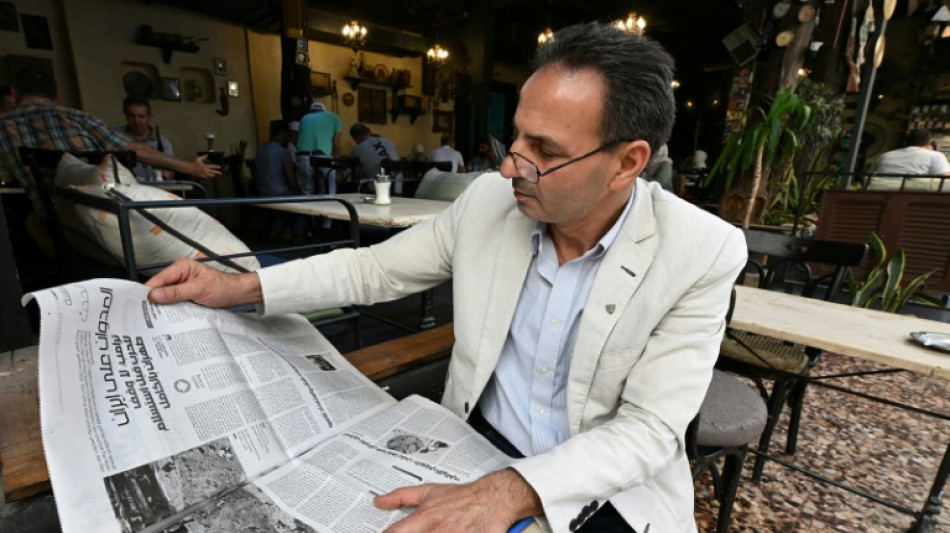
Syrians watch Iran-Israel crossfire as government stays silent / Photo: LOUAI BESHARA - AFP

 US-brokered truce begins in Ukraine city occupied by Russia

 Qatar launches Fashion and Crafts Council to connect talent with global markets
 Jordan strikes militant groups in Syria after church attack

 FIA chief praises Middle East motorsport volunteers and officials

 Australia warns of 'unprecedented' AI threat

 Qatar Amir arrives in Moscow for eighth GECF summit

 Kane beats Yamal and Mbappe to taste Ballon d'Or glory

 Ballon d'Or crowns Putellas's return to top of women's game

 Godts stars as PSG beat Lyon to go top of Ligue 1

 NBA inks deal with Kalshi and Polymarket, citing safeguards

 US rapper Macklemore launches 'Free Palestine Tour' after Ed Sheeran fallout

 Venezuela leader criticizes Machado over dramatic return from exile

 Brazil markets battered after Lula win, AI in focus elsewhere
 Lula savors Brazil win as Bolsonaro rejects result, markets tumble
 Canadian youths ask court to impose binding climate protections

 Walter Koenig, who played original Chekov on 'Star Trek,' dies at 90

 Netanyahu, rivals trade attacks over Iran as clock counts down to Israel vote
 Townsend urges Scotland to use Nations Championship as World Cup springboard

 Microsoft offers voluntary exit packages to 60,000 staff
 S.Africa ambassador calls for talks with US over 'tense' ties
 'Smells of freedom': Serbians hopeful after landmark election

 South Africa select 'enforcer' Coetzee for Australia decider
 Botanists comb Gabon's rich rainforests with nature on the line
 New levy on non-EU parcels kicks in Sunday
 Stocks climb ahead of tech earnings, central bank calls

For days, Syrians have watched as Iranian missiles and Israeli interceptors light up the skies over their territory, but the new government in Damascus has so far remained officially silent on the unprecedented conflict.
Iran was one of former ruler Bashar al-Assad's biggest backers, playing a crucial role in propping up his government by providing military advisers and the support of affiliated armed groups throughout the 14-year Syrian civil war.
Israel, meanwhile, has occupied the Golan Heights since seizing it from Syria in 1967, and has kept troops in a UN-patrolled buffer zone there since December, when the fall of Assad at the hands of an Islamist-led coalition sparked a wave of Israeli air strikes on military targets.
But despite both countries looming large in Syrian affairs over the years, Damascus -- and everyday Syrians -- appear eager to keep the current crisis at arm's length.
"From my balcony at night, I watch the missiles going towards Israel and the anti-missile systems, and I observe the explosions in the sky," said surgeon Mohammed Khayr al-Jirudi.
"The people are fed up with everything related to killing and destruction, we've had enough. Therefore, we are currently in the position of spectators to both sides, and will not gloat over either of them."
On Friday, Israel launched an unprecedented campaign against Iran, saying it aimed to stop the country from obtaining the nuclear bomb -- an ambition Tehran denies.
Iran has responded with barrages of ballistic missiles targeting Israeli cities, with the exchanges of fire sparking fears of regional spillover.
Unlike most Arab countries, which issued strong condemnations of Israel's strikes, Syria's new government has not commented on the war, potentially signalling a shift in the country's regional posture.
"It is very difficult for us to take a stand," Jirudi said, with many war-weary Syrians seeming to share the government's reluctance.
- 'Both dictatorial systems' -
Sitting with his wife in Damascus' famous Rawda cafe, 42-year-old actor Ahmad Malas said he hoped to "be rid of both the Iranian and Israeli regimes, as they are both dictatorial systems (and) Syrian people have been paying the price for their actions".
However, he added, "I have an emotional connection with the Iranian people, and with the Palestinian people, as their cause has been ours for a long time".
Iran's support for Assad following his violent repression of peaceful protests in 2011 created strong animosity towards Tehran among many Syrians.
Thousands of Iranians left Syria after the fall of Assad, and Tehran's embassy was subjected to looting and vandalism.
The walls surrounding the embassy in Damascus still bear the spray-painted slogans "curse Iran" and "free Iran".
Since becoming Syria's interim president, former rebel leader Ahmed al-Sharaa has repeatedly criticised Iran's role in his country during the civil war, stating that restoring relations with Tehran will require respect for Syria's "sovereignty" and "non-interference" in its affairs.
Iran has said it is "not in a hurry" to establish ties with the new Syrian authorities.
Israel has conducted hundreds of strikes on Syria since Assad's fall, saying it aimed to stop advanced weapons from reaching the new rulers, whom it considers jihadists.
Israeli troops in the UN-patrolled buffer zone between Syria and the Golan Heights have also regularly carried out ground incursions, condemned by Damascus.
Syria admitted to holding indirect talks with Israel seeking de-escalation, and the United States has called for it to normalise ties with its southern neighbour.
- 'Neutrality' -
Amid the breaches of Syria's airspace, at least one civilian has been killed and several others injured by fallen debris from intercepted projectiles.
The Syrian foreign ministry did not respond to a request for comment on the war.
"Damascus adheres to a policy of neutrality... It tries to completely distance itself from the war and any mention of it, because Syria has no interest in getting involved," said Bassam al-Suleiman, a political analyst close to the new authorities.
As the government tries to kickstart post-war economic recovery and reconstruction, Syria's primary battle is "internal", according to Suleiman.
He added that while "both Israel and Iran are a source of danger, we have no stake in this war", which he said Syria should "avoid".
From a rooftop nightclub overlooking Damascus, a 27-year-old doctor who gave her name as Sarah watched the flash of missiles in the sky.
"We try to forget the atmosphere of war by spending time here with friends," she said.
"However, I still fear that some effects of the war will reach us."
T.Perez--AT