In Ukraine, war raises spectre of devastating Stalin-era famine / Photo: SERGEY BOBOK - AFP

 'I call it a bribe': Pennsylvania residents spurn $10,000 data center checks
 In a former US steel city, ordinary people struggle to get by
 'Liar,' 'clown': Lula and Bolsonaro spar in Brazil poll debate
 Record El Nino? Depends who's counting
 On the front line of ocean conservation off Portugal's Madeira
 Wembanyama targets title breakthrough as NBA season tips off
 With LeBron on board it's title or bust for Philly fans

 One year after Louvre heist, where are the missing jewels?

 Knicks face tall task in NBA championship repeat bid

 Warriors' Curry 'fine' after limping out of practice - Kerr

 Zelensky speaks to US envoys as Trump lashes out

 'Surprise package' Lazio crush Juve to keep pace with Serie A leaders Inter

 China growth expected to miss official target in third quarter

 Lazio crush Juventus to move level with Serie A leaders Inter

 Leeds draw feels like 'fresh start' for Man Utd's Carrick

 Macron denounces 'unbridled' violence as France hit by new clashes

 Hurzeler lauds 'hard worker' Gomez after Brighton goal from halfway line
 Toulouse hold off Exeter, Northampton save English Champions Cup blushes

 Arsenal snatch late win to keep pressure on Man City as Man Utd held
 Arsenal strike late to keep pressure on Man City as Man Utd held

 Four soldiers dead, dozens injured in fire at Canada military base
 Ton-up Agha helps Pakistan down Sri Lanka in tri-series opener

 Man Utd draw at Leeds keeps pressure on Carrick
 Barca defenders Garcia, Kounde injured before key games
 Lula, Bolsonaro to face off in first debate of bruising election
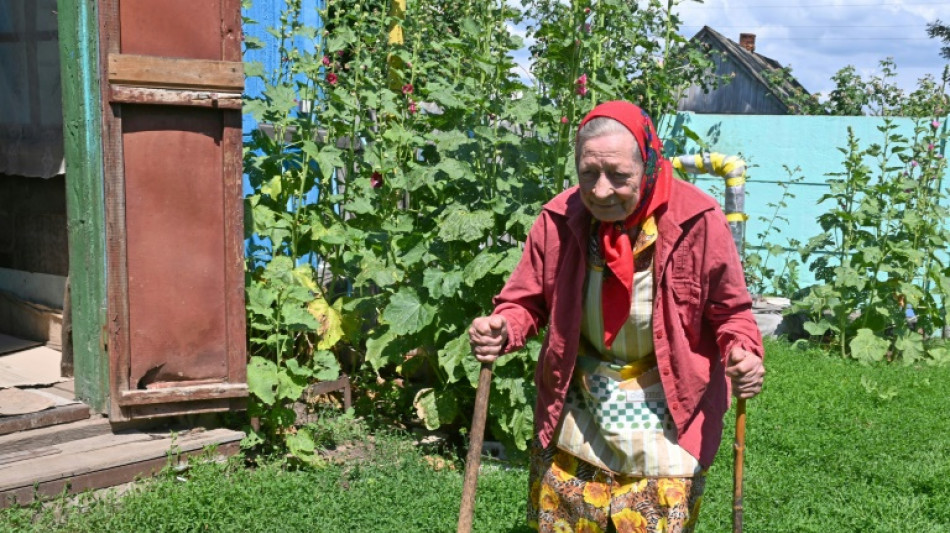
For Maria Goncharova, a 93-year-old survivor of the devastating famine that hit Ukraine in the 1930s, Russia's invasion has awoken fears that the nightmare of starvation could happen again.
Scarred for life by Stalin's campaign of forced "collectivisation", when seized grain and other foodstuffs left millions to starve, this elderly lady still hoards everything for fear of going without.
Since the Russian invasion began, the skies over her small pale blue house in Cheremushna, a village in the eastern Kharkiv region, have been filled with missiles, the war bringing back some awful memories.
"We only survived by cooking a potato and some flour each day," says Goncharova, a red scarf covering her hair, who has three chickens in her small garden.
Her tiny monthly pension of 2,000 hryvnia (65 euros/$68) means every penny counts, with everything cooked on her wood-fired stove.
The Russians "have already stolen a lot of grain from us and they are capable of taking everything," she sighs, crossing herself.
- The Holodomor -
Known as the "Holodomor" -- Ukrainian for "death by starvation" -- the 1932-1933 famine is regarded by Kyiv as a deliberate act of genocide by Stalin's regime with the intention of wiping out the peasantry.
"Food was used by the Soviet authorities to achieve their objectives by killing those who were resisting their authority on a large scale," said Lyudmyla Grynevych, a historian who heads the Holodomor research and education centre.
The Holodomor has long been a major sticking point in ties between Russia and Ukraine.
Moscow rejects Kyiv's narrative, placing the events in the broader context of famines that devastated regions of Central Asia and Russia.
And the current conflict has only fuelled fears that history may repeat itself, with Russia's targeting of grain storage facilities and its blockade of Ukraine's Black Sea exports sparking accusations that Moscow is once again using food as a weapon of war.
European Commission chief Ursula von der Leyen raised the allegation at Davos and earlier this month, Andriy Yermak, head of the Ukrainian presidency, accused Russia of "trying to recreate the Holodomor" through its shelling of agricultural areas.
"The 1930s are very appropriate for drawing parallels because that was also an attempt to annihilate what we would call today the political entity that is Ukraine," says Grynevych.
"Ukrainians had their grain confiscated and starved to death, and then the Soviet authorities sent in some grain but only to those who agreed to join the kolkhozes," she said, referring to the huge Soviet agricultural cooperatives.
- A mark on every family -
Kharkiv, which lies more than 450 kilometres (280 miles) east of Kyiv, was the first capital of the Ukrainian Soviet Socialist Republic from 1919-1934.
At the time, the area was considered to be one of the top 23 most fertile regions in the entire Soviet Union.
Around Cheremushna village where Goncharova grew up, "a third of the residents died" during the famine, says Tamara Polishchuk, who runs a museum dedicated to the Holodomor.
But even then, not all deaths were registered as the process "was suspended", said Polishchuk, who has done extensive research into the subject.
For her, every family in the area is marked by the memory of the devastating famine that the USSR tried for decades to erase, and which Ukraine was only able to commemorate in its own right after independence in 1991.
Showing off the supplies she has put away, Goncharova proudly says she "still has a little bit of everything".
"Many countries help us. They bring us things and give it to the people. But only God knows how much longer it will continue," she says before going out to sit on her porch in the shade of a walnut tree.
E.Flores--AT