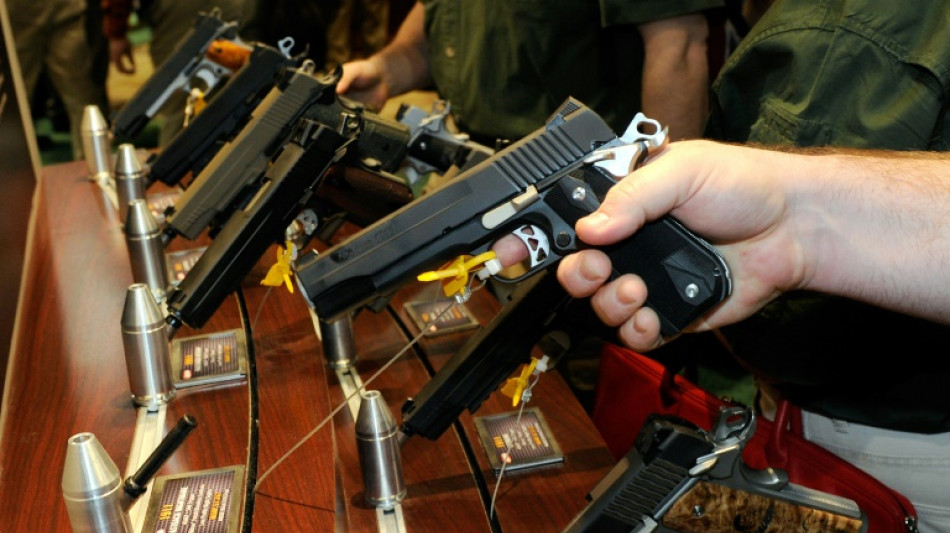
US Supreme Court on guns: what happens next? / Photo: Ethan Miller - GETTY IMAGES/AFP/File

 'I call it a bribe': Pennsylvania residents spurn $10,000 data center checks
 In a former US steel city, ordinary people struggle to get by

 'Liar,' 'clown': Lula and Bolsonaro spar in Brazil poll debate
 Record El Nino? Depends who's counting
 On the front line of ocean conservation off Portugal's Madeira

 Wembanyama targets title breakthrough as NBA season tips off

 With LeBron on board it's title or bust for Philly fans
 One year after Louvre heist, where are the missing jewels?
 Knicks face tall task in NBA championship repeat bid
 Warriors' Curry 'fine' after limping out of practice - Kerr
 Zelensky speaks to US envoys as Trump lashes out
 'Surprise package' Lazio crush Juve to keep pace with Serie A leaders Inter

 China growth expected to miss official target in third quarter
 Lazio crush Juventus to move level with Serie A leaders Inter

 Leeds draw feels like 'fresh start' for Man Utd's Carrick
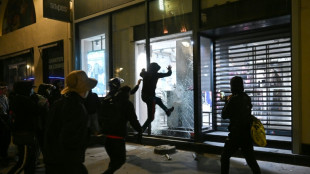
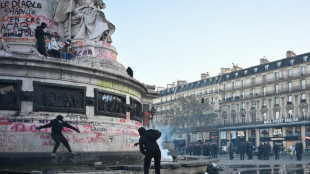 Macron denounces 'unbridled' violence as France hit by new clashes

 Hurzeler lauds 'hard worker' Gomez after Brighton goal from halfway line
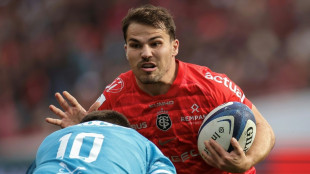 Toulouse hold off Exeter, Northampton save English Champions Cup blushes
 Arsenal snatch late win to keep pressure on Man City as Man Utd held
 Arsenal strike late to keep pressure on Man City as Man Utd held
 Four soldiers dead, dozens injured in fire at Canada military base
 Ton-up Agha helps Pakistan down Sri Lanka in tri-series opener
 Man Utd draw at Leeds keeps pressure on Carrick
 Barca defenders Garcia, Kounde injured before key games
 Lula, Bolsonaro to face off in first debate of bruising election
The US Supreme Court ruling in the most important gun rights case in more than a decade does not mean a New Yorker can now openly carry an AR-15 rifle into a movie theater.
But they may be able to eventually bring in a concealed and loaded handgun.
In a 6-3 decision in a case brought against New York's gun licensing requirements, the conservative-dominated court ruled that Americans have a fundamental right to carry a concealed handgun in public.
The ruling represents a major legal shift on the issue of gun control, but it will likely take time for the real impact on the streets and citizens of US cities to make itself felt:
- New York vows to fight back -
New York Governor Kathy Hochul called the Supreme Court decision "reprehensible" and pledged to enact new state gun control legislation.
"We do not need people entering our subways, our restaurants, our movie theaters with concealed weapons," Hochul said.
New York City police commissioner Keechant Sewell warned New Yorkers that nothing has changed yet.
"If you carry a gun illegally in New York City, you will be arrested," she said.
New York City Mayor Eric Adams vowed to use "every legal resource available" to ensure that "New Yorkers are not put in greater danger of gun violence."
New York, the nation's fourth-largest state with a population of 19.3 million, has some of the strictest gun laws in the country.
Illegally possessing a loaded firearm outside one's home or place of business has been a felony punishable by up to 15 years in prison.
Adams, the mayor, said the city will start identifying sensitive places where guns may legally be banned.
- 'Sensitive places' -
In its ruling, the Supreme Court said it was "settled" law that guns may be prohibited in some "sensitive places" such as schools, government buildings, polling places and courthouses.
But they left it to lower courts to determine exactly what other places may be added to the list.
Jeffrey Fagan, a law professor at Columbia University, said the court had "created a precedent that there are extremely limited circumstances where one cannot carry a firearm."
Fagan predicted a "cat-and-mouse game" between municipal governments seeking to restrict the right to carry on one hand and the gun lobby and constitutional conservatives who want to expand that right.
"Can one carry a firearm into a church? Can one carry a firearm onto mass transit? Can one carry a firearm into a movie theater?" he asked. "I think it's going to be an interesting period of experimentation."
- Impact on other states -
About half of the 50 US states allow permitless carry of concealed firearms in public while the other half allow it in some form but with restrictions, according to the gun control group Giffords.
A number of US states also allow the open carrying of rifles, including semi-automatics, and several recent protests in the United States have featured heavily-armed demonstrators.
The Supreme Court ruling will have an immediate impact on the five states with laws similar to New York's -- California, New Jersey, Maryland, Massachusetts, and Hawaii -- and the nation's capital, Washington.
Joseph Blocher, a law professor at Duke University, said he expected those states to "attempt to distinguish their laws from New York."
They may argue that their laws are less stringent and involve less discretion in the licensing authority, said Blocher, co-director of the Center for Firearms Law.
"But I would expect there to be strong pressure in litigation for their laws to be revamped or struck down," he added.
O.Brown--AT