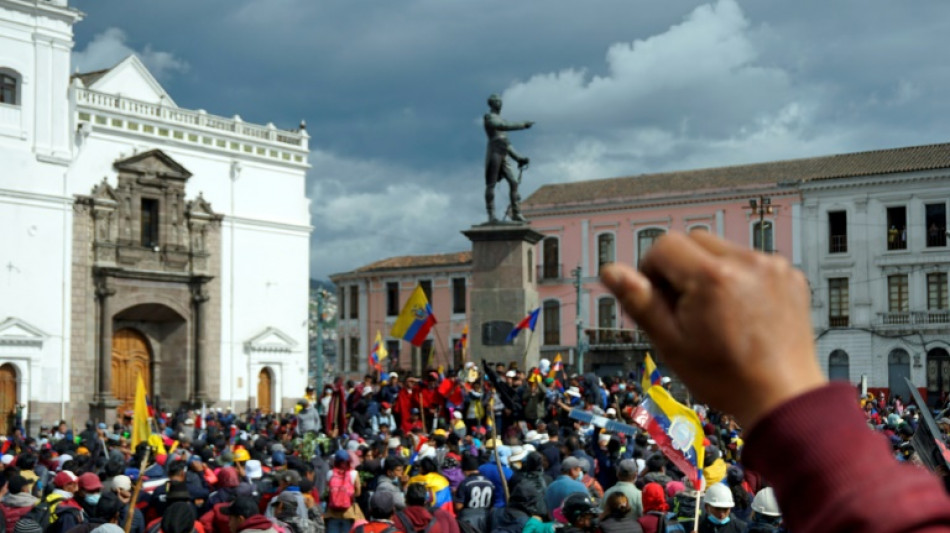
'We are suffering': Indigenous Ecuadorans explain protest / Photo: Veronica LOMBEIDA - AFP

 'I call it a bribe': Pennsylvania residents spurn $10,000 data center checks

 In a former US steel city, ordinary people struggle to get by
 'Liar,' 'clown': Lula and Bolsonaro spar in Brazil poll debate
 Record El Nino? Depends who's counting
 On the front line of ocean conservation off Portugal's Madeira

 Wembanyama targets title breakthrough as NBA season tips off

 With LeBron on board it's title or bust for Philly fans

 One year after Louvre heist, where are the missing jewels?

 Knicks face tall task in NBA championship repeat bid

 Warriors' Curry 'fine' after limping out of practice - Kerr

 Zelensky speaks to US envoys as Trump lashes out

 'Surprise package' Lazio crush Juve to keep pace with Serie A leaders Inter

 China growth expected to miss official target in third quarter

 Lazio crush Juventus to move level with Serie A leaders Inter

 Leeds draw feels like 'fresh start' for Man Utd's Carrick

 Macron denounces 'unbridled' violence as France hit by new clashes

 Hurzeler lauds 'hard worker' Gomez after Brighton goal from halfway line

 Toulouse hold off Exeter, Northampton save English Champions Cup blushes

 Arsenal snatch late win to keep pressure on Man City as Man Utd held

 Arsenal strike late to keep pressure on Man City as Man Utd held

 Four soldiers dead, dozens injured in fire at Canada military base

 Ton-up Agha helps Pakistan down Sri Lanka in tri-series opener

 Man Utd draw at Leeds keeps pressure on Carrick

 Barca defenders Garcia, Kounde injured before key games
 Lula, Bolsonaro to face off in first debate of bruising election
Indigenous Ecuadorans have poured into the capital Quito from across the country in recent days to join protests against high fuel prices and the cost of living.
Four out of the thousands of demonstrators told AFP why they answered the call for countrywide anti-government demonstrations by the Conaie Indigenous peoples' association.
- At 'war' -
Margarita Malaver, 35, travelled some 270 kilometers (167 miles) on the back of a truck from Puyo, the capital of southeastern Pastaza province, to Quito to declare herself at "war" with the state.
In Puyo -- where she moved 15 years ago from her childhood home in the Amazon jungle region of Sarayaku in search of a decent living -- she works as a laundrywoman to feed herself and her three children.
Malaver, her face painted in black motifs that she explained represent "war," said she relies heavily on a monthly $50 poverty grant from the state.
She pays $80 to rent two rooms and a small kitchen for her family, and has little left for school supplies for her children, or anything else.
She desperately wants for "prices to come down."
Life is "hard," she told AFP. "There is no work."
The cost of a basic basket of consumer goods in Ecuador, for a family of four, is $735 today -- up from $710 a year ago.
Many like Malaver are protesting for more government spending on job creation, education and healthcare.
- Just two notebooks -
Carlos Nazareno, 31, makes bamboo furniture in Pastaza, the same province Malaver is from.
This work earns him about $300 in a good month, less than the minimum salary of $425, he told AFP, spear in hand among hundreds of other protesters.
The money, he said, is "hardly enough to eat, and not enough for the school needs" of his four children, who go to class "with just two notebooks" between them.
Nazareno said there are periods that he sells "nothing for a week" on end.
"My children ask me for things and I have no way of giving it... my motorbike is parked because I have no money for fuel nor to go look for food," he said.
In just over a year, fuel prices have risen sharply -- almost doubling for diesel from $1 to $1.90 per gallon and rising from $1.75 to $2.55 for gasoline.
- Wasted vote -
Nele Cuchipe, 52, took over the care of her two grandchildren when her son, their father, died.
Her goal she says, is to give the young ones a proper education and a better future than their current impoverished life in the southern Cotopaxi province.
None of her surviving children have work.
Cuchipe makes a subsistence living from growing potatoes, barley and a grain called chocho, but suffers under recent price increases for products such as oil, butter and fertilizer for her crops.
She said she wished she could undo the vote she cast for President Guillermo Lasso just over a year ago in the mistaken belief that as "a banker, a businessman" he would rescue the economy.
"Instead, hunger will kill us," said Cuchipe.
"We are suffering because of this government that does not want to understand, that does not react to anything," she said.
- No savings -
Ruben Chaluisa, 30, said he makes $10 a day working as a mason in the town of Zumbahua, elsewhere in Cotopaxi province.
He also grows potatoes and a root vegetable known as melloco to feed his wife and two children.
"We do not manage to have savings like other people," said Chaluisa, huddling against the cold in a red poncho.
Chaluisa said he had to start working at the age of 12, and fears the cycle of poverty will be repeated with his own offspring.
I want them "not to suffer like we do, to be a little more advanced than we are."
W.Stewart--AT