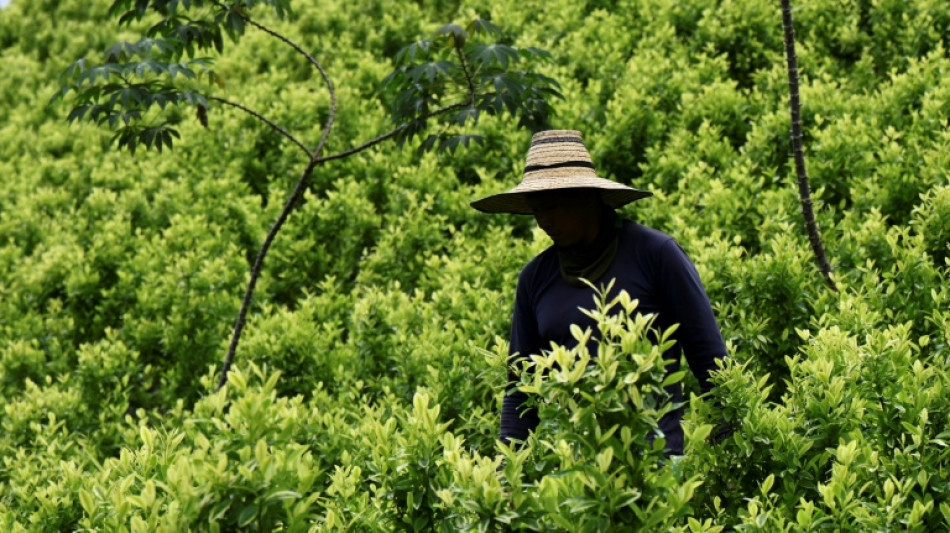
Aiming a blow at narcos, Colombia pays farmers to uproot coca / Photo: JOAQUIN SARMIENTO - AFP

 Mercedes-Benz cuts 2026 profit outlook on tough China market

 Reparations calls follow Charles on tough Caribbean trip

 Jammu and Kashmir ministers resign before planned council expansion

 Germany, EU, stable investment stops despite upheaval: Merz

 China brands drop Mbappe for 'offending national sentiments'

 India orders evacuations as Cyclone Arnab looms

 Dutch broadcaster pulls out of Eurovision over Israel 'sensitivities'

 Critical coal inventories affect nearly half of India’s domestic power plants

 FCNR(B) deposit drive puts sharper margin pressure on private banks

 Noel Tata requests records of September 17 Tata Sons board meeting

 Reparations calls to dog King Charles's tough Caribbean trip

 Global rates and foreign outflows remain key risks for Indian markets

 Neha Nagar says ₹3 crore can fund retirement with disciplined planning

 Vikas Satija says steady SIP flows shielded Indian equities from deeper losses

 Brewers rout Rays to reach brink of World Series sweep

 Mbappe dropped by Chinese brands for 'offending national sentiments'

 Kuwait exhibition presents Ukraine’s Islamic heritage and cultural ties

 Tech firms track Wall St rally on mixed day for Asian markets

 Jay-Z to perform at Super Bowl LXI halftime show: NFL

 Climate-threatened Fijian utopia rejects calls to relocate

 Israel to give verdict on Netanyahu in pivotal election

 $1m bounties, dawn arrests: Trump presses voter fraud campaign

 Gasping for air: Borneo residents struggle as island burns

 Doha exhibition charts a millennium of Chinese maritime ceramics trade

 New Zealand ex-PM Ardern to teach leadership in Sydney

With cocaine production at an all-time high, Colombia's government is testing a pacific approach to its narcotics problem: paying farmers to uproot crops of coca, the drug's main ingredient.
Among the beneficiaries are Alirio Caicedo and his son Nicolas, who a decade ago planted an expanse of coca as they staked their future on the continued patronage of criminal gangs.
Today, they are uprooting the crops and hoping for the best.
The Caicedos and some 4,000 other Colombian families have entered into a pact with the government to replace their coca with alternative crops such as cocoa and coffee.
It is part of a $14.4 million project to reduce supply of a product blamed for untold misery in a country where armed groups force rural communities to grow coca and raze forests for its cultivation.
The project seeks to eradicate coca production on 45,000 hectares in three of Colombia's most conflict-riddled regions, including the southwestern Micay Canyon where the Caicedos ply their trade in the Argelia municipality.
For farmers it is a risk.
They cannot be sure that their new plantations -- coffee in the Caicedos' case -- will succeed, or that guerrillas and other groups whose income depend on cocaine sales will leave them in peace.
"When one is planting a coca plant, there is hope that in time... there will be a harvest and there will be some income," Nicolas Caicedo, 44, told AFP while he and his dad, 77, shoveled and tugged at the remaining coca shrubs on their property.
"Uprooting the plants means that... there will be no more harvests -— in other words, no more money," from coca at least.
With coca, the Caicedos said they were guaranteed an income of about $800 per month.
They have received an initial payment of about $300 under the project to grow coffee, with more to come.
But another farmer, who spoke to AFP on condition of anonymity, said he doubted the project could work in areas such as Argelia where illegal groups outnumber the state in terms of fighters and guns.
"No armed group that lives off (coca) is going to want a farmer to stop growing coca and switch to coffee," he said.
- 'Naive' -
Gustavo Petro, Colombia's first-ever leftist president, took office in 2022 with the goal of extricating his country from the US-led "war on drugs" blamed for double-victimization of rural Colombians already living under the yoke of violent criminal groups.
On his watch, cocaine production in Colombia -- the world's biggest exporter of the drug -- reached record levels as demand continues to grow in Europe and the United States -- the principal consumer.
Several previous attempts to get Colombian coca producers to change crops have failed as armed groups caused havoc and government payments and other assistance eventually dried up.
For Gloria Miranda, head of Colombia's illegal crop substitution program, told AFP would be naive to think this new program will end drug trafficking "as long as there is a market of 20 million consumers and it (cocaine) remains illegal."
In his stated quest for "total peace," Petro has sought to negotiate with a variety of armed groups, meaning fewer military operations and the abandonment of forced coca eradication.
But talks have mostly broken down, and the arrival of Donald Trump in the White House in January has ramped up pressure on Bogota.
The Trump administration is reviewing Colombia's certification as an ally in the fight against drugs -- a move that could restrict millions of dollars in military aid.
With high stakes for its crop replacement gamble, observers fear the government may be taken advantage of.
Some farmers may "try to deceive" by taking the money while continuing to grow coca, Argelia government secretary Pablo Daza told AFP.
Without adequate monitoring, "the chances are quite high that we are wasting money," added Emilio Archila, who oversaw a similar, failed, project under former President Ivan Duque.
Miranda assures there will be "meticulous" satellite monitoring, and anyone found not to be complying will be expelled from the program.
Used not only for cocaine, the coca leaf is also chewed as a stimulant in Andean countries or brewed into a tea thought to combat altitude sickness.
Colombia's appeals for the leaf to be removed from a UN list of harmful narcotics so it can be commercialized in alternative products such as fertilizers or beverages, have so far fallen on deaf ears.
W.Moreno--AT