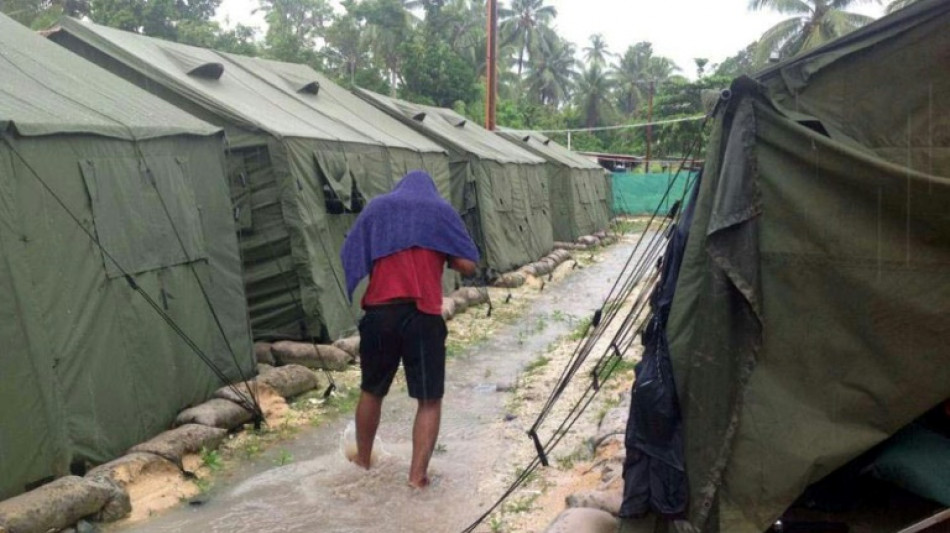
Offshore detention survivors decry UK's Rwanda scheme / Photo: STR - REFUGEE ACTION COALITION/AFP

 Rubio seeks to strengthen US foothold in Central Asia

 LeBron joins 76ers to chase one more NBA title at age 41

 Rays one win from World Series return after downing Guardians

 Kings' Ben Simmons tears Achilles in training

 Lula, Bolsonaro set for first debate showdown in bitter election race

 Mbappe hits two as Real Madrid rout Sevilla

 Browns edge Ravens for division lead, Texans beat Jags

 Lyon go top of Ligue 1 as Monaco fall to first defeat of the season

 Venezuela opposition alliance reaffirms Nobel laureate Machado as leader

 'Street Fighter' wins N. America box office, buzzy doc stuns in 2nd

 NFL: Paris game to go ahead despite protests in France

 Arteta hails Arsenal 'finishers' after Madueke fells Forest

 Trump backs ally Netanyahu ahead of Israel's tight election

 Madueke strikes late as below-par Arsenal sink Forest
 Second day of street clashes in Milan

 Dupont's Toulouse hold off Exeter as English Champions Cup woes continue

 Zelensky speaks to US envoys amid Trump spat

 Paris police in new battles with protesters and looters

 Multiple deaths, injuries at western Canada military base: minister

 Boland strikes twice for Australia in rain-hit South Africa Test

 Marseille put Angers to the sword in Ligue 1

 Albanian PM refuses to quit as violent protests enter sixth day

 Chwalinska fights back to win Wuhan Open in title breakthrough
 Kulusevski on brink of return for Spurs after 17-month absence

 Ukraine sets Saint Petersburg refinery ablaze in large-scale drone attack

Britain's plan to send migrants and asylum seekers to Rwanda has left survivors of a similar scheme in Australia wondering why the "failed" policy that shattered their lives is being revived elsewhere.
For more than six years, Sudan-born refugee Abdul Aziz Muhamat was detained by Australian authorities in a small tropical island camp off Papua New Guinea's mainland, hidden from full legal and public oversight.
"The simplest way to describe daily life on Manus Island is there's no life," Muhamat explained.
"It's worse than a prison," he told AFP. "If you cry, no one will listen. If you shout, no one will come."
Muhamat's detention was part of Australia's "Pacific Solution", under which thousands of people who attempted to reach the country by boat were moved to offshore centres on Manus and the tiny nation of Nauru.
There, they were processed, given identification numbers and barred from ever permanently settling in Australia.
Many languished in the camps for years, in conditions described by rights groups as "hellish".
"They never could have got away with the conditions in those camps if they had been in Australia," said Nick McKim, a Greens senator who visited Manus five times before being refused entry.
"I have no hesitation in describing what happened in those camps as torture."
After vast taxpayer expense, 14 detainee deaths, a string of suicide attempts -- some by detainees as young as five -- and at least six referrals to the International Criminal Court, Australia's scheme has been scaled back piece-by-piece. As of last month there were about 100 people still on Nauru.
Now the concept is being given new life by Britain, which plans to send asylum seekers to the land-locked African nation of Rwanda.
- The Australian solution -
Manus-detainee-turned-author Behrouz Boochani has urged the British public to resist plans "to copy the deeply dehumanising asylum policies of Australia".
But UK Prime Minister Boris Johnson -- who has taken advice from a series of prominent Australian political strategists -- has offered a familiar explanation for why it needs to go ahead: deterrence.
Like his Australian counterparts, Johnson has argued the policy will convince would-be migrants not to undertake perilous sea journeys on often rickety and overloaded vessels.
But Australian legal expert Madeline Gleeson of the Kaldor Centre said data shows "definitively" that offshore detention did not deter asylum seekers.
Gleeson said the UK scheme most closely mirrors Australia's policy between August 2012 and July 2013, when only some asylum seekers were sent to offshore camps.
"In that period, the number of people arriving by boat continued to rise to levels never before seen in Australia," she said.
Muhamat, who attempted three times to reach Australia by boat from Indonesia, losing five of his closest friends en route, is more direct.
The policy "achieved nothing", he said. "When you're running to save your life. You don't think about the tragedy you will encounter on your journey."
"This is really one of the points that people don't understand," he added. "What option do people have? They have only one option; they will continue risking their life."
Now living in Switzerland, Muhamat said the policy will simply condemn people to a "failed" system -- and tarnish Britain's status in the world.
"It will destroy the reputation of an entire country," he said. "The image of the UK will be replaced with an image of human misery."
S.Jackson--AT