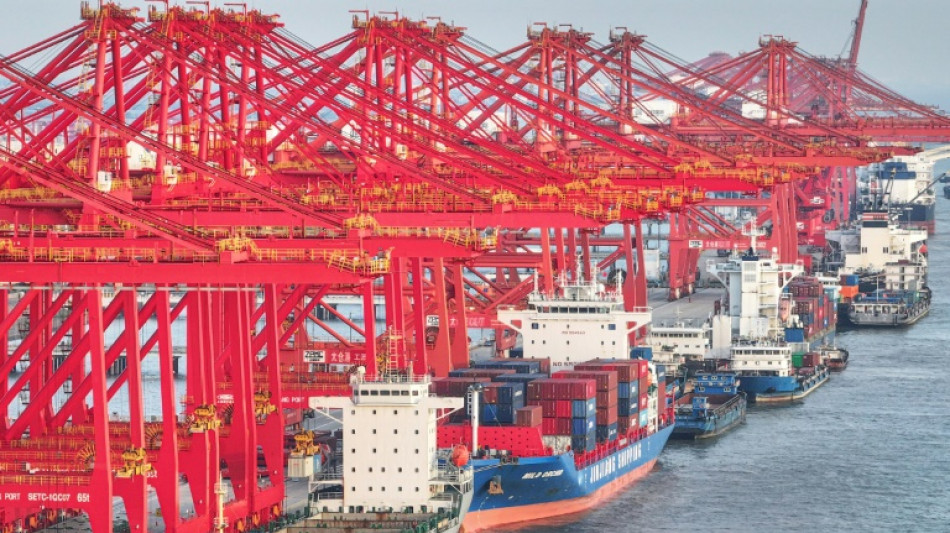
China, US slash sweeping tariffs in trade war climbdown / Photo: STR - AFP

 Trump tamed after US midterms? Europe doubts it

 Tech stocks soar as SK hynix adds to rising AI confidence

 Sri Lanka's Tamil farmers fight to reclaim land after civil war
 Afghans compete for jobs, homes as millions return

 'They don't care about us': Trump food aid cuts leave Americans struggling and angry
 Meta, Snap head to trial in another case about social media's harms
 French Senate passes bill to make protesters pay for unrest damage

 India evacuates tens of thousands as Cyclone Arnab makes landfall

 In tight Israel vote, both camps hold out cautious hope
 AI chip giant SK hynix says quarterly operating profit soars 630%

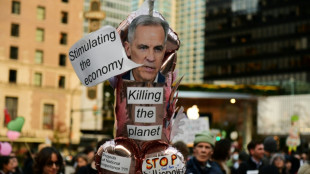 Youths testify about 'despair' in unprecedented Canadian climate trial

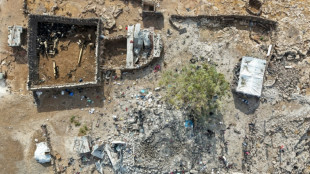 Syria, Jordan agree to mend ties after deadly strike
 Arsenal stunned by fourth-tier Fleetwood in League Cup

 Last-gasp Sabitzer strike sends Dortmund past Bremen in German Cup
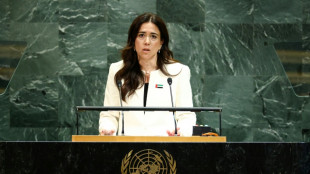 Rights groups reject Emirati diplomat for UN top job

 Flavio Bolsonaro headed to US after Brazil election defeat: US media

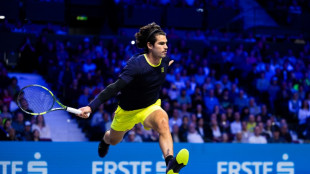 Alcaraz and Zverev win Vienna openers
 Tech firms gain ahead of Fed decision, results from AI giants

 Syria condemns deadly Jordan strikes as 'unacceptable violation'
 England's Fin Smith in race against time to face Australia

 UN nuclear watchdog chief urges Iran to grant access

 Boeing shares tumble after it releases cautious growth forecast

 Lula's re-election revives Brazil-US tensions
 Carney moves to remake Canada alliances as US ties strained

 Serbia's students demand state media chiefs resign after poll win
The United States and China slashed sweeping tariffs on each others' goods for 90 days on Wednesday, after a temporary ceasefire in a brutal trade war that roiled global markets and international supply chains.
Washington and Beijing agreed to drastically lower skyhigh tariffs in a deal that emerged from pivotal talks at the weekend in Geneva.
US President Donald Trump said Washington now had the blueprint for a "very, very strong" trade deal with China that would see Beijing's economy "open up" to US businesses, in an interview broadcast Tuesday on Fox News.
"We have the confines of a very, very strong deal with China. But the most exciting part of the deal...that's the opening up of China to US business," he told the US broadcaster while aboard Air Force One on the way to the start of his Gulf tour.
"One of the things I think that could be most exciting for us and also for China, is that we're trying to open up China," he added, without elaborating on details.
Trump had upended international commerce with his sweeping tariffs across economies, with China hit hardest.
Unwilling to budge, Beijing had responded with retaliatory levies that brought tariffs on both sides well over 100 percent.
After billions were wiped off equities and with businesses ailing, negotiations finally got underway at the weekend in Geneva between the world's trade superpowers to find a way out of the impasse.
Under the deal, the United States agreed to lower its tariffs on Chinese goods to 30 percent while China will reduce its own to 10 percent -- down by over 100 percentage points.
The reductions came into effect just after midnight Washington time (0401 GMT) on Wednesday, a major de-escalation in trade tensions that saw US tariffs on Chinese imports soar to up to 145 percent and even as high as 245 percent on some products.
Markets have rallied in the glow of the China-US tariff suspension.
Chinese officials have kept their cards closer to their chests, pitching themselves at a summit in Beijing with Latin American leaders this week as a stable partner and defender of globalisation.
"There are no winners in tariff wars or trade wars," Xi told leaders including Brazil's Luiz Inacio Lula da Silva, while his top diplomat Wang Yi swiped at a "major power" that believed "might makes right".
- 'Risk of renewed escalation' -
Deep sources of tension remain, too -- the US additional tariff rate remains higher than China's because it includes a 20 percent levy over Trump's complaints about Chinese exports of chemicals used to make fentanyl.
Washington has long accused Beijing of turning a blind eye to the fentanyl trade, something China denies.
And while the US said it sees room for progress on the issue, Beijing on Tuesday warned Washington to "stop smearing and shifting blame" onto it.
Analysts also warn that the possibility of tariffs coming back into force after 90 days simply piles on more uncertainty.
"Further tariff reductions will be difficult and the risk of renewed escalation persists," Yue Su, Principal Economist at The Economist Intelligence Unit, told AFP.
Trump's rollercoaster tariff row with Beijing has wreaked havoc on US companies that rely on Chinese manufacturing, with a temporary de-escalation only expected to partially calm the storm.
And Beijing officials have admitted that China's economy -- already ailing from a protracted property crisis and sluggish consumer spending -- is likewise being affected by the trade uncertainty.
"Both sides have endured a good deal of economic pain and they can still endure a little bit more," Dylan Loh, an assistant professor at Singapore's Nanyang Technological University, told AFP.
A.Williams--AT