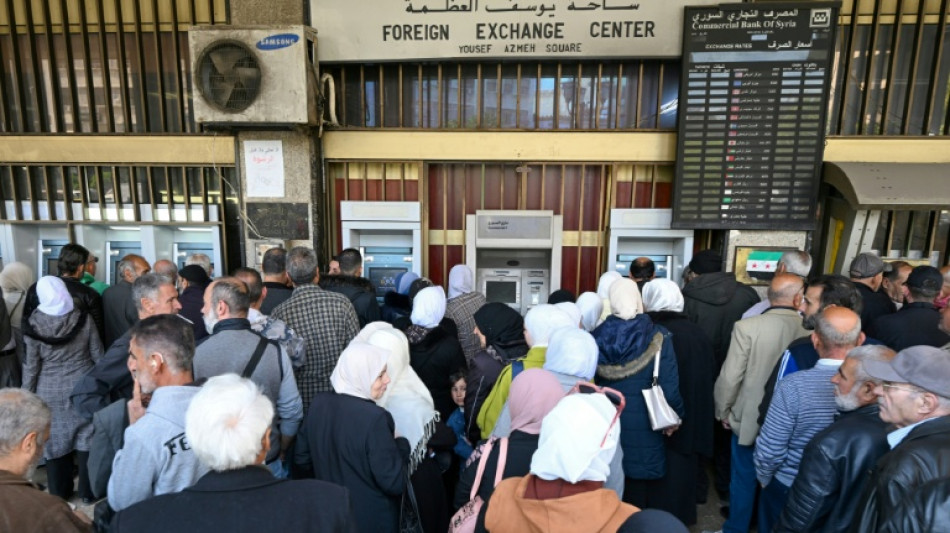
Cash crunch leaves Syrians queueing for hours to collect salaries / Photo: LOUAI BESHARA - AFP

 Russia fired record number of missiles at Ukraine in July: AFP analysis
 Search ended at mall wrecked by Japan quake blast
 Deadly strikes rock Kyiv as Zelensky appeals for air defences
 Egypt captains recount scramble to stop disaster after drone strike
 South Korea baseball league cancels two games over heatwave

 US drops Reflecting Pool case, admits damage due to botched renovation
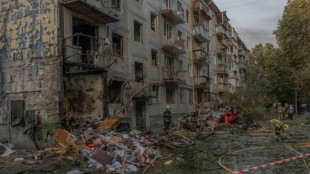 Russian attacks on Kyiv kill 9, wound more than two dozen
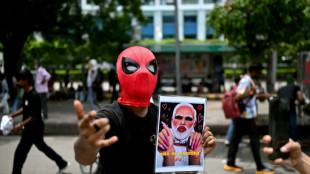
 Injured Australian swim star O'Callaghan pulls out of PanPacs
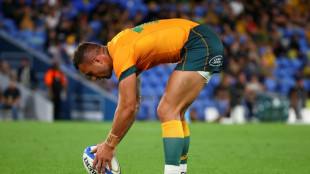
 California lifeguards wiped out from extreme weather

 FIFA scraps private investment plan after backlash: Infantino
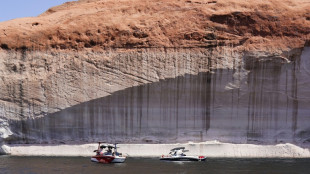
 South Africa's WAFCON hopes hang in the balance after dramatic draw

 Hunter Bell cruises to Commonwealth gold, Pathirage stuns javelin stars

 Amazon surges as US stocks shrug off bond yield worries

 Google rolls back new satellite image AI tool after backlash

 Ryu leads in bid for third straight major at women's British Open

 Fire-hit France region 'coming up for air' as main blaze calms
 Wembanyama to get signature shoe in Nike contract extension: reports
 Oil giants report blowout profits on war, warn high gas prices could persist
 Google launches new satellite image AI tool, alarming researchers
 Eddie Howe resigns as Newcastle boss to 'recharge'

 High winds hamper firefighting efforts in western Turkey

 Howe resigns as Newcastle boss

 Full-scale tour will benefit All Blacks, says coach Rennie

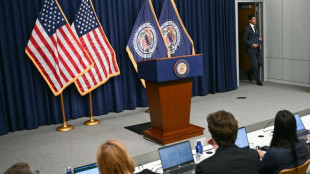 US Fed dissenters call for rate hikes over sustained inflation
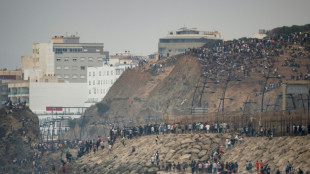 Trump and far-right seize on Spanish migration crisis

Seated on the pavement outside a bank in central Damascus, Abu Fares's face is worn with exhaustion as he waits to collect a small portion of his pension.
"I've been here for four hours and I haven't so much as touched my pension," said the 77-year-old, who did not wish to give his full name.
"The cash dispensers are under-stocked and the queues are long," he continued.
Since the overthrow of president Bashar al-Assad last December, Syria has been struggling to emerge from the wake of nearly 14 years of civil war, and its banking sector is no exception.
Decades of punishing sanctions imposed on the Assad dynasty -- which the new authorities are seeking to have lifted -- have left about 90 percent of Syrians under the poverty line, according to the United Nations.
The liquidity crisis has forced authorities to drastically limit cash withdrawals, leaving much of the population struggling to make ends meet.
Prior to his ousting, Assad's key ally Russia held a monopoly on printing banknotes. The new authorities have only announced once that they have received a shipment of banknotes from Moscow since Assad's overthrow.
In a country with about 1.25 million public sector employees, civil servants must queue at one of two state banks or affiliated ATMs to make withdrawals, capped at about 200,000 Syrian pounds, the equivalent on the black market of $20 per day.
In some cases, they have to take a day off just to wait for the cash.
"There are sick people, elderly... we can't continue like this," said Abu Fares.
- 'Meagre sums' -
"There is a clear lack of cash, and for that reason we deactivate the ATMs at the end of the workday," an employee at a private bank told AFP, preferring not to give her name.
A haphazard queue of about 300 people stretches outside the Commercial Bank of Syria. Some are sitting on the ground.
Afraa Jumaa, a civil servant, said she spends most of the money she withdraws on the travel fare to get to and from the bank.
"The conditions are difficult and we need to withdraw our salaries as quickly as possible," said the 43-year-old.
"It's not acceptable that we have to spend days to withdraw meagre sums."
The local currency has plunged in value since the civil war erupted in 2011, prior to which the dollar was valued at 50 pounds.
Economist Georges Khouzam explained that foreign exchange vendors -- whose work was outlawed under Assad -- "deliberately reduced cash flows in Syrian pounds to provoke rapid fluctuations in the market and turn a profit".
Muntaha Abbas, a 37-year-old civil servant, had to return three times to withdraw her entire salary of 500,000 pounds.
"There are a lot of ATMs in Damascus, but very few of them work," she said.
After a five-hour wait, she was finally able to withdraw 200,000 pounds.
"Queues and more queues... our lives have become a series of queues," she lamented.
O.Gutierrez--AT