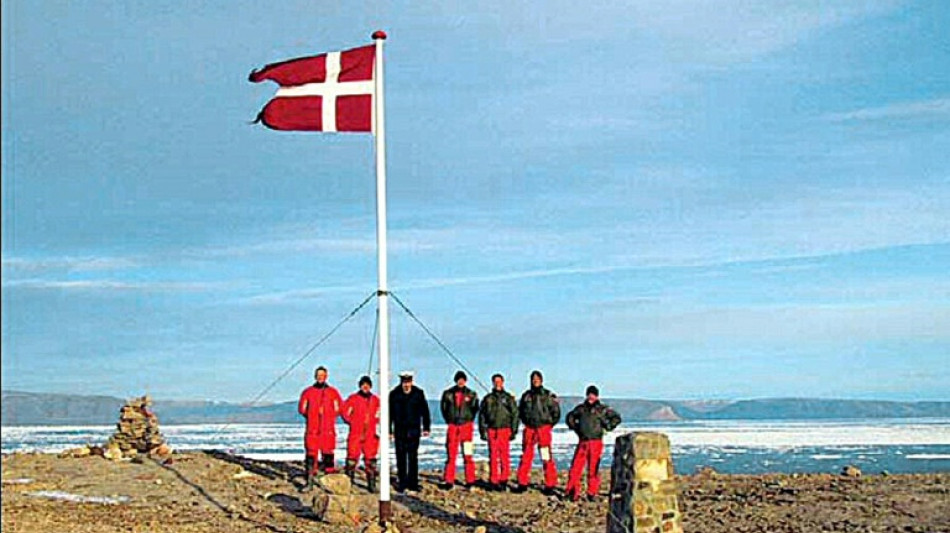
Canada, Denmark settle 'whiskey war' over Arctic island / Photo: Royal Danish Navy - SCANPIX/AFP/File

 Mbappe hits two as Real Madrid rout Sevilla

 Browns edge Ravens for division lead, Texans beat Jags

 Lyon go top of Ligue 1 as Monaco fall to first defeat of the season

 Venezuela opposition alliance reaffirms Nobel laureate Machado as leader
 'Street Fighter' wins N. America box office, buzzy doc stuns in 2nd

 NFL: Paris game to go ahead despite protests in France

 Arteta hails Arsenal 'finishers' after Madueke fells Forest

 Trump backs ally Netanyahu ahead of Israel's tight election

 Madueke strikes late as below-par Arsenal sink Forest
 Second day of street clashes in Milan

 Dupont's Toulouse hold off Exeter as English Champions Cup woes continue

 Zelensky speaks to US envoys amid Trump spat

 Paris police in new battles with protesters and looters

 Multiple deaths, injuries at western Canada military base: minister

 Boland strikes twice for Australia in rain-hit South Africa Test

 Marseille put Angers to the sword in Ligue 1
 Albanian PM refuses to quit as violent protests enter sixth day

 Chwalinska fights back to win Wuhan Open in title breakthrough
 Kulusevski on brink of return for Spurs after 17-month absence

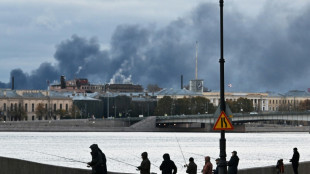 Ukraine sets Saint Petersburg refinery ablaze in large-scale drone attack
 Spain's in-form Chacarra wins DP World India Championship

 Kuwait announces maintenance closures in Nuzha, Surra and Rai

 Moody’s lifts OYO parent Prism outlook to positive before planned IPO
 RCom professional asks Supreme Court to revisit spectrum insolvency ruling

 Premium products and financing drive Navratri appliance demand

Canada and Denmark on Tuesday finally settled the largely good-natured "whiskey war" that was fought for decades with weapons such as flags and bottles of alcohol over a tiny, barren, and uninhabited outcrop in the Arctic.
The two sides formally announced a deal to split Hans Island and effectively create the first land border between Canada and Europe at a signing ceremony in Ottawa with Canadian and Danish foreign ministers.
Dividing up the kidney-shaped island and resolving the 49-year-old benign impasse was held up as a model for peacefully resolving territorial disputes -- contrasted with Russia's invasion of Ukraine.
"The Arctic is a beacon for international cooperation, where the rule of law prevails," Canadian Foreign Minister Melanie Joly told AFP.
"As global security is being threatened, it's more important than ever for democracies like Canada and Denmark to work together, alongside Indigenous peoples, to resolve our differences in accordance with international law."
The waggish row over the 1.3 square kilometer (0.5 square mile) Hans Island, which sits between Ellesmere and Greenland, dated back to 1973, when a marine boundary was drawn between Canada and Greenland, part of the Danish kingdom.
Danes and Canadians have visited the rock by helicopter over the past decades to lay claim to it, leading to diplomatic protests, online campaigns and even a Canadian call to boycott Danish pastries.
During those ministerial visits, each side would plant a flag and leave behind a bottle of whiskey or schnapps for the other to enjoy, along with comical notes.
"Many have called it the whiskey war. I think it was the friendliest of all wars," Joly said of the territorial dispute -- which had drawn in no less than 26 foreign ministers over the decades -- at a news conference with her Danish counterpart Jeppe Kofod.
Kofod said that its resolution, however, comes at a time when "the ruled-based international order is under pressure" and democratic values "are under attack."
- 'Playing by the rules' -
"We see gross violations of international rules unfold in another part of the world," he said, alluding to the war in Ukraine.
"In contrast, we have demonstrated how longstanding disputes can be resolved peacefully by playing by the rules," Kofod said, adding that he hoped Canada and Denmark's experience will "inspire other countries to follow the same path."
"This sends a strong signal: diplomacy and the rule of law actually works, and that great result can be achieved by following the rules."
As they exchanged bottles on Tuesday, Joly and Kofod laughed off suggestions that Canada might join the EU now that the two share a land border.
Joly quipped that a Canadian singer would surely enter the next Eurovision Song Contest, while Kofod offered: "Welcome Canada to the European continent!"
Snow-covered Hans Island is uninhabitable, but the onset of global warming is bringing more ship traffic to the Arctic, and opening it up to fishing and resources exploration -- although maybe not in the area of the island.
Arctic expert Michael Byers noted that "the island is so incredibly remote as to make it uneconomical to contemplate any serious activity there."
Putting off resolution of this unusual territorial dispute, however, made for good political theater in both countries, flaring up ahead of elections.
"It was an entirely risk-free sovereignty dispute between two NATO allies over an insignificant, tiny island," Byers said.
Denmark had also feared that losing the ownership battle would undermine relations with Greenland, while Canada worried that a loss would weaken its negotiating position in a more consequential dispute with the United States over the Beaufort Sea, in far northwestern Canada, believed to be rich in hydrocarbons.
More recently, Canadian Prime Minister Justin Trudeau "has not made Arctic sovereignty part of his brand," in contrast to his predecessor, Byers said. "So that reduced the temperature, at least from our side."
"But most importantly, Russia invaded Ukraine, and that created an opportune moment to tell the world that responsible countries settle territorial disputes in a peaceful way," he said.
L.Adams--AT