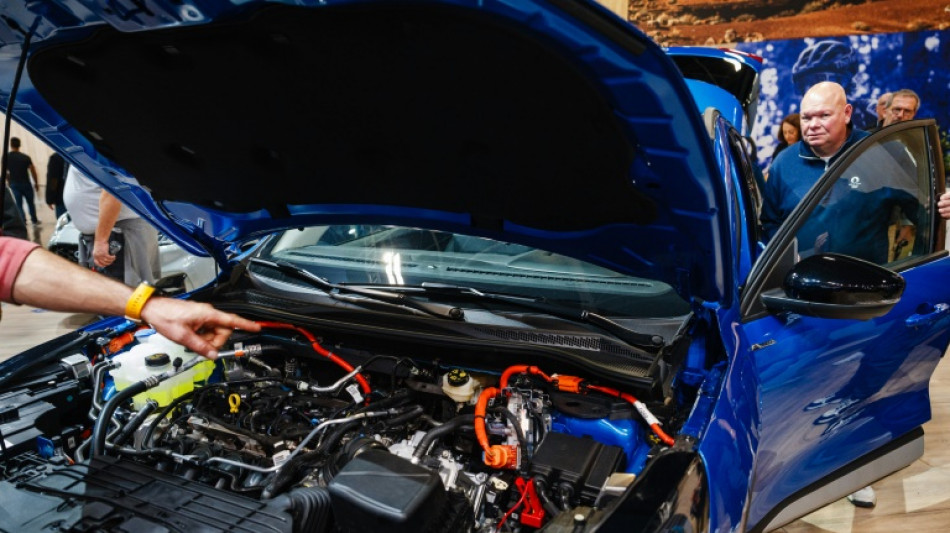
Automakers shift gears after Trump tariffs / Photo: Dimitar DILKOFF - AFP/File

 Hunter Bell cruises to Commonwealth gold, Pathirage stuns javelin stars

 Amazon surges as US stocks shrug off bond yield worries

 Google rolls back new satellite image AI tool after backlash

 Ryu leads in bid for third straight major at women's British Open

 Fire-hit France region 'coming up for air' as main blaze calms

 Wembanyama to get signature shoe in Nike contract extension: reports

 Oil giants report blowout profits on war, warn high gas prices could persist
 Google launches new satellite image AI tool, alarming researchers

 Eddie Howe resigns as Newcastle boss to 'recharge'
 High winds hamper firefighting efforts in western Turkey

 Howe resigns as Newcastle boss

 Full-scale tour will benefit All Blacks, says coach Rennie

 US Fed dissenters call for rate hikes over sustained inflation

 Trump and far-right seize on Spanish migration crisis

 Hamas agrees to disarm under Trump plan

 French, Italian winegrowers face earliest ever harvest

 Alarm over climate-linked low level of German waterways

 UK court rejects challenge against new Chinese embassy in London

 New York sues online prediction markets giant Kalshi

 Commerzbank agrees to talks with UniCredit after two-year standoff

 A rumour, a rush: chaos at Morocco border with Spain's Ceuta
 Fornaro Legal Releases Guidance to Help Businesses Maintain Clear Ownership Records During Growth

 Hamas agrees to disarm: what are the challenges ahead?
 Turkey fights to last major blaze inland from Bodrum
 Japan probe made closest-ever asteroid flyby: space agency

Automakers have already started to adapt to the 25-percent tariff imposed on car imports by US President Donald Trump, from pausing production to raising prices or halting certain models.
The additional levy came into effect on Thursday and applies to all cars that are not manufactured in the United States.
Bank of America estimates that some 7.3 million vehicles, or eight percent of global auto sales, will get hit by the tariff.
Ford CEO Jim Farley said in February that the tariffs will expose automakers to a "lot of cost and a lot of chaos".
Similar tariffs on car parts will also gradually come into effect.
- Sticker shock, sales slump? -
The tariffs raise two fundamental questions for the US auto market: by how much will prices rise and to what extent will consumers buy fewer vehicles?
Volkswagen has already informed its US dealers that it will add an "import fee" to cars it ships into the country from Europe and Mexico, according to trade publication Automotive News.
Bank of America estimates that US vehicle prices would rise by about $10,000 if manufacturers fully pass on the cost of tariffs and maintain their profit margins.
"However, we don't expect consumers would absorb the price increase in full," said analysts at the bank.
Carmakers "are more likely to sell vehicles at breakeven until they rebalance the production footprint", it said, estimating that US consumers would see price hikes of around $4,500.
US consumers rushed to dealerships to purchase or order vehicles before the tariffs entered into force.
Mid-range imported vehicles, such as the Chevrolet Silverado pick-up and the Toyota Rav4 SUV, are most likely to feel the pinch from higher tariffs.
But even luxury manufacturers like Porsche could have trouble absorbing the cost of tariffs on their low-end models, such as the German automaker's Macan SUV, said Cigdem Cerit, an auto industry expert at Fitch Ratings.
Ferrari was the first carmaker to announce a hike in prices -- as much as 10 percent -- on vehicles sold in the United States, its top market.
Ford, one of the companies that manufactures most in the United States, has seized the moment to launch an advertising campaign with the tag line "From America, For America".
- Canada-Mexican chaos -
US automakers -- Ford, GM and Jeep-maker Stellantis -- have all called on Trump to ease the tariffs. That is because they developed supply chains and factories in Canada and Mexico which have for decades enjoyed free trade arrangements with the United States.
But now the free trade deal between the three countries, the USMCA, applies only to US-made parts.
Stellantis, with also makes Chrysler, Dodge and RAM Truck vehicles, announced Thursday it would pause production at some plants in Canada and Mexico.
Its Chrysler plant in the Canadian city of Windsor, which employs 4,000 people and sits across a river from US auto capital Detroit, will pause production from April 7 to 21.
Nissan plans to stop selling in the United States the QX50 SUV and QX55 crossover coupe SUV, which are both made in its Mexican factory in Aguascalientes.
- Made in the USA -
Trump has stated that the goal of the tariffs is to encourage manufacturing jobs to return to the United States, but it is unclear whether that will be achieved.
Deloitte auto analyst Guillaume Crunelle said carmakers will have to ask themselves: "Is it more competitive to manufacture in the United States, with a weaker market, or to pay customs duties?"
South Korea's Hyundai and Stellantis plan to open or reopen factories, but the entry into force of the tariffs on Thursday has sped up announcements.
Nissan, which had planned to halt production of its Rogue SUV in Tennessee as part of cost-cutting measures, said it would in the end keep production there to avoid tariffs.
Volvo indicated that it would boost production at its factory in South Carolina and look at producing a new model there.
But such changes can take time -- several years to build a new production line in an existing facility. Carmakers must then persuade their suppliers -- who have also been weakened by the transition to electric vehicles -- to follow.
Bank of America estimates that an additional million vehicles could be produced in the United States on top of the 10.6 million that were assembled in the country last year, but recruiting sufficient workers could prove problematic.
A.Taylor--AT