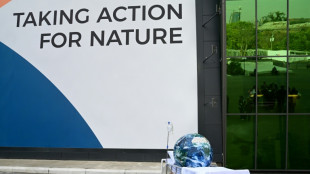
Poland mulls mines treaty exit, plans military training for men / Photo: Wojtek RADWANSKI - AFP

 Meta settles, leaving Snap sole defendant in new social media trial

 Chelsea manager Alonso dismisses talk of Estevao loan deal

 Thousands of students, workers hold peaceful protests in Italy

 Iraola glad to raise Liverpool fans' hopes but says hard work ahead

 Pope Leo makes history with US midterm vote

 Arsenal boss Arteta fires 'Disneyland' warning at Dowman after Fleetwood red card

 Russia's ice hockey stars come in from the cold after CAS ruling

 Wall Street tech rout deepens on doubts over AI spending
 'Life in the old dog': German economy grows more than expected
 England great Anderson asks what's 'wrong with me?' after Lancashire exit
 Markets lashed by tech rout as earnings fan AI fears

 Germans to join Europe's youth protest wave
 Novaya Gazeta closure part of Russia's 'giant military campaign': Muratov to AFP
 US oil giants report profit surge again on Iran war

 Tech sell-off deepens as earnings fan AI fears
 Carmaker Audi cuts outlook again on China, US woes
 Chase sparks Bangladesh collapse as West Indies on top in Mirpur

 BP net profit quadruples as Mideast war lifts oil prices
 Kulusevski says 'nervous system changes' behind Spurs return

 Marquez crashes, then tops second practice in Malaysia
 New home for orangutans rescued from Indonesia's burning forests

 Independent Russian newspaper Novaya Gazeta shuts under Kremlin pressure

 Thailand extends activist's jail term to more than 34 years
 China denies spying on Nvidia's Jensen Huang
 BP net profit quadruples on higher oil prices

Polish Prime Minister Donald Tusk on Friday announced a slew of measures aimed at boosting his country's defence, including a possible exit from a landmark anti-mines treaty and large-scale military trainings for men.
Poland, a staunch Ukraine ally, has been arming itself heavily as it eyes warily neighbouring Russia and amid calls from US President Donald Trump for European countries to take more responsibility for their own defence.
Warsaw is already far ahead of its allies in terms of military expenditure, aiming to spend 4.7 percent of its GDP on defence this year -- and now it mulls new measures.
"We are facing a very serious race, and it is a race for security," Tusk told the parliament.
"We must be aware that Poland must reach for the most modern possibilities, also related to nuclear weapons and modern unconventional weapons," he said, pledging Poland would use "every available opportunity to increase our defence".
A new military training scheme was intended to be ready by the end of the year "so that every adult man in Poland is trained in case of war," Tusk announced.
The trainings will turn "those who do not join the army to fully-fledged and valuable soldiers during a conflict," Tusk said, adding the goal was to have a military reserve force "adequate to potential threats".
Tusk, who this week has called on Europe to strengthen its defences to win the "arms race" with Moscow, has also backed withdrawing his country from a landmark treaty prohibiting the use of anti-personnel landmines.
"I will recommend a positive opinion for Poland to withdraw from the Ottawa Convention and possibly from the Dublin Convention," Tusk told lawmakers, referring to treaties on anti-personnel mines and on cluster munitions.
"Let's face it: it's not something nice, nothing pleasant. We know that very well," Tusk said.
"The problem is that in our environment, those we may be afraid of, or those who are at war, they all have it," he added.
- Constitutional amendment -
Designed to be buried or hidden on the ground, anti-personnel mines often mutilate victims who are not immediately killed and aid groups have decried their long-term impact on civilians.
The Anti-Personnel Landmines Convention, also known as the Ottawa Convention, prohibits the use, stockpiling, production and transfer of landmines.
At least two NATO countries, Finland and Lithuania -- both also bordering Russia -- have in the past months mulled exiting from the Ottawa Convention.
Lithuania on Thursday has quit the treaty banning cluster bombs citing security concerns over a threat from Moscow, sparking outrage from human rights watchdogs.
Amnesty International called the move "disastrous", while Human Rights Watch said it was "alarming", and the International Committee of the Red Cross (ICRC) warned it "weakens vital protections for civilians".
But Tusk brushed off a potential backlash.
"We will not look at anyone. We will not fear anyone's criticism," he told the parliament.
Earlier on Friday, Polish President Andrzej Duda said he had submitted an amendment to anchor in the constitution a defence spending mark of four percent of GDP, twice NATO's current target.
Poland is far ahead of its allies in terms of military expenditure, aiming to spend 4.7 percent of its GDP on defence this year.
The amendment would be "a guarantee that these expenses will actually be carried out," Duda, allied with the conservative right-wing opposition, told reporters.
Tusk said the proposal should be "analysed very seriously" but did not say if his ruling coalition would back it.
It would need a cross-party support of two-thirds of the lawmakers in the Polish parliament's lower chamber to enter into force.
A.Taylor--AT