Residents of Israel's north slowly returning home after Hezbollah truce
/ Photo: Menahem KAHANA - AFP

 Ferrand-Prevot bids to defend Tour de France Femmes title

 China factory activity slides as leaders seek spending boost
 Far right and far left battle for power in polarised Berlin

 Hamas agrees to deal for disarmament, Israel's withdrawal from Gaza

 Cables and cooling bring AI windfall to Indian suppliers

 Oil industry sees war windfall but girds for political blowback

 Spain safari park animals grazed calmly amid 'terror' of fire

 Casemiro keen to team with Messi at Miami

 Trump announces areement for disarmament of Hamas

 Apple tops estimates in CEO Cook's final quarter, but shares fall

 Turkey battles wind-fuelled wildfires on tourist coasts

 Venezuela begins demolishing buildings in quake zone

 Grynspan ahead in process to pick next UN chief: diplomats

 Thitikul leads from history-chasing Ryu at women's British Open

 Hundreds of migrants flood into Spain's Ceuta exclave from Morocco
 French minister defends expulsion order against Russian commentator

 Milei demands expulsion of foreigners expressing 'hate' against Argentina

 UK's highest court to hear Palestine Action's appeal against ban
 Hundreds of migrants swim to Spain's Ceuta territory from Morocco

 'Beginning of the end': Relief but no party as French wildfire winds down
 UEFA says will boycott World Cup over FIFA proposals
 Rashford says final goodbye to Barcelona ahead of Man Utd return

 History-chasing Ryu sets pace at women's British Open
 Italy's Po River valley on drought alert
 France, Spain eye wildfire reprieve as other blazes start up in Europe

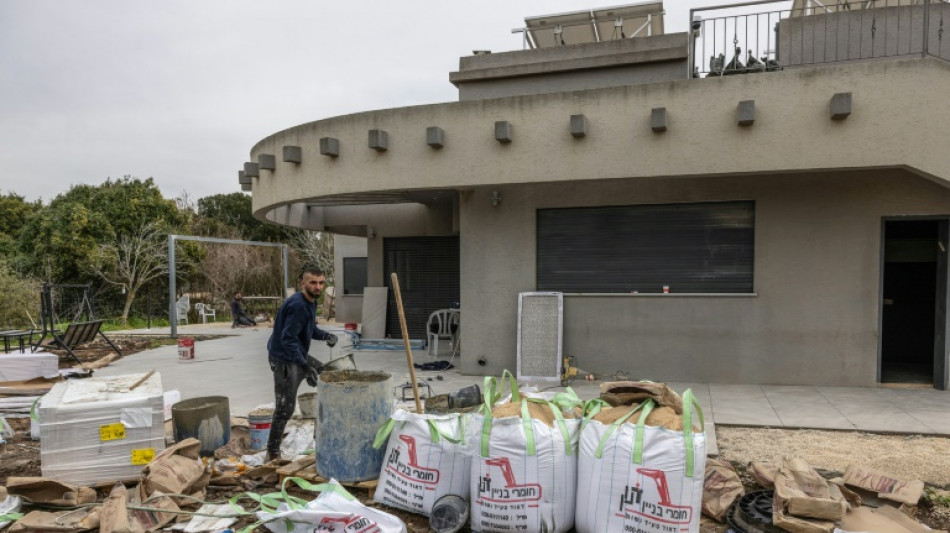
On a lush green hilltop on Israel's northern border with Lebanon, Carmela Keren Yakuti proudly shows off her home in Dovev, which she fled more than 16 months ago over fears of a Hezbollah attack.
"Now that everyone is back, it's an amazing feeling," said Yakuti, 40, standing on her freshly washed patio and breathing in the crisp country air.
"It's great here. We have a beautiful moshav, a beautiful view," she added, referring to what Israelis call a small agricultural community. "It's simply great to be back home."
On October 8, 2023, a day after Hamas's unprecedented attack on southern Israel triggered war in Gaza, Lebanon's Hezbollah group declared its support for the Palestinian militants and began firing rockets into northern Israel.
For their own protection, the Israeli military ordered Yakuti, her family, friends and neighbours to leave Dovev, and they were sent to live in a hotel in the city of Tiberius, further south.
In total, the hostilities with Iran-backed Hezbollah displaced around 60,000 residents of northern towns and villages, according to official data.
Half are yet to return home.
On the Lebanese side, more than one million people fled the south of the country, around 100,000 of whom are still displaced, according to the United Nations.
On November 27, 2024, after more than a year of hostilities, including two months of all-out war during which Israel sent ground troops into Lebanon, a truce agreement came into force.
Israeli authorities have said residents of northern border communities could return home from March 1.
Yakuti, who retrained as a beautician during the time she was displaced, said she immediately packed up her belongings, bid farewell to the "kind" hotel staff and moved back into her two-storey home.
From her living room and patio, she has a clear view of a Lebanese village that was emptied of its residents following evacuation calls issued by the Israeli army in September ahead of its ground offensive.
"I'm not afraid and not shaking. The army did its job and carried out its work," the mother of three said, adding: "I'm at peace with my decision to return here, and I wouldn't give up my home and my moshav even if the war continued."
- Rockets, mortars -
While many of Dovev's residents were returning this week, the scene was not so joyous in other communities along Israel's northern border.
In the kibbutz community of Hanita, Or Ben Barak estimated that only about 20 or 30 families out of around 300 had come back.
"At first, there was this kind of euphoria when they announced that we could return," said Ben Barak, who counts his grandparents among the founders of the 97-year-old kibbutz.
"But now people are also seeing that the place isn't quite ready for living yet."
Ben Barak, 49, pointed out the multiple places where rockets and mortars had fallen, as well as the damage done by the heavy Israeli military vehicles such as tanks that passed through on their way into Lebanon.
Asked if he was concerned about security now the war was over, Ben Barak said that what worried him more was "what will happen with the community. Who will come back, how they will come back, and how many will come back?"
"I believe that in Lebanon, the army fought very hard and did everything it needed to do, but the real question is how to maintain this quiet," he said.
"That's the challenge -- how to guarantee a peaceful life for the next 20 to 30 years. That's the challenge for the state, and that will also determine whether people stay here."
Just down the hill from the still abandoned streets of Hanita, the town of Shlomi appeared to be returning to life.
At Baleli Falafel, Yonatan Baleli stuffed pita with salad and tahini as a long line of hungry customers waited to blaring trance music.
"I feel much safer than before, but do I feel 100 percent safe? No," said Ronit Fire, 54.
"It's not pleasant to say this, but it feels like it's just a matter of time," she said, adding that she believed there would be another war in the future.
"The next time will come again at some point," said Fire.
H.Thompson--AT