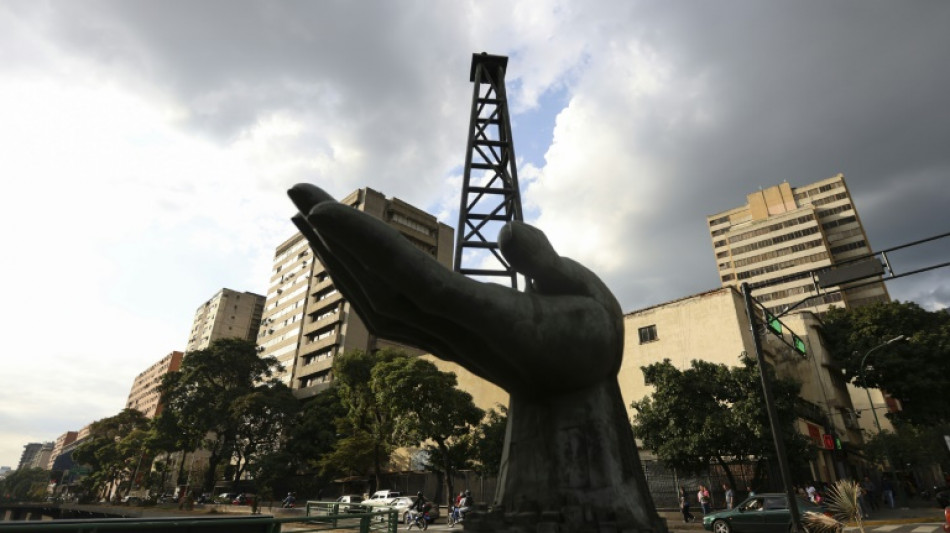
What now for Venezuela with Chevron's oil permit in peril? / Photo: Pedro MATTEY - AFP

 Amazon beats expectations with cloud and AI growth
 De Minaur beats teen Hewitt in all-Aussie Washington clash

 Davies completes Commonwealth double in 5,000m, LaFond leaps to historic Dominica gold
 Blowout Microsoft results lift US stocks as oil retreats
 De Minaur beats teen Hewitt in Washington all-Aussie clash

 England's Stones joins Inter Milan on free transfer
 Renewed Iran war raises US missile supply concerns

 Nobel Peace Prize winner Murad says justice for Yazidis far too slow

 Mexico escalates war against smelly seaweed on Caribbean beaches

 Selection process for next UN chief under way
 UEFA says will boycott World Cup if FIFA pushes private investor proposal
 Volunteers rush to feed scared animals in fire-stricken France
 Russian missile strike destroys family home, 10 feared dead

 Djokovic to make return at Cincinnati Masters

 Selection process for next UN chief begins
 Southern Europe 'becoming more flammable' in hotter climate, experts say
 Prada profits pinched as growth hard to chase
 Turkey confronts growing wildfires on tourist coasts

 Stocks climb on earnings and rates, oil retreats

 Russia blamed for missile that blasted crater in Polish field
 US economic growth slows in second quarter, missing expectations

 Russia adds Telegram founder Durov to 'terrorist' blacklist

 MEXC Ventures Supports Alpha Arena's APAC Debut at Coinfest Bali
 Grealish hits back over Man City tour snub claims
 Firefighters battle to contain deadly Crete blaze in Greece
US President Donald Trump's threat to strip oil giant Chevron of a license to operate in Venezuela could plunge the troubled South American nation into deeper economic and social turmoil, experts say.
Chevron currently produces and exports almost a quarter of the million barrels per day from Venezuela, the country with the world's largest known oil reserves.
The company had only resumed Venezuela-US exports in 2022 after a sanctions exemption granted by Trump's predecessor Joe Biden.
At the time, the world was in the midst of an energy crisis sparked by Russia's invasion of Ukraine, and Venezuela's President Nicolas Maduro had pledged to allow fair elections.
It is a promise much of the world, including Trump, considers Maduro to have broken.
So what are the implications of Trump's decision to revoke Chevron's license to operate in Venezuela?
- For Venezuela -
Experts say the loss of Chevron-linked exports could spell recession and an even greater number of people fleeing the country.
For the government, it would immediately dry up already sparse foreign reserves -- a loss of some $150-200 million per month.
Energy expert Francisco Monaldi of Rice University in Texas told AFP "the hit to cash flow will undoubtedly have macroeconomic impacts."
Leonardo Vera, an economist at the Central University of Venezuela, said the loss of Chevron would mean that "a modest growth scenario for this year could turn into a recessive and highly inflationary one."
It's not difficult to imagine how bad things could get. Between 2014 and 2021, Venezuela's GDP fell by 80 percent, thanks in part to low oil prices and biting US sanctions.
During Trump's first term and his policy of "maximum pressure" Venezuela's oil production had reached its lowest point in decades, just 400,000 barrels per day in 2020 -- a return to 1934 levels.
Twelve years earlier, the petrostate was producing 3.5 million barrels per day, with the United States as its main client.
The economic and political turmoil has already forced nearly eight million Venezuelans -- about a quarter of the population -- to flee the country.
- For the United States -
Jorge Rene Pinon of the University of Texas's Energy Institute said there would be "no major change" for consumers in the United States, which will likely easily replace Venezuelan imports with those from Canada or elsewhere.
One big winner could be Venezuela's leftist ally and fellow US sanctions target Cuba.
Prioritizing cash from US exports, Venezuela's crude deliveries to Cuba had recently dropped to about a fifth of what they once were.
"Now you are going to see some of those barrels going to Cuba," said Pinon.
Under previous rounds of sanctions, Venezuela had been able to shift exports to major economies such as China and India, albeit at lower prices -- so Beijing and New Delhi could benefit too.
But with Chevron out in the cold, it is not clear the struggling PDVSA can keep up production solo.
- Can it be undone? -
"There is some uncertainty about which licenses are cancelled and what they might be replaced with," said energy analyst Rachel Ziemba.
Chevron's licence was last renewed on February 1, and remains valid for six months to August 1.
This leaves "time to negotiate" with the Trump administration, said Monaldi.
Trump has linked the move to his vow to deport some 600,000 Venezuelans from the United States.
In announcing the revocation of Chevron's license, Trump said Caracas had not been taking back its nationals "at the rapid pace that they had agreed to."
This causes some to believe there may yet be room to negotiate.
"It may be like what Trump did with Colombia or like he did with Mexico," exerting pressure "so that Maduro yields to what he wants," said Monaldi.
P.Smith--AT