A French-UK nuclear umbrella for Europe? Not likely, say analysts
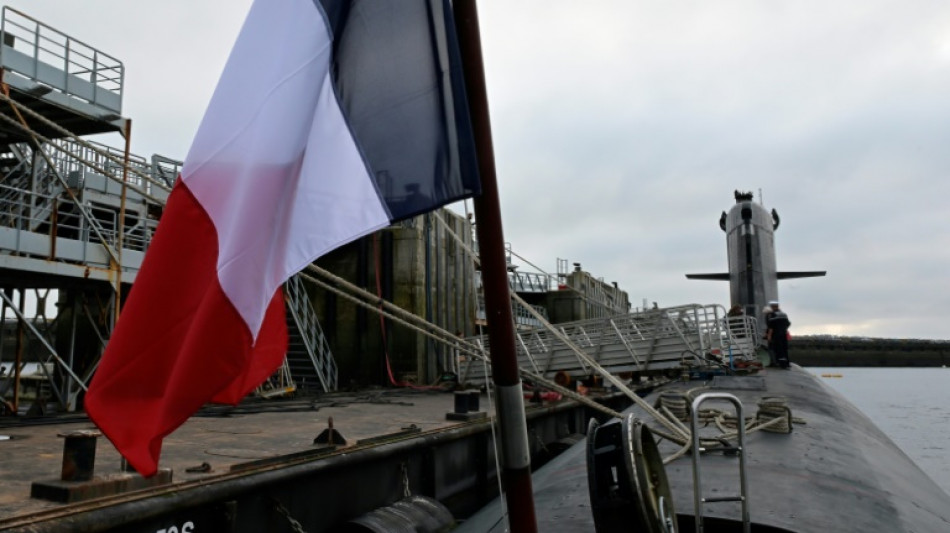
/ Photo: Damien MEYER - AFP

 Amazon beats expectations with cloud and AI growth

 De Minaur beats teen Hewitt in all-Aussie Washington clash

 Davies completes Commonwealth double in 5,000m, LaFond leaps to historic Dominica gold

 Blowout Microsoft results lift US stocks as oil retreats
 De Minaur beats teen Hewitt in Washington all-Aussie clash

 England's Stones joins Inter Milan on free transfer
 Renewed Iran war raises US missile supply concerns
 Nobel Peace Prize winner Murad says justice for Yazidis far too slow
 Mexico escalates war against smelly seaweed on Caribbean beaches
 Selection process for next UN chief under way

 UEFA says will boycott World Cup if FIFA pushes private investor proposal

 Volunteers rush to feed scared animals in fire-stricken France

 Russian missile strike destroys family home, 10 feared dead

 Djokovic to make return at Cincinnati Masters
 Selection process for next UN chief begins

 Southern Europe 'becoming more flammable' in hotter climate, experts say

 Prada profits pinched as growth hard to chase
 Turkey confronts growing wildfires on tourist coasts

 Stocks climb on earnings and rates, oil retreats

 Russia blamed for missile that blasted crater in Polish field
 US economic growth slows in second quarter, missing expectations

 Russia adds Telegram founder Durov to 'terrorist' blacklist
 MEXC Ventures Supports Alpha Arena's APAC Debut at Coinfest Bali
 Grealish hits back over Man City tour snub claims
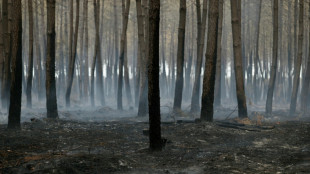
 Firefighters battle to contain deadly Crete blaze in Greece
France and Britain are unlikely to include European allies in their nuclear deterrence, analysts said after future German leader Friedrich Merz called for European defence "independence" and a possible "nuclear sharing".
Faced with a seismic strategy shift by the United States under Donald Trump, Europe could be facing a future without America's nuclear umbrella, which protected them throughout the Cold War and in the decades since.
Germany's election winner Merz said last week he wanted a discussion on "nuclear sharing" with France and Britain, western Europe's only nuclear powers. Germany cannot acquire its own nuclear weapons without violating an international treaty on non-proliferation (NPT) of which it is a signatory.
German potential access to French nuclear guarantees had already been floated in July 2022 -- months after Russia's attack on Ukraine -- by former German finance minister Wolfgang Schaeuble. He suggested making a financial contribution to a "nuclear deterrent at the European level".
On Thursday, French Defence Minister Sebastien Lecornu rejected any such pooling of France's nuclear weapons capability.
"It's French, and it will remain French," he told broadcaster Franceinfo.
France's nuclear doctrine says atomic weapons can be used if the country's vital interests are at stake. That is a call that the French president alone gets to make.
But that prerogative does not rule out dialogue with partners, President Emmanuel Macron suggested in 2020, highlighting "an authentically European dimension" of his country's vital interests.
Emmanuelle Maitre, at the French Foundation for Strategic Research (FRS), said there was indeed "compatibility" between French national interests and those of the rest of western Europe because of France's long-standing membership of the European Union and NATO.
"Because we are a member of a highly integrated regional community and of a military alliance, our vital interest will automatically align, to a large extent, with the vital interests of our neighbours," she told AFP.
There could be, however, "no assurance, no guarantee" on how a president would decide on "vital" interests if confronted with the risk of nuclear retaliation aimed at France, she cautioned.
- 'Neither British nor independent' -
In Britain, the prime minister alone decides on nuclear weapons use, despite the fact that the UK buys its nuclear missiles and warheads from the US.
But, in contrast to France, British nuclear weapons "are already part of NATO's extended deterrence guarantee", said Marion Messmer, a senior research fellow in the International Security Programme at Chatham House. In that sense, she told AFP, Britain already provides "some" nuclear protection for the rest of Europe.
Looming over the debate about any European nuclear force is the question of its credibility. The French and British arsenals are of limited size and there are doubts about first-strike capabilities.
There are also questions about how independent Britain's arsenal is from that of the United States.
"Britain's independent nuclear deterrent is neither British nor independent," wrote Norman Dombey, an emeritus physics and astronomy professor and nuclear weapons expert. "Both its missiles and its warheads are dependent on the US and US design. Nor is it a deterrent."
According to the Stockholm International Peace Research Institute (SIPRI), France has 290 nuclear warheads and Britain 225, compared to 3,708 American warheads.
France has four nuclear submarines as well as nuclear weapons-capable fighter jets, while the UK relies exclusively on four submarines for delivery.
"The biggest challenge would be the psychological component, because we know that Russia takes the US very seriously as an opponent, and we also know that Russia takes European states much less seriously," Messmer said.
Pending any doctrine change, France could take some limited practical steps to involve allies, such as inviting their participation in nuclear-weapons exercises with escort fighters or supply functions.
France could also choose to deploy nuclear-capable aircraft in allied countries, complicating Russian strategic calculations.
But French partners may not be overly interested in playing second fiddle to France's doctrine without having any say. "They can take what's on offer, but they can't make any demands whatsoever," said Maitre.
A.Ruiz--AT