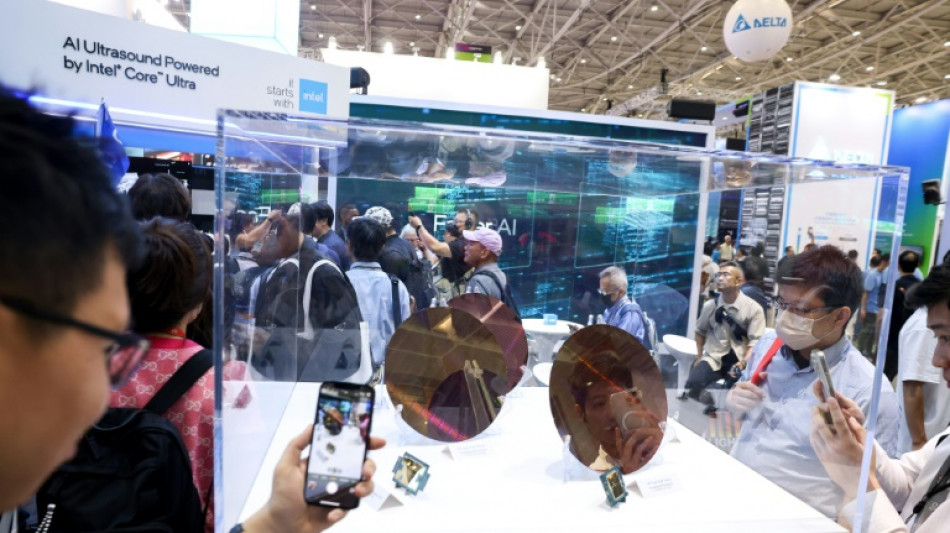
Trump's chip tariff threats raise stakes for Taiwan / Photo: I-Hwa CHENG - AFP/File

 Blowout Microsoft results lift US stocks as oil retreats

 De Minaur beats teen Hewitt in Washington all-Aussie clash

 England's Stones joins Inter Milan on free transfer
 Renewed Iran war raises US missile supply concerns

 Nobel Peace Prize winner Murad says justice for Yazidis far too slow

 Mexico escalates war against smelly seaweed on Caribbean beaches

 Selection process for next UN chief under way
 UEFA says will boycott World Cup if FIFA pushes private investor proposal

 Volunteers rush to feed scared animals in fire-stricken France

 Russian missile strike destroys family home, 10 feared dead

 Djokovic to make return at Cincinnati Masters

 Selection process for next UN chief begins
 Southern Europe 'becoming more flammable' in hotter climate, experts say

 Prada profits pinched as growth hard to chase
 Turkey confronts growing wildfires on tourist coasts

 Stocks climb on earnings and rates, oil retreats

 Russia blamed for missile that blasted crater in Polish field

 US economic growth slows in second quarter, missing expectations

 Russia adds Telegram founder Durov to 'terrorist' blacklist

 MEXC Ventures Supports Alpha Arena's APAC Debut at Coinfest Bali

 Grealish hits back over Man City tour snub claims

 Firefighters battle to contain deadly Crete blaze in Greece
 Chelsea sign France defender Lacroix from Crystal Palace

 Root named England Test captain, Fleming appointed coach

 May, June heatwaves caused 2,877 extra deaths in England: govt
US President Donald Trump's threat of tariffs on semiconductor chips has complicated Taiwan's bid to remain a global powerhouse in the critical sector and stay onside with key backer Washington, analysts said.
Since taking office last month, Trump has warned of sweeping tariffs against some of his country's biggest trade partners to push companies to shift manufacturing to the United States and reduce its huge trade deficit.
The latest levies announced last week include a 25 percent, or higher, tax on imported chips, which are used in everything from smartphones to missiles.
Taiwan produces more than half of the world's chips and nearly all of the most advanced ones, making the island essential to global supply chains.
The island's economic importance has been described as a "Silicon Shield" against an invasion or blockade by China, which claims it as part of its territory and has threatened to use force to bring it under its control.
"Taiwan's economic security depends heavily on its leadership in semiconductor manufacturing, which it has been using strategically to maintain its importance in global supply chains," said Julien Chaisse, an international trade expert at City University of Hong Kong.
"I think that Trump's tariff threats make this strategy much more complicated. For instance, Taiwan could face pressure to make concessions."
Despite strong bipartisan support in the US Congress for Taiwan, there are fears Trump might not consider the island worth defending if China attacked.
Trump has accused Taiwan of stealing the US chip industry and suggested it should pay the United States for its protection.
Taiwan President Lai Ching-te has already vowed to boost investment in the United States to reduce the trade imbalance and spend more on the island's military, while his government is also considering increasing US natural gas imports.
- Give it all away -
The pressure from Trump may accelerate the shift of Taiwanese chip production to the United States, said Wayne Lin of Witology Markettrend Research Institute in Taipei, but he added it would take years to build new foundries.
Taiwan's TSMC, which is the world's largest chipmaker, has long faced demands to move more of its production away from Taiwan.
The company has pledged to invest more than $65 billion in three factories in Arizona, one of which began production in late 2024.
TSMC plans a second facility in Japan and last year it broke ground on its first European plant.
But there are concerns Taiwan could lose its "silicon" protection if its companies build too many factories overseas.
"It's a very dicey situation that they're in," Dan Hutcheson, a California-based senior research fellow at specialist platform TechInsights, told AFP.
"It's in (Taiwan's) interest to move some of their manufacturing (to the United States), but not to give it all away, because if they give it all away, then they lose their importance."
- Recession threat -
Taiwan's government is still calculating the potential impact of Trump's tariffs and has flagged support for affected industries.
One determining factor would be whether levies are applied only to chips shipped to the United States or also on chips in finished products.
A fraction of Taiwan's $165 billion in chip exports last year went directly to the United States, official data show.
The vast majority were sent to other countries where they were put into electronic products for export.
"A 25 percent tariff is significant, but it is unlikely to be a game changer for Taiwan's semiconductor industry, certainly in the short term," Robyn Klingler-Vidra, an innovation policy expert at King's College London, told AFP.
But, she warned, the tariffs "will likely have broader global supply chain effects rather than simply curbing direct Taiwan-to-US exports".
Tariffs could raise the price of smartphones and laptops, hurting demand for chips and potentially triggering a "recession in the semiconductor industry", Hutcheson said.
Taiwan National Security Council chief Joseph Wu said last Thursday that US consumers would end up bearing the cost of the levies.
"I'm sure, eventually, the US will reconsider its decision," Wu said.
N.Walker--AT