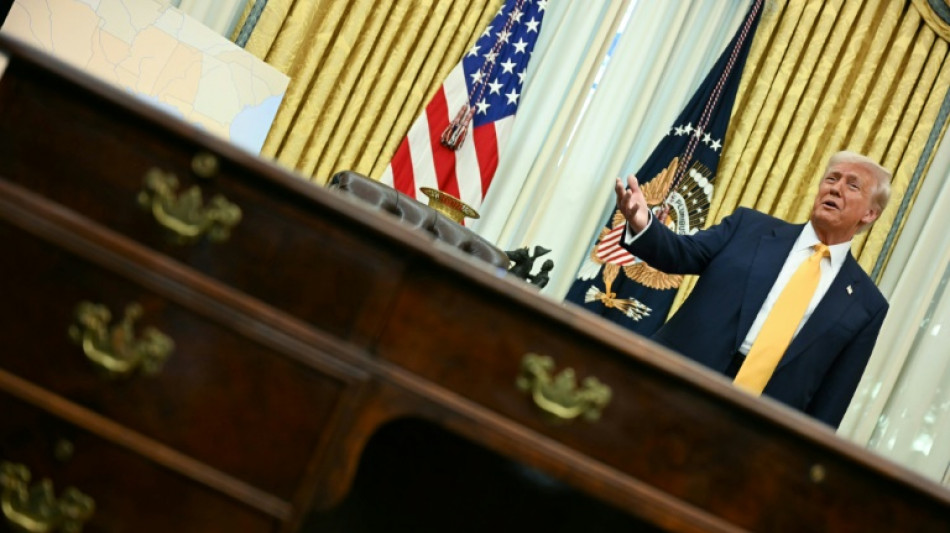
Trump shakes transatlantic alliance with Russia pivot / Photo: Jim WATSON - AFP

 Blowout Microsoft results lift US stocks as oil retreats
 De Minaur beats teen Hewitt in Washington all-Aussie clash
 England's Stones joins Inter Milan on free transfer
 Renewed Iran war raises US missile supply concerns
 Nobel Peace Prize winner Murad says justice for Yazidis far too slow
 Mexico escalates war against smelly seaweed on Caribbean beaches
 Selection process for next UN chief under way
 UEFA says will boycott World Cup if FIFA pushes private investor proposal

 Volunteers rush to feed scared animals in fire-stricken France
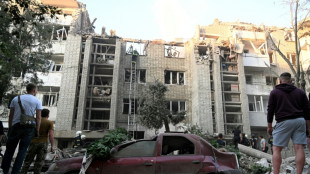 Russian missile strike destroys family home, 10 feared dead
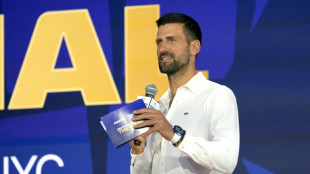 Djokovic to make return at Cincinnati Masters
 Selection process for next UN chief begins
 Southern Europe 'becoming more flammable' in hotter climate, experts say

 Prada profits pinched as growth hard to chase
 Turkey confronts growing wildfires on tourist coasts

 Stocks climb on earnings and rates, oil retreats

 Russia blamed for missile that blasted crater in Polish field
 US economic growth slows in second quarter, missing expectations
 Russia adds Telegram founder Durov to 'terrorist' blacklist
 MEXC Ventures Supports Alpha Arena's APAC Debut at Coinfest Bali
 Grealish hits back over Man City tour snub claims
 Firefighters battle to contain deadly Crete blaze in Greece
 Chelsea sign France defender Lacroix from Crystal Palace

 Root named England Test captain, Fleming appointed coach
 May, June heatwaves caused 2,877 extra deaths in England: govt
Donald Trump's sudden shift on Ukraine has shaken the transatlantic alliance to its core. Now European leaders are crossing that same ocean in a desperate bid to shore it up.
French President Emmanuel Macron and British Prime Minister Keir Starmer will meet Trump separately at the White House this week to try to convince him to stick by Kyiv.
But fears are growing in European capitals that the bond forged from the ruins of World War II is on the verge of collapse as Trump pursues talks with Russian President Vladimir Putin.
In Trump, many see a president who has abandoned the traditional US view of a rules-based world order in favor of a nationalist, great power game with Moscow and Beijing.
That has caused panic on a continent that has relied on US security assurance for 80 years.
"The Europeans are running around with their hair on fire," Max Bergmann, director of the Europe, Russia and Eurasia program at the Washington-based Center for Strategic and International Studies, told AFP.
- 'Other side of the ocean' -
For his part, Trump insists that he is just seeking peace in Ukraine.
"I think that President Putin and President Zelensky are going to have to get together. Because you know what? We want to stop killing millions of people," Trump told reporters in the Oval Office on Friday.
But Trump's embrace of Kremlin talking points on Ukraine -- calling President Volodymyr Zelensky a "dictator without elections" and blaming Ukraine for Russia's 2022 invasion -- has caused alarm in Europe.
It has also reinforced suspicions that Trump is effectively pulling the plug on decades of US support for Europe. In Trump's view, European officials fear, the United States, Russia and China will instead look after their own spheres of influence closer to home.
"You know, it doesn't affect the United States very much. It's on the other side of the ocean," Trump added on Friday about the Ukraine war.
Even in his first term he threatened to pull out of the NATO military alliance and questioned why the United States spends huge amounts on keeping troops in Europe.
Trump's meetings with Macron on Monday and Starmer on Thursday could therefore be testy.
Macron said he would tell Trump not to be "weak" on Ukraine. Britain and France have both offered to send peacekeepers in the event of a deal to end the war, but Starmer has pushed for a US "backstop".
Trump for his part accused both leaders of doing "nothing" to end the Ukraine war over the past three years.
- 'Dangerous moment' -
Many Europeans are also realizing that the writing could be on the wall.
"We experience now quite a difficult and very dangerous moment when both parts of the transatlantic community, so to say, are getting more and more away from each other," Polish Prime Minister Mateusz Morawiecki told AFP at the Conservative Political Action Conference (CPAC) near Washington.
For Nigel Gould-Davies, Senior Fellow for Russia and Eurasia at the London-based International Institute for Strategic Studies, it was an "unprecedented transatlantic crisis."
"By negotiating with Russia over European heads and intervening in European politics, the United States is not only decoupling from, but deciding for and disrupting Europe," he said in a commentary.
The question now is whether Europe -- after years of talking about how they need to take more responsibility for their security umbrella in case of a rainy day -- will do so now that day has come.
Danish Foreign Minister Lars Lokke Rasmussen told AFP on Wednesday that Europe "has to do much more in order to defend ourselves, but also in order to support Ukraine. Because we are in a very, very critical period in world history."
The European Union's top diplomat Kaja Kallas on Tuesday separately urged the United States not to walk into "traps" set by Russia as it attempts to divide the West.
But for analyst Bergmann, it could also be a wake-up call for Europe.
"I think what is being asked of Europe now is not just to simply do a bit more -- but is for Europe to effectively take actions that would make it emerge, frankly, as a superpower," he said.
A.Clark--AT