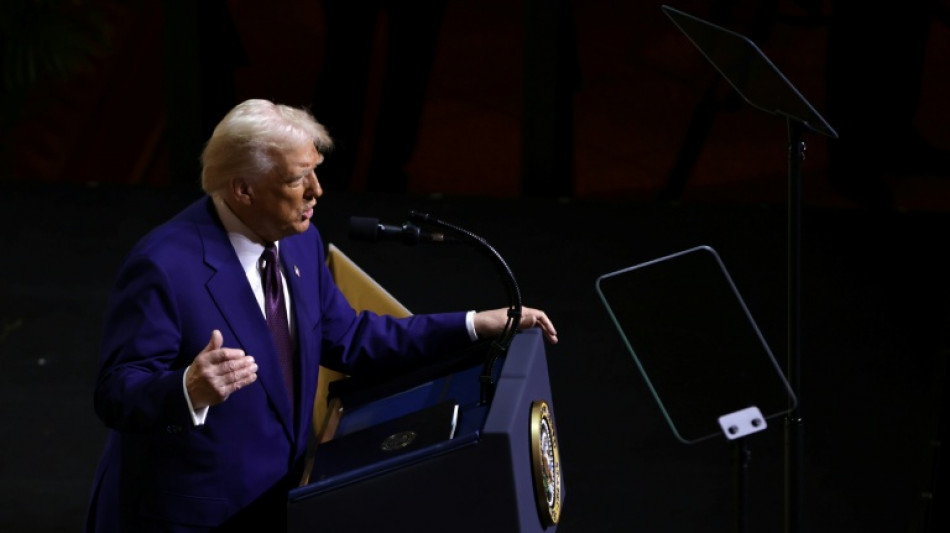
Tech, auto, medicines: who will pay Donald Trump's tariffs? / Photo: Samuel Corum - AFP/File

 Blowout Microsoft results lift US stocks as oil retreats
 De Minaur beats teen Hewitt in Washington all-Aussie clash

 England's Stones joins Inter Milan on free transfer

 Renewed Iran war raises US missile supply concerns

 Nobel Peace Prize winner Murad says justice for Yazidis far too slow

 Mexico escalates war against smelly seaweed on Caribbean beaches

 Selection process for next UN chief under way

 UEFA says will boycott World Cup if FIFA pushes private investor proposal

 Volunteers rush to feed scared animals in fire-stricken France
 Russian missile strike destroys family home, 10 feared dead

 Djokovic to make return at Cincinnati Masters

 Selection process for next UN chief begins

 Southern Europe 'becoming more flammable' in hotter climate, experts say

 Prada profits pinched as growth hard to chase

 Turkey confronts growing wildfires on tourist coasts

 Stocks climb on earnings and rates, oil retreats

 Russia blamed for missile that blasted crater in Polish field
 US economic growth slows in second quarter, missing expectations

 Russia adds Telegram founder Durov to 'terrorist' blacklist

 MEXC Ventures Supports Alpha Arena's APAC Debut at Coinfest Bali

 Grealish hits back over Man City tour snub claims

 Firefighters battle to contain deadly Crete blaze in Greece
 Chelsea sign France defender Lacroix from Crystal Palace

 Root named England Test captain, Fleming appointed coach
 May, June heatwaves caused 2,877 extra deaths in England: govt
After steel and aluminium, US President Donald Trump has set his sights on slapping 25 percent tariffs on semiconductors, cars and pharmaceuticals.
Trump has already slapped additional 10 percent tariffs on goods from China and has also threatened tariffs on Canada and Mexico, plus ordered a study into putting into place reciprocal tariffs.
Here's a look who would be hit the hardest if US import tariffs on semiconductors, cars and pharmaceuticals go into force.
- Semiconductors: Asia in the crosshairs
Semiconductors, or microchips, are the brains in our electronic devices and demand has soared with the development of AI, which relies on thousands of them to crank through reams of information.
Asia is a major centre of manufacturing of semiconductors.
The United States exported $70 billion of electronic components last year, but imported double that amount, according to the US Commerce Department.
Imports from Taiwan alone represented nearly $37 billion.
The island is home to chip manufacturing giant TSMC and a big portion of its factories. Tariffs could encourage it to diversify its production sites further. It already has plans to build three new factories in the United States.
Taiwanese President Lai Ching-te said last week that Taiwan would "expand investment and procurement in the United States to promote bilateral trade balance".
South Korea, home to Samsung, saw its exports of electronic components double last year to more than $8 billion, according the country's customs data. Its components are the country's second-largest export item to the United States behind cars.
"Disrupting the supply chain... would create serious challenges for the whole world, including the United States," said an executive of the trade association for South Korea's electronics industry.
- Everyone impacted by car tariffs -
The United States, the world's number two auto market behind China -- imported $269 billion in vehicles last year according to US Commerce Department figures.
Of those, $95 billion came from Mexico. Japan, South Korea, Canada and Germany are also major importers of vehicles into the United States.
US auto exports totalled only $72 billion.
Additional tariffs would affect all carmakers, with US automakers having factories in Mexico and Canada. US carmakers would also be affected through components suppliers located abroad, noted Matthieu Noel at the Roland Berger consultancy.
Laurel Broten, who heads up Canada's agency that attracts foreign investment, Invest in Canada, gave an example of an auto component that crossed the US-Canadian border eight times before being installed into a vehicle.
"Tariffs on 'Canadian cars' are also tariffs on US players in the supply chain," she told AFP.
Moreover, carmakers from all countries, including the United States, built factories "in Mexico to tap into lower wages", noted Noel.
For US consumers, "the price of vehicles will rise considerably. When one adds 25 percent import tariffs that can't be totally absorbed by margins," he said.
But many international brand cars are now made in the United States.
The world's largest carmaker, Japan's Toyota, sold 2.3 million vehicles in the United States last year. But more than half were manufactured in the United States, where it will soon open its eleventh factory.
German carmakers Volkswagen, BMW and Mercedes already manufacture SUVs in the United States.
Stellantis, which owns the Jeep, Ram, Dodge and Chrysler brands in addition to a number of European marques -- said it wants to boost its US production even before Trump's latest announcements.
- Pharmaceuticals: limited impact? -
Ireland alone accounted for 30 percent of US pharmaceutical imports in 2024. The country's favourable tax rates have attracted drugs manufacturers, including US firms.
Italy was the top source for US antibiotics imports, followed closely by China.
Nearly a quarter of Germany's pharmaceutical exports -- in particular vaccines and immunology products, head to the United States.
Some products are in very high demand by Americans, particularly the weight-loss treatments Ozempic and Wegovy made by Danish drugmaker Novo Nordisk.
But the drugs market is not like others, noted analysts at Moody's.
"Patients' medical needs, lack of substitutes, insurance coverage and doctor preferences limit the effects of price changes on demand," it said in a recent note.
"Most branded pharmaceutical companies have diversified manufacturing, including US facilities, and can absorb tariff increases thanks to high profit margins," it added.
US consumers might see more price increases on generic drugs made abroad as manufacturers have tight margins and would likely pass on the cost of tariffs.
A.Moore--AT