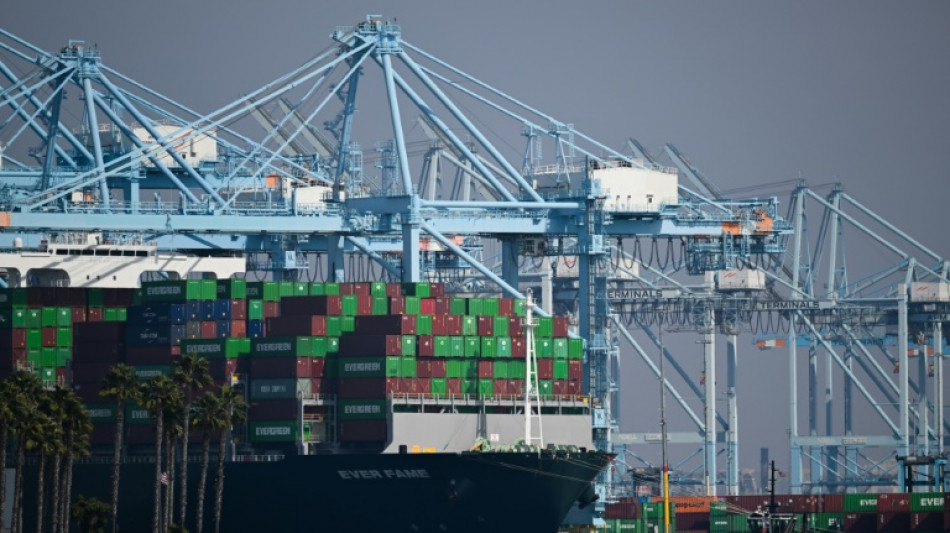
What are Trump's reciprocal tariffs and who may be hit? / Photo: Patrick T. Fallon - AFP/File

 Mammoth bones found on parched bed of Danube in Bulgaria

 Atletico complain to FIFA over Barca's Alvarez approach
 MEXC Lists Grvt (GRVT) with $60,000 Worth of GRVT and 10,000 USDT in Airdrop+ Rewards
 Musk plans major Republican midterm spending push: report
 George and Amal Clooney flee French home due to wildfire

 Howe set to leave Newcastle, with Al-Ahli's Jaissle to take over: reports

 Ugandan opposition leader in intensive care: wife

 France firefighters hopeful, as Spain ends national emergency

 Stocks diverge on earnings, as oil steadies

 AI data centre supplier Zhongji InnoLight slips on Hong Kong debut

 Eurozone economy grows despite Middle East war
 Singapore group will develop 'most promising' Ebola vaccine

 BMW profit down a third as carmaker plans job cuts

 Newcastle boss Eddie Howe leaves club: reports

 Japan quake toll hits 34 as survivors struggle in heat

 Seoul extends losses as most Asian markets drop, oil rises again

 New Zealand top diplomat draws Chinese embassy complaint in racism row

 Eggs back in India school meals after outcry

 Gambling.com Group Is Now Grandstand

 South Korea coach Hong grilled by MPs over World Cup flop
 Nolan's 'Odyssey' boosts sales of mythology tales in UK

 'It's exhausting': southwest Japan deals with second big quake in 10 years

 Russian strikes kill at least 8, wound more across Ukraine

 Samsung quarterly operating profit up 1,800% on AI boom

 Son at the double as MLS All-Stars beat Liga MX 4-3
President Donald Trump's plan for "reciprocal tariffs" on US trading partners are set to spark a flurry of negotiations that could bring reductions in levies -- but analysts warn that it also risks painful retaliation.
"This is every country, and essentially, when they treat us fairly, we treat them fairly," Trump told reporters.
What are the details of his plan and what consequences could they bring?
- What are reciprocal tariffs? -
Tariffs are taxes imposed on goods imported from another country.
As for reciprocal tariffs -- during election campaigning, Trump promised: "An eye for an eye, a tariff for a tariff, same exact amount."
"It doesn't matter whether it's strategic competitors like Communist China or allies like the European Union or Japan or Korea," a White House official told reporters Thursday.
"Every one of those countries is taking advantage of us in different ways, and the president characterizes this as a lack of reciprocal trade," the official added, speaking on condition of anonymity.
Reciprocal tariffs could mean hiking rates on imports to match the level that other countries apply to US products, and officials said the levies will be imposed country by country.
But besides considering the tariff rates other countries impose on US goods, Trump's plan will also look into non-tariff factors like value-added taxes (VATs).
- When will they be imposed? -
For now, Trump's memo calls for the commerce secretary and US trade representative, in consultation with the treasury chief and others, to study the issue and propose remedies.
Trump's commerce secretary nominee Howard Lutnick said Thursday that tariffs could start as soon as April 2, after studies on the issue were completed.
The White House official told reporters that the administration will begin by examining countries that have the highest trade deficits or most egregious imbalances with the United States.
The process could take weeks or months, and tariffs could be invoked under legal authorities involving national security, unfair trading or emergency economic powers.
"So far, it seems more like an invitation to negotiate," said Mercatus Center senior research fellow Christine McDaniel.
- Who may be hard-hit? -
Reciprocal tariffs might open the door to a broad tariff hike on emerging market economies who have high duties on US products, JPMorgan analysts expect.
The White House referred to countries like Brazil and India as it unveiled the latest tariff plan.
It pointed to the United States' ethanol tariff at 2.5 percent while Brazil charges an 18 percent rate on US ethanol exports, for example.
Officials also took aim at the European Union over its 10 percent tariff on imported cars in contrast to the United States' 2.5 percent levy -- and Trump called the bloc "absolutely brutal" on trade.
But analysts have pointed out that the United States has higher tariffs on other products such as light trucks.
- What are the complications? -
Using reciprocal levies to address non-tariff issues like VATs could raise the average effective tariff rate notably, Goldman Sachs analysts earlier said.
Analysts at the Tax Foundation noted that "VATs are border-adjusted, meaning they rebate tax on exports and impose tax on imports."
"Despite the appearance of subsidizing exports and punishing imports, however, a border-adjusted VAT is trade neutral," they said in a Wednesday report.
This could prove tricky in negotiations.
Maurice Obstfeld, senior fellow at the Peterson Institute for International Economics (PIIE), warned that other countries could retaliate if Trump doubled down on various levies.
"The more major countries retaliate, the more other countries will be tempted to join in," he told AFP.
US tariff hikes would also result in higher costs for importers.
- What is the goal? -
Obstfeld of PIIE said Trump's policy appears to be aiming to get countries to "discriminate in favor of the United States."
"Suppose that Brazil drops its tariffs on US autos, but keeps its tariffs the same on all foreign autos" for example, he added.
Analysts also note that the threat of tariffs creates uncertainty as a negotiating tactic. This contributes to a situation that ultimately weighs on American and foreign businesses.
The White House on Thursday did not rule out a separate "one-size-fits-all" levy down the road.
R.Lee--AT