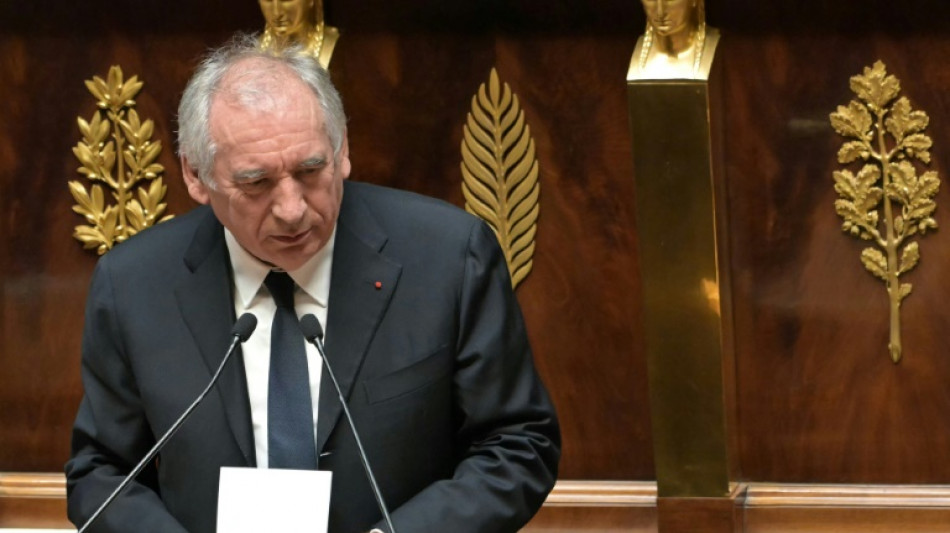
French PM survives no-confidence vote / Photo: Bertrand GUAY - AFP

 Stocks diverge on earnings, as oil steadies

 AI data centre supplier Zhongji InnoLight slips on Hong Kong debut

 Eurozone economy grows despite Middle East war
 Singapore group will develop 'most promising' Ebola vaccine

 BMW profit down a third as carmaker plans job cuts

 Newcastle boss Eddie Howe leaves club: reports

 Japan quake toll hits 34 as survivors struggle in heat

 Seoul extends losses as most Asian markets drop, oil rises again

 New Zealand top diplomat draws Chinese embassy complaint in racism row

 Eggs back in India school meals after outcry

 Gambling.com Group Is Now Grandstand

 South Korea coach Hong grilled by MPs over World Cup flop

 Nolan's 'Odyssey' boosts sales of mythology tales in UK

 'It's exhausting': southwest Japan deals with second big quake in 10 years

 Russian strikes kill at least 8, wound more across Ukraine

 Samsung quarterly operating profit up 1,800% on AI boom
 Son at the double as MLS All-Stars beat Liga MX 4-3

 Meet the astronomer digging into the Milky Way's 'fossils'

 French teen fined in Singapore 'straw licking' case

 AI data centre supplier Zhongji InnoLight falls on Hong Kong debut

 South Korea's women web sleuths fight AI deepfake porn

 Rushdie assailant convicted of terrorism charges

 Australian regulator says Telegram breached online safety law

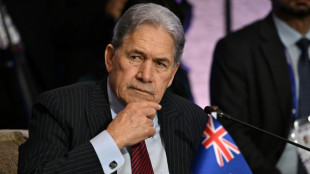 New Zealand foreign minister in racism row with Chinese ambassador

 JASCO and Bioz Celebrate a Longstanding Partnership Advancing Scientific Product Discovery

French Prime Minister Francois Bayrou on Wednesday survived a no-confidence vote in parliament, winning some breathing space after less than two months in office but still facing an uncertain future.
Bayrou, a veteran centrist named by President Emmanuel Macron in December to end months of political crisis, on Monday used a controversial constitutional article to ram his cost-cutting budget through parliament without a vote.
"This budget is an urgent step," Bayrou told the National Assembly.
But the use of this mechanism, article 49.3 of the constitution, allows opposition parties to put forward a no-confidence motion, and the bid to topple the government was duly proposed by the hard-left France Unbowed party (LFI), backed by the Communists and the Greens.
But while Bayrou is nowhere near having a majority in the National Assembly, the Socialists and far-right National Rally (RN) both said they would not back two no-confidence motions put forward by the hard left.
In the end, the motion concerning the budget gathered 128 votes, well short of the 289 votes needed to topple the government, which still needs approval from the upper-house Senate for the draft to become law.
A second no-confidence motion, targeted at the government's social security financing plan, was also on Wednesday's agenda, and also expected to fail.
But observers said that Wednesday's vote, while a victory, secured little more than a reprieve for the embattled premier.
"Passive support from both the Socialists and Marine Le Pen's far right for Bayrou will end once a 2025 budget is fully enacted in the next few days," risk analysis firm Eurasia Group said, giving a 70 percent chance that the government would "fall in the next few months".
- 'Trigger fresh elections' -
Jordan Bardella, head of the far-right RN said ahead of the vote that "we need to avoid uncertainty because many of our fellow citizens... are extremely worried about possible long-term instability".
The party's vice-president, Sebastien Chenu, said Wednesday that the RN wanted stability "until it is possible to trigger fresh elections", which could be in June, one year after the last legislative polls.
"As soon as we can go before the voters again, we must do so," he said.
Socialist leader Olivier Faure said his party decided against voting to topple the government over the budget, as it would have resulted only in France having "a prime minister further to the right".
The Socialists' stance is a major boost for Bayrou that could mark the end of a broad left-wing alliance including the Socialists and LFI party that had endured since the election campaign.
But in a symbolic move, the party leadership decided Monday to propose a separate no-confidence motion after Bayrou referred to migrants "flooding" France, using terminology previously used by the far right.
However, this has little chance of passing as it is expected to be rejected by right-wing parties.
Bayrou's predecessor Michel Barnier was toppled in a no-confidence vote late last year, leaving France in uncharted political waters.
The survival of Bayrou's government will be a relief for Macron, who has faced calls to resign since dissolving parliament last year, but who has insisted he will stay on until the end of his term in 2027.
Many analysts and even allies are still baffled by the president's decision to call snap parliamentary elections last summer, which gave the far right its biggest-ever foothold in a divided parliament.
The cost-cutting and tax-hiking budget has proved controversial in some quarters, with France's richest man, the luxury goods mogul Bernard Arnault, denouncing a planned special corporate tax.
Budget Minister Amelie de Montchalin said the government, now in possession of a budget, would do what it takes "to meet our 5.4 percent target" for the 2025 deficit as a percentage of GDP, after an estimated six percent last year.
Turbulent months remain ahead in French politics.
A verdict is due in far-right leader Marine Le Pen's trial over allegations of fake EU parliament jobs -- charges she denies -- on March 31, and if convicted she could be disqualified from the 2027 elections.
burs-jh/js
W.Stewart--AT