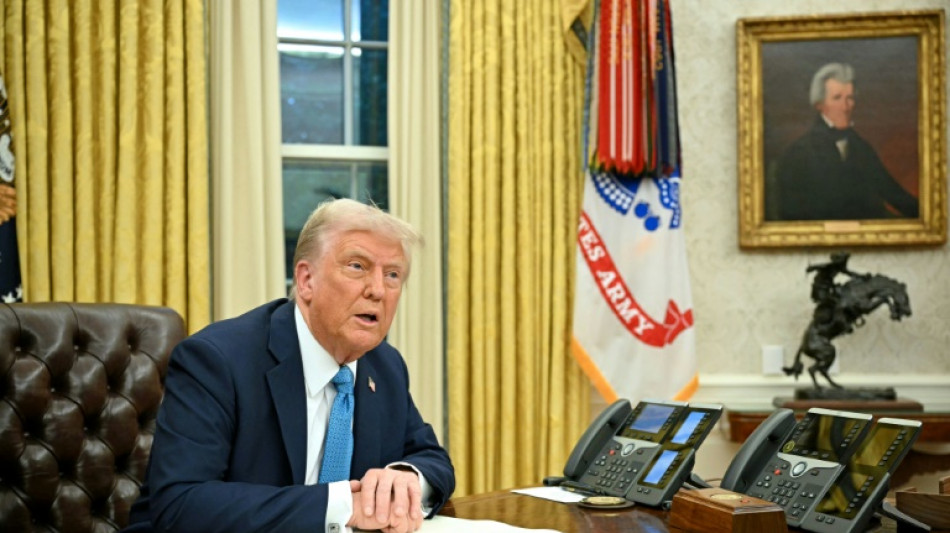
Autos, electronics: What will Trump's tariffs impact? / Photo: Mandel NGAN - AFP/File

 BMW profit down a third as carmaker plans job cuts

 Newcastle boss Eddie Howe leaves club: reports

 Japan quake toll hits 34 as survivors struggle in heat

 Seoul extends losses as most Asian markets drop, oil rises again

 New Zealand top diplomat draws Chinese embassy complaint in racism row

 Eggs back in India school meals after outcry

 Gambling.com Group Is Now Grandstand

 South Korea coach Hong grilled by MPs over World Cup flop

 Nolan's 'Odyssey' boosts sales of mythology tales in UK

 'It's exhausting': southwest Japan deals with second big quake in 10 years

 Russian strikes kill at least 8, wound more across Ukraine

 Samsung quarterly operating profit up 1,800% on AI boom

 Son at the double as MLS All-Stars beat Liga MX 4-3

 Meet the astronomer digging into the Milky Way's 'fossils'

 French teen fined in Singapore 'straw licking' case

 AI data centre supplier Zhongji InnoLight falls on Hong Kong debut

 South Korea's women web sleuths fight AI deepfake porn

 Rushdie assailant convicted of terrorism charges

 Australian regulator says Telegram breached online safety law

 New Zealand foreign minister in racism row with Chinese ambassador

 Anything but programmable: New cost-efficient EC-power-supply-series for the DIN rail by CAMTEC PS

 JASCO and Bioz Celebrate a Longstanding Partnership Advancing Scientific Product Discovery

 Messi returns to Miami training after World Cup break

 Idi Amin's grandson disqualified from Commonwealth boxing bout

 O'Connor wins Commonwealth heptathlon as Australia set new record for swimming golds

US President Donald Trump's sweeping tariffs on Canada and Mexico are set to roil supply chains for products ranging from automobiles to avocados -- with industries girding for cost increases.
US imports from both countries covered nearly $900 billion in goods as of 2023, and supply lines between the three North American neighbors -- who share a trade agreement -- are deeply integrated. Fresh tariffs would pose complications for businesses with a footprint across one or more countries.
Analysts expect Trump's 25 percent across-the-board tariffs on Canada and Mexico would hit the automobile and electronics sectors hard.
While Canadian energy exports have a lower 10 percent rate, this still marks an uptick as Washington previously did not impose tariffs on Canadian oil imports.
Mexico and Canada also account for significant US agriculture imports, meaning the duties could add to prices of popular foods like avocados and tomatoes.
- Canada: energy, autos -
Nearly 80 percent of Canadian goods exports go to the United States, amounting to some $410 billion in value, according to Statistics Canada.
The levies will hit Canadian vehicle and energy industries hard, given that they represent over 40 percent of Canada's exports to the United States.
The energy exports involve mainly crude oil and bitumen, alongside natural gas.
The auto sector in Ontario -- the nation's most populous province -- faces particular challenges.
This is because "various parts cross the border multiple times before ending up in a finished product," said Robert Kavcic, at Bank of Montreal, in a research note.
The United States imports construction materials from Canada, too, meaning tariffs could drive up housing costs.
More than 70 percent of imports of two key materials homebuilders need -- softwood lumber and gypsum -- come from Canada and Mexico, said National Association of Home Builders chairman Carl Harris.
"Tariffs on lumber and other building materials increase the cost of construction and discourage new development," he said.
- Mexico: autos, electronics -
Mexico's exports to the United States represented 84 percent of the goods it sold to the world last year, according to its National Institute of Statistics.
This amounts to over $510 billion.
The auto industry spanning vehicles and parts, alongside the electronics and machines sector, will likely see the greatest impact.
They send around half of all their production to the United States, analysts from Capital Economics said.
The latest 25 percent tariffs would also affect sectors like food.
Mexico supplied 63 percent of US vegetable imports and nearly half of US fruit and nut imports in 2023, according to the US Department of Agriculture.
More than 80 percent of US avocados come from Mexico -- meaning higher import costs could push up prices of items like guacamole.
- Basis for tariffs -
Trump invoked emergency economic powers in imposing tariffs on Canada, Mexico and China, arguing they had failed to stem the flow of illegal immigrants and drugs into the United States.
Chinese goods faced an added 10 percent tariff under the latest announcement.
But analysts have said that US tariffs on Canadian and Mexican imports could be incompatible with the United States-Mexico-Canada Agreement (USMCA), a trade deal Trump inked during his first presidential term.
Some anticipated that Trump's posturing could be a way for Washington to gain an upper hand ahead of a 2026 deadline to review the USMCA.
- Potential impact -
Economists warned that heavy US tariffs -- and retaliatory measures -- could tip Canada and Mexico's economies into recession, while the United States would face risks of a shallow downturn too.
"The tariffs send a clear message, reinforcing Trump's America First stance while using trade as a geopolitical tool," EY chief economist Gregory Daco told AFP.
Markets will view this as heightened political uncertainty while investors brace for inflationary pressures and supply chain disruptions, he said.
Mexican President Claudia Sheinbaum has already announced that her country would impose retaliatory tariffs.
"Mexico and Canada could challenge the move under USMCA, while China may counter with targeted restrictions," Daco said.
A bigger concern, he said, is that the situation could escalate into a prolonged and broader conflict.
Th.Gonzalez--AT