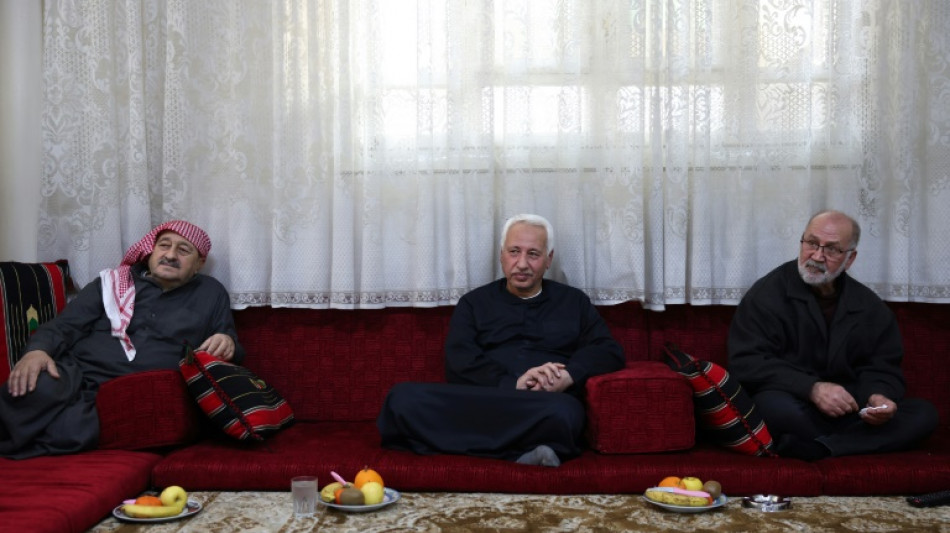
40 years on, Hama survivors recall horror of Assad-era massacre / Photo: OMAR HAJ KADOUR - AFP

 Japanese survivors deal with second quake disaster in 10 years

 Stranded boats, out-of-work fishermen as Danube hits record lows
 South Korea Hong coach grilled by MPs over World Cup flop

 Japan quake toll hits 30 as survivors struggle in heat
 Japan quake toll hits 28 as survivors struggle in heat
 AI data centre supplier Zhongji InnoLight tumbles on Hong Kong debut

 Drones and blackouts inflict a tense summer on Russia-annexed Crimea

 Australia ask for more information on FIFA sell-off plan

 South Korean stocks bounce after rout, oil holds gains on Mideast woes
 Stokes should return for 'one more Ashes': Australia coach McDonald

 Ngumoha scores as Liverpool beat Wrexham 1-0 in New York friendly

 Up to 23 feared dead in Japan quake
 Samsung operating profit up 1,800% in second quarter on AI boom

 De Zerbi wants Bergvall at Spurs, but can't promise starting role
 De Minaur tops Tsitsipas to set up Hewitt clash in Washington

 Cooperstown Dreams Park: Making History

 Japanese population below 120 million for first time in decades

 Meta misses profit expectations, sticks to massive AI spending

 Inequality best predicts how nations handle pandemics: study

 Brazil's Jair Bolsonaro denies authorizing deepfake for election message
 Boaduwaa strikes as Ghana beat WAFCON debutants Cape Verde

 US actor Jared Leto denies latest accusations of sexual assault

 Danube drops to 'historic lows' as fresh heatwave hits

 US Federal Reserve holds rates steady as inflation hawks call for hike

 Eala beats defending champ Fernandez in Washington
Hayan Hadid was 18 when soldiers arrested him in his pyjamas and took him for execution in Syria's Hama in 1982, during one of the darkest chapters of the Assad clan's rule.
"I've never really talked about that, it was a secret. Only my family knew," said Hadid, now a father of five.
In light of the December 8 ouster of Bashar al-Assad, "we can talk at last", he said.
On February 2, 1982, amid an information blackout, Assad's father and then leader Hafez launched a crackdown in Hama in central Syria against an armed Muslim Brotherhood revolt.
The banned movement had tried two years earlier to assassinate Hafez, and his brother Rifaat was tasked with crushing the uprising in its epicentre.
Survivors who witnessed extra-judicial executions told AFP that the crackdown spared no one, with government forces killing men, women and children.
The death toll of the 27 days of violence has never been formally established, though estimates range from 10,000 to 40,000, with some even higher.
"I had no ties with the Muslim Brotherhood, I was at school," said Hadid, now in his sixties.
But "my father was always very afraid for me and my brother", he said.
Hadid's cousin Marwan had been an influential figure in the Fighting Vanguard, an armed offshoot of the Brotherhood.
After days of battles, soldiers turned up in Hadid's neighbourhood and arrested around 200 men, taking them to a school.
When night fell, around 40 were called by name and forced into trucks, their hands tied behind their backs, he said.
When the vehicles stopped, he realised they were at a cemetery.
"'That means they are going to shoot us'," said the person next to him.
- 'Please, kill me' -
Blinded by the truck lights as he stood among rows of men for execution, Hadid said he felt a bullet zip past his head.
"I dropped to the ground and didn't move... I don't know how, it was an instinctive way to try to escape death," he said.
A soldier opened fire again, and Hadid heard a wounded man say, "please, kill me", before more shooting.
Miraculously, Hadid survived.
"I heard gunfire, dogs barking. It was raining," said the former steelworker, who now runs the family's dairy shop.
When the soldiers left, he got up and set off, crossing the Orontes River before arriving at his uncle's house.
"My face was white, like someone who'd come back from the dead," he said.
Forty-three years later, Bashar al-Assad's ouster opened the way to gathering testimonies and combing the archives of Syria's security services.
In 1982, Camellia Boutros worked for Hama's hospital service, managing admissions.
"The bodies arrived by truck and were thrown in front of the morgue. Dead, dead, and more dead. We were overwhelmed," said Boutros, now an actor.
Bodies bearing identity cards were registered by name, while others were recorded as "unknown" and classified by neighbourhood, she said.
Some bodies were kept at the morgue, while others were taken to mass graves.
"Hour by hour, the command would call wanting precise figures on how many soldiers, Muslim Brotherhood" and civilians had been killed, she said.
Boutros said the toll was "7,000 soldiers, around 5,000 Muslim Brotherhood" members, and some 32,000 civilians.
"All the relevant authorities" received the statistics, she said, adding that her registers were later taken away.
- 'Nobody was spared' -
From her office window, she said she saw people being shot dead in the street.
The Brotherhood is a conservative Sunni Muslim organisation with a presence around the region, while the Assads, who stem from the minority Alawite community, purported to champion secularism.
But not all the victims of the crackdown were Sunni. Boutros said a relative of hers, a Christian, was taken from his home and killed.
"Nobody was spared death in Hama... women, men, children, people young and old, were lined up against the wall and shot," she said.
Bassam al-Saraj, 79, said his brother Haitham, who was not involved with the Muslim Brotherhood, was "shot in front of his wife and two children" outside the city's sports stadium.
The retired public servant recalled how the elite Defence Brigades headed by Rifaat al-Assad had moved in on their neighbourhood.
Six months later, authorities detained his other brother, Myassar, rumoured to be a Brotherhood member.
"After two or three hours, they called me in to pick up his body," Saraj said, but authorities forbade them from holding a funeral.
Over more than half a century of rule, the Assads sowed terror among Syrians, imprisoning and torturing anyone even suspected of dissent.
Mohammed Qattan was just 16 when he took up arms with the Fighting Vanguard. He was arrested in February 1982 and jailed for 12 years.
"The regime's line was incompatible with the country's values," he said, citing mixed education in public schools as one of the policies he opposed.
- 'Kill everything in sight' -
Qattan said the authorities "discovered a Brotherhood headquarters" and a plan "to launch coordinated military action" in Hama and Aleppo further north.
After five days of fighting, "we started running out of ammunition and our frontline commanders started falling", he said.
When government forces retook any area, "it was as if they had orders to kill everything in sight", he said.
"The streets were littered with bodies of civilians, even women and children."
Qattan said a dozen relatives, mostly civilians were killed, including his two brothers, one of them a Brotherhood member.
Released from prison in 1993, he became a pharmacist and returned to studying history.
When Bashar al-Assad's 2011 crackdown on pro-democracy protests sparked war, Qattan joined an armed group, eventually seeking exile in Turkey.
He returned home after Assad's ouster last month.
What happened in Hama "was a crime that was planned" to bring the population to heel, he said.
"And it worked -- the regime hit Hama hard, and all the other cities learnt the lesson."
O.Ortiz--AT