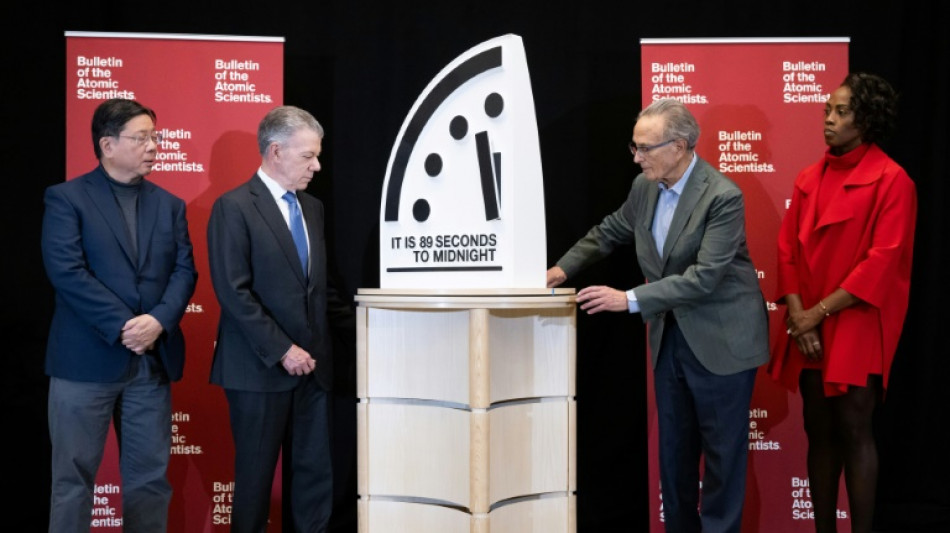
Doomsday clock ticks one second, closest ever to midnight / Photo: SAUL LOEB - AFP

 'It's exhausting': southwest Japan deals with second big quake in 10 years
 Russian strikes kill at least 8, wound more across Ukraine

 Samsung quarterly operating profit up 1,800% on AI boom
 Son at the double as MLS All-Stars beat Liga MX 4-3
 Meet the astronomer digging into the Milky Way's 'fossils'
 French teen fined in Singapore 'straw licking' case
 AI data centre supplier Zhongji InnoLight falls on Hong Kong debut

 South Korea's women web sleuths fight AI deepfake porn
 Rushdie assailant convicted of terrorism charges
 Australian regulator says Telegram breached online safety law

 New Zealand foreign minister in racism row with Chinese ambassador
 Cooperstown Dreams Park: Making History
 Japanese population below 120 million for first time in decades
 Meta misses profit expectations, sticks to massive AI spending
 Inequality best predicts how nations handle pandemics: study
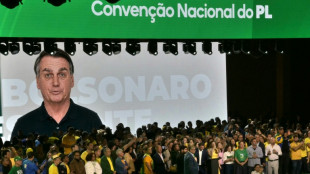
 Brazil's Jair Bolsonaro denies authorizing deepfake for election message
 Boaduwaa strikes as Ghana beat WAFCON debutants Cape Verde
 US actor Jared Leto denies latest accusations of sexual assault

 Danube drops to 'historic lows' as fresh heatwave hits
 US Federal Reserve holds rates steady as inflation hawks call for hike
 Eala beats defending champ Fernandez in Washington
 US man accused of destroying evidence by wiping phone at airport
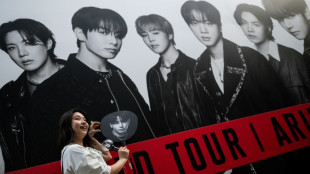 BTS pulls out of Grammys after Asian pop category introduction
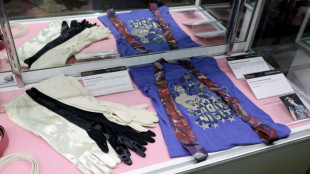 Judge orders Amy Winehouse's father to pay nearly £1mn to her friends
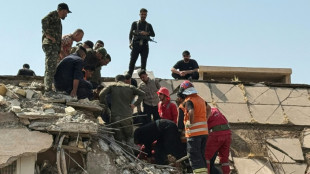
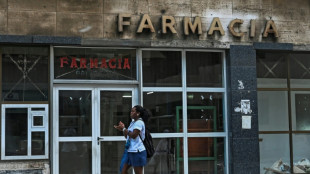 Crisis-hit Cuba opens pharmacies, gas stations to private firms
The "doomsday clock" symbolizing how close humanity is to destruction ticked one second closer to midnight Tuesday as concerns on nuclear war, climate and public health were jolted by US President Donald Trump's return.
The Bulletin of the Atomic Scientists, which set up the clock at the start of the Cold War, shifted the clock to 89 seconds to midnight, the closest it has ever been, a week after Trump's inauguration.
The clock was last moved to 90 seconds to midnight over nuclear-armed Russia's invasion of Ukraine in 2022. It was originally placed at seven minutes to midnight in 1947.
"At 89 seconds to midnight, the doomsday clock stands closer to catastrophe than at any moment in its history," said former Colombian president and Nobel Peace laureate Juan Manuel Santos, chair of The Elders, a group of major former leaders.
"The clock speaks to the existential threats that confront us and the need for unity and bold leadership to turn back its hands," he told a news conference in Washington to present the findings from the board of experts.
"This is a bleak picture. But it is not yet irreversible," he said.
Just days into his second presidency, Trump has already shattered norms on international cooperation.
Santos welcomed Trump's pledges for diplomacy with Russia and China. Trump has vowed to end the Ukraine war, which has raised fears of Russian use of nuclear weapons, by pressing both sides.
But Santos said that the US withdrawal from the Paris climate accord and World Health Organization set back the planet on two top risks.
The world just experienced another record-breaking year of high temperatures and major disasters.
Other countries could soon say that if the United States, the world's largest economy, "is not going to make an effort to limit the carbon emissions, why should I?" Santos said.
And with many people's memories fading of Covid-19, "we have to remind them what happened -- and what will happen will be worse, according to all the scientists," Santos said.
- Threats, and benefits, from AI -
Suzet McKinney, a public health expert on the board of Bulletin of the Atomic Scientists, said the risks of infectious disease was confounded by advances in artificial intelligence, which increase the risks that rogue actors could unleash biological weapons.
"As nation-states around the world and even our own government engage in practices that are sure to encourage rogue behavior and/or cripple our ability to curb the spread of infectious diseases, novel or otherwise, we cannot hide our heads in the sand," she told the news conference.
But Robert Socolow, a physicist who also serves on the board, said that the unveiling of Chinese intelligence firm DeepSeek -- which has rattled the United States -- could ultimately also pay dividends by reducing energy demand from the fast-growing field of AI.
The Chinese breakthrough may mirror "the kind of progress in semiconductor chips that reduce the energy demands of ordinary computing" in the analogue era.
But the experts also warned that artificial intelligence risked worsening disinformation.
"All of these dangers are greatly exacerbated by a potent threat multiplier -- the spread of misinformation, disinformation and conspiracy theories that degrade the communication ecosystem and increasingly blur the line between truth and falsehood," said Daniel Holz, chair of the board.
A.Taylor--AT