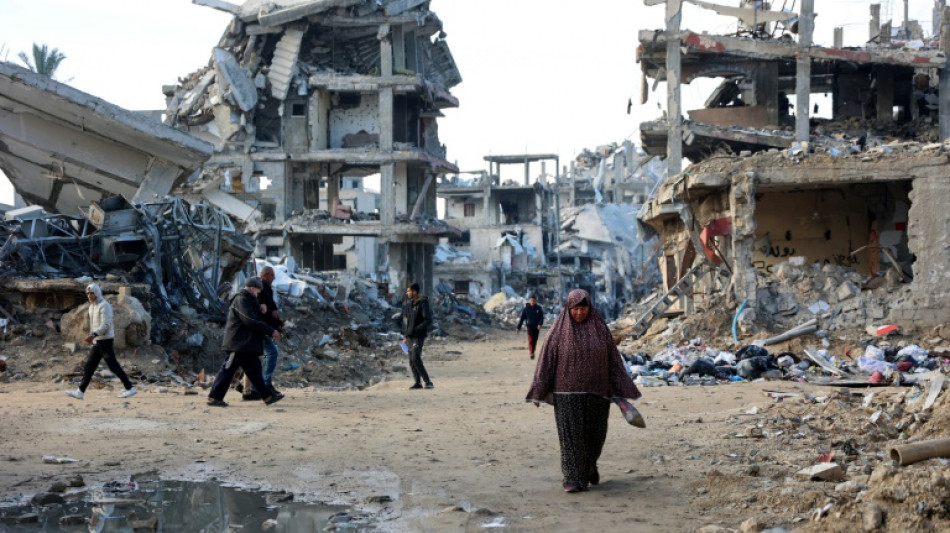
Gaza development put back 60 years by war: UNDP chief / Photo: Omar AL-QATTAA - AFP

 Stokes should return for 'one more Ashes': Australia coach McDonald

 Ngumoha scores as Liverpool beat Wrexham 1-0 in New York friendly

 Up to 23 feared dead in Japan quake

 Samsung operating profit up 1,800% in second quarter on AI boom

 De Zerbi wants Bergvall at Spurs, but can't promise starting role

 De Minaur tops Tsitsipas to set up Hewitt clash in Washington

 Japanese population below 120 million for first time in decades

 Meta misses profit expectations, sticks to massive AI spending

 Inequality best predicts how nations handle pandemics: study

 Brazil's Jair Bolsonaro denies authorizing deepfake for election message

 Boaduwaa strikes as Ghana beat WAFCON debutants Cape Verde

 US actor Jared Leto denies latest accusations of sexual assault

 Danube drops to 'historic lows' as fresh heatwave hits

 US Federal Reserve holds rates steady as inflation hawks call for hike

 Eala beats defending champ Fernandez in Washington

 US man accused of destroying evidence by wiping phone at airport

 BTS pulls out of Grammys after Asian pop category introduction

 Judge orders Amy Winehouse's father to pay nearly £1mn to her friends
 Crisis-hit Cuba opens pharmacies, gas stations to private firms

 Pro-Kremlin TV commentator ordered to leave France, under house arrest

 'I started crying': Battle to tame fresh blaze near French seaside

 Former top US Covid expert Fauci declines to answer hostile Senate questioning

 Neymar says his time playing for Brazil 'is over'

 F1 boss says season to finish in Europe if Gulf races cancelled
 Spanish wildfire evacuees go home as France hit by new heat alert

The Israel-Hamas war has put back development in Gaza by 60 years and mobilising the tens of billions of dollars needed for reconstruction will be an uphill task, the United Nations said.
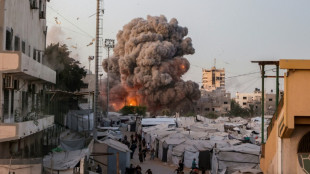
Around two-thirds of all buildings in the Gaza Strip have been destroyed or damaged, and removing the estimated 42 million tonnes of rubble will be dangerous and complex, the head of the UN Development Programme told AFP.
"Probably between 65 percent to 70 percent of buildings in Gaza have either been entirely destroyed or damaged," Achim Steiner said in an interview at the World Economic Forum annual meeting in the Swiss ski resort town of Davos.
"But we're also talking about an economy that has been destroyed, where we estimate that roughly 60 years of development have been lost in this conflict over 15 months.
"Two million people who are in the Gaza Strip have lost not only their shelter: they've lost public infrastructure, sewage treatment systems, freshwater supply systems, public waste management. All of these fundamental infrastructure and service elements simply do not exist."
And for all these towering numbers, Steiner stressed: "Human desperation is not just something that you capture in statistics."
- 'Years and years' -
The fragile ceasefire agreement between Israel and Hamas in the Gaza war took effect on Sunday.
Steiner said it was difficult to put a timeframe on reconstruction due to the "volatile" nature of the ceasefire, and because the UN's immediate focus is on life-saving aid.
"When we talk about reconstruction, we are not talking about one or two years here," he said.
"We are talking about years and years, until you even come close to rebuilding, first of all, the physical infrastructure, but it's also an entire economy.
"People had savings. People had loans. People had invested in businesses. And all of this is lost. So we are talking about the physical and economic, and in some ways even the psychosocial phase for reconstruction."
He said the physical reconstruction alone would cost "tens of billions of dollars", and "we do face an enormous uphill struggle on how to mobilise that scale of finance".
- 'Extraordinary' destruction -
The estimated volume of rubble may yet rise and will leave the reconstruction effort with vast challenges.
"This is not a simple undertaking of just loading it and transporting it somewhere. This rubble is dangerous. There are often still bodies that may not have been recovered. There's unexploded ordnance, landmines," Steiner explained.
"One option is recycling. With reconstruction, there is a significant degree to which you can recycle these materials and use them in the reconstruction process," Steiner said.
"The interim solution will be to move the rubble into temporary dumps and deposits from where it could then later be either taken for permanent processing or disposal."
In the meantime, if the ceasefire endures and firms up, Steiner said huge amounts of temporary infrastructure would be needed.
"Virtually every school and every hospital has been either severely damaged or destroyed," he said.
"It's an extraordinary physical destruction that has happened."
E.Flores--AT