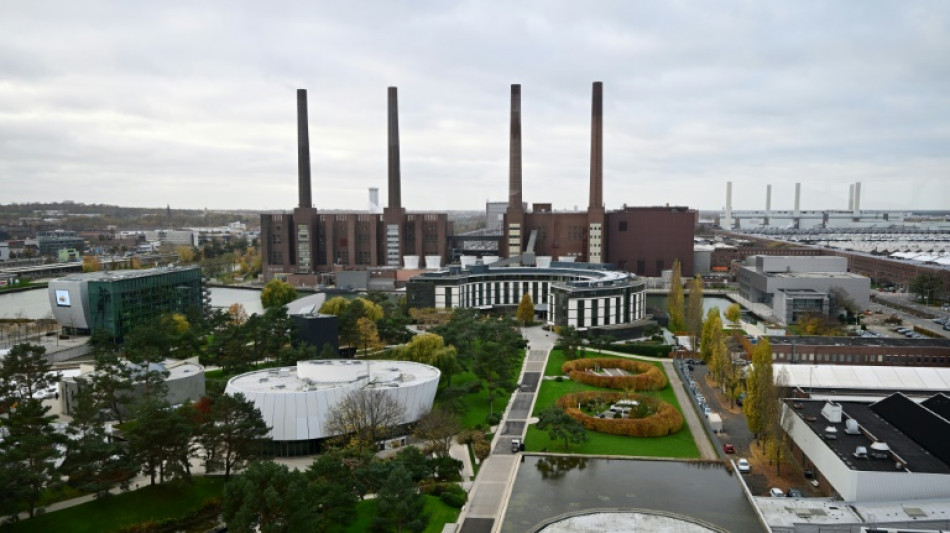
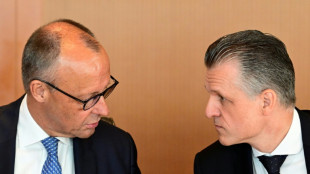
German economy shrinks again amid political crisis / Photo: Tobias SCHWARZ - AFP

 Brazil's Jair Bolsonaro denies authorizing deepfake for election message

 Boaduwaa strikes as Ghana beat WAFCON debutants Cape Verde

 US actor Jared Leto denies latest accusations of sexual assault

 Danube drops to 'historic lows' as fresh heatwave hits

 US Federal Reserve holds rates steady as inflation hawks call for hike

 Eala beats defending champ Fernandez in Washington
 US man accused of destroying evidence by wiping phone at airport

 BTS pulls out of Grammys after Asian pop category introduction

 Judge orders Amy Winehouse's father to pay nearly £1mn to her friends
 Crisis-hit Cuba opens pharmacies, gas stations to private firms

 Pro-Kremlin TV commentator ordered to leave France, under house arrest

 'I started crying': Battle to tame fresh blaze near French seaside

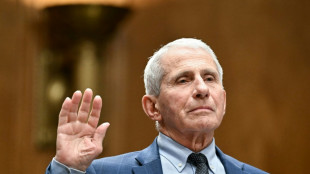 Former top US Covid expert Fauci declines to answer hostile Senate questioning

 Neymar says his time playing for Brazil 'is over'
 F1 boss says season to finish in Europe if Gulf races cancelled
 Spanish wildfire evacuees go home as France hit by new heat alert

 French DJ Kavinsky, famed for 'Nightcall', found dead in Paris
 How an AFP beach snap became emblem of Europe's wildfire summer
 More than half of England 'officially in drought': UK govt

 MEXC Integrates World-Check to Fortify Institutional Grade Compliance Architecture

 Tech stocks plunge further but London market hits record high

 Spain's three worst wildfires since 1961 happened in last two years

 FIFA proposal 'an outright attack on football', says DFB vice-president

 Principal reaction to FIFA's private investor plan
 Ireland's Harrington named as vice-captain for 2027 Ryder Cup

Germany's economy shrank for a second straight year in 2024, official figures showed Wednesday, with little hope of a speedy recovery as Europe's traditional powerhouse is also mired in political crisis.
Gross domestic product in Europe's largest economy fell 0.2 percent last year, according to preliminary figures from federal statistics agency Destatis, after a 0.3 percent contraction in 2023.
Germany has faced a perfect storm, with high energy costs battering its manufacturing sector, demand weak in China and other key export markets, and the economy facing deep-rooted structural problems including a shortage of skilled labour.
Destatis president Ruth Brand said the economy suffered under both "cyclical and structural pressures" last year.
"These include increasing competition for the German export industry on key sales markets, high energy costs, an interest rate level that remains high, and an uncertain economic outlook," she said.
Preliminary data also showed that the economy had contracted 0.1 percent in the final quarter of last year compared to the previous quarter.
Fears are growing that the economy will struggle to get back on its feet this year, due in part to the political crisis at home.
Following the collapse of Chancellor Olaf Scholz's coalition, Germany is heading for early polls on February 23, which is expected to be followed by a period of paralysis before a new coalition emerges.
- Trump tariffs threat -
The data released Wednesday -- in line with most forecasts, including from the government -- will be further bad news for Scholz, who has been criticised for failing to reboot the economy and already faces an uphill battle to win re-election.
US President-elect Donald Trump's threat to hit imports into the world's top economy with tariffs is adding to jitters for German exporters.
In December, the German central bank slashed its growth projection for 2025 to a meagre 0.2 percent from a previous estimate of 1.1 percent.
The Destatis data showed that the manufacturing sector declined markedly in 2024, highlighting the challenges for a traditional pillar of the economy, which has struggled since Russia's full-scale invasion of Ukraine in 2022 sent energy costs soaring.
Brand noted that the country's exports fell in 2024, even as global trade increased overall, adding that "the international competitiveness of the manufacturing industry faced further pressure".
- 'Sick man' again? -
The last time Germany recorded two straight years in the red was 2002-2003, when the country was still seen as the "sick man" of Europe.
Relative success in the years that followed earned it a reputation as the powerhouse of the eurozone but Germany's economic motor has stalled since the coronavirus pandemic and outbreak of the Ukraine war.
Germany finds itself in the unusual position of having to bring up the rear in Europe in terms of growth -- the European Commission has predicted the overall eurozone economy to have grown by 0.8 percent in 2024, well above Germany's result.
The country's economic woes have been reflected in a string of job cuts and poor results at leading companies throughout the year.
Volkswagen, Europe's biggest carmaker, has come to symbolise the problems facing German industrial titans. Last month, it announced plans to cut 35,000 jobs at home in the coming years as it battles high costs, and fierce competition in key market China.
Clashes between Scholz and his coalition partners over how to get the economy back on its feet were at the heart of the government's collapse in November.
Some hope a stronger government will emerge after February's election -- where centre-right opposition leader Friedrich Merz is seen as favourite to take over -- and be better able to turn the economy around.
Klaus Borger, an economist from public lender KfW, said bold actions were urgently needed.
"Besides containing the numerous global crises and uncertainties, what is needed above all are convincing answers from policymakers and companies to the huge transformative challenges, especially in industry," he said.
L.Adams--AT