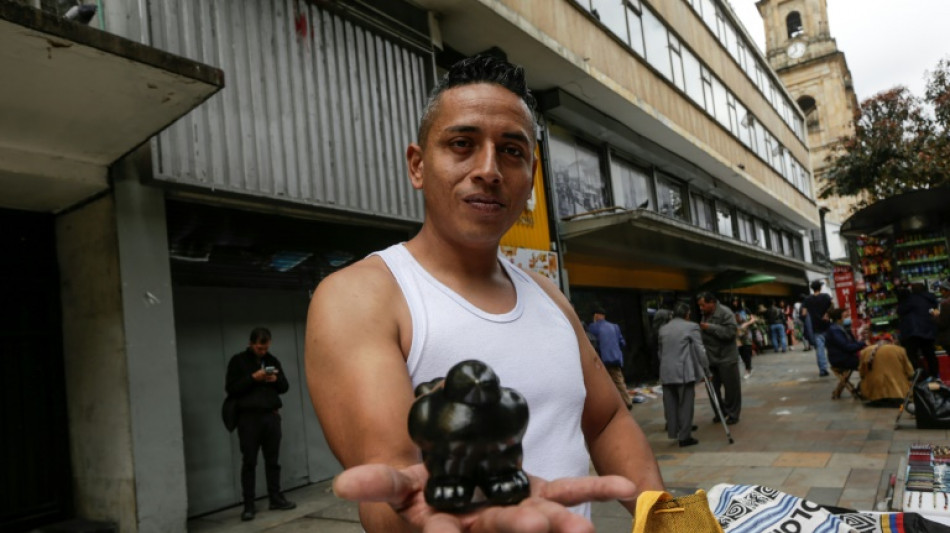
'Polarized election' - Bogota voters weigh presidential options / Photo: Juan Pablo Pino - AFP

 US aircraft carrier departs Thailand after port call
 Haze emergency grips Malaysian Borneo town
 Messi creates both Miami goals in 2-2 draw with Atlanta
 Rybakina books US Open fourth-round berth, inches closer to No. 1
 Sobering reality: Curbs on alcohol in northeast Syria cause discontent
 Wobbly Osaka 'shocked' to battle past Mertens and reach last 16

 Indian Oscar-nominated filmmaker turns camera on his cancer
 Argentina 'let off hook' by Australia as Kiss's winning run ends
 Argentina threatens to sanction oil projects around Falklands
 Gauff into round four at US Open after straight-set win
 Bordeaux hammer Racing in Top 14 start as Bielle-Biarrey extends deal

 Zheng, Potapova pull off upsets to reach US Open last 16
 Swiatek into US Open fourth round in tight two-setter
 Werro wins in Brussels, as Russell and Dos Santos shine
 Kolbe breaks jaw and shoulder injury sidelines Savea

 US military strikes oil tankers as Iran vows tougher reprisals

 Zheng rallies to stun Keys, Anisimova out in US Open third round
 Bayern held to draw by stubborn Schalke
 Lens lose again ahead of Champions League date
 Olympic champion Zheng storms home to reach US Open last 16

 Big-spending Spurs must make better attacking decisions, says De Zerbi

 South Africa dominate New Zealand in second half to lead series
 Kiefer Sutherland still in action, but ibuprofen lending helping hand
 'Are we ready?' Oasis film captures band's frosty reunion

 Commemoration held for late Bosnian Serb war criminal Ratko Mladic
Six men will contest Sunday's first-round presidential election in Colombia, but most voters are zooming in on one of three frontrunners they hope holds the answers to the country's many pressing problems.
For residents of the capital Bogota, a city of eight million, those issues include violent crime, deep-rooted inequality and fast-rising consumer prices.
Leftist former Bogota mayor and ex-guerrilla Gustavo Petro, 62, holds a seemingly unassailable lead in opinion polls, followed by right-wing candidate Federico Gutierrez, 47 -- an erstwhile mayor of second city Medellin.
Rising in the polls, but never higher than third place, is anti-corruption candidate Rodolfo Hernandez, a 77-year-old businessman.
Here is a sample of voters in their own words:
- For Petro -
Jhon Richard Pejendino, 33, sells art on the streets of Bogota but would have liked to be a lawyer.
He did not have money to go to university.
"There are public universities but you have to have very good marks to get in. If you don't have the marks you must pay, and if you do not have money, you do not get educated."
Pejendino supports Petro, who he believes "is for us, the poor."
The World Bank says Colombia is one of the countries of Latin American with the worst income inequality and biggest underground labor markets.
Shoe shiner Jaime Guerrero, 55, said crime and scant public transport were his main concerns.
"When he (Petro) was mayor, he did good things for the people, and we are hopeful he will do better as president," he said with a broad smile revealing many missing teeth.
Jewelery store worker Rosa Empera Alvis, 60, said she hoped Petro would negotiate with Colombia's last guerrilla group, the ELN -- as he has promised -- and finally bring lasting peace to the violence-plagued country.
And office cleaner Petrona Guzman, 43, said that as president, Petro should take steps to "bring down the cost of the basket of basic goods, which is very expensive, especially food."
She said she also believed Colombians deserved better access to health care, pensions and unemployment benefits.
"And we have to change education. Many people send their children out to work rather than university, because they do not have the money."
- For Gutierrez -
Maria Elvira Almanzar, a 71-year-old retired industrial designer, has put her faith in Gutierrez's "strong state" anti-crime stance.
"Security is the most important thing. One should be able to walk in the street without looking over your shoulder for who is going to rob you," she told AFP as she did exactly that.
Fear of crime is a common complaint for people of all social classes.
According to official data, Bogota registered 8.4 murders per 100,000 inhabitants in 2021, a percentage point higher than the previous year but not among the highest in the world.
There were also 108,000 reported muggings -- often committed with guns-- in 2021, an increase of 24,000 in one year.
For Almanzar, like many other Colombians, the political left "is an extremist thing" historically associated with the guerrilla groups that she said sowed murder and mayhem for decades until a 2016 peace deal ended a near six-decade civil conflict.
Wilson, a hotel porter of 40 who did not want to give his full name for fear of getting into trouble at work, said he, too, was distrustful of the left.
"This is one of the most polarized elections yet," he told AFP while on a break outside his place of work on the eve of elections.
"There is a saying that people deserve the leader they have, so if people want to elect him (Petro), they have to accept the consequences."
- For Hernandez -
Businessman Freddy Montoya, 42, said he preferred Hernandez's focus on fighting corruption, and was distrustful of Petro's leftist leanings: "He is very close to communism."
- Undecided -
Carlos Caisedo, 78, sells cleaning rags on the street to make enough money to eat and rent a room for the night.
He has not decided who to vote for because "everyone makes promises but in the end, no one fulfils them."
Caisedo is clear, though, on what the main issues are: "Insecurity and the lack of employment opportunities."
"For example, in my case: why am I in the street at this age? Because I need to pay rent. I do not have help from the state."
- Staying away -
Andrea Perez, 30, sells trinkets on the streets of Bogota and is one the many who abstain from voting -- some 50 percent in recent elections.
"I do not vote because it is always the criminals who win," she told AFP.
S.Jackson--AT