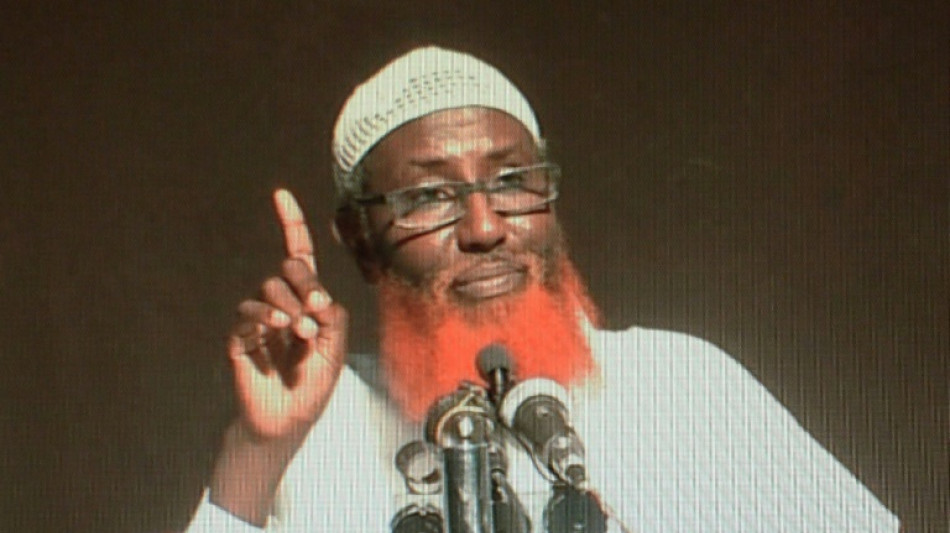
The quiet financier: Islamic State's elusive strongman / Photo: SIMON MAINA - AFP

 Irish singer, musician Glen Hansard killed in motorbike crash at 56
 Ukraine appeals against Russian return to Olympics
 Rheinmetall shares surge after armsmaker reports record profit
 Israel army hit Gaza mosque, says used for Hamas 'weapons storage'
 Trump says US to hit Iran hard

 UBS second-quarter net profit up 17% to $2.8 billion
 FIFA hit by furious backlash over plans to sell stake in competitions
 TRX Spot and Perpetuals Listing Launches on Backpack, Expanding Access to the TRON Ecosystem

 Tel on target as Tottenham held to 1-1 draw by Sydney FC

 UN chief to convene new talks on divided Cyprus
 'No home': Spanish pensioner returns to charred ruins after wildfire
 Nepal's tiger numbers climb 20 percent to estimated 429: survey

 Germany's Merz under fire over chaotic reshuffle
 US, Saudi strike Iraq alliance in expanding war
 FIFA's plans to sell $4.2bn stake in its tournaments widely criticised
 Russia seeks arrest of Telegram chief Durov

 South Korean stocks plunge as tech rout deepens, oil rises
 On London streets, homeless wary at PM's vow to end rough sleeping
 Bangladesh ex-premier Hasina vows to return despite fearing for life

 Senate confirms Clayton as Trump intelligence chief

 South Korean stocks collapse amid Asian tech rout

 Search for survivors after powerful Japan quake kills 13

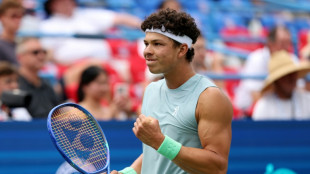 Shelton fends off Damm at Washington as veteran Venus ousted

 Indian hockey back on 'road to gold' after years in the wilderness
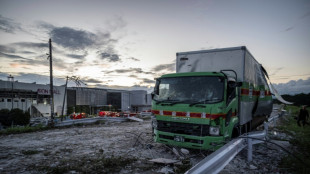 Rescuers search for survivors after powerful Japan quake kills 13

His orange henna-dyed beard and striking eyewear would make him easy to pick out in a crowd, but Abdul Qadir Mumin has remained elusive.
The Somalian leader of the Islamic State (IS) group has in all likelihood risen to the status of strongman of the entire organisation, even if he lacks the official title, analysts say.
While observers wonder who is behind IS-designated caliph Abou Hafs al-Hachimi al-Qourachi -- the would-be leader of all Muslims -- or whether such a person actually exists, Abdul Qadir Mumin may already be running IS's general directorate of provinces from Somalia.
"He is the most important person, the most powerful one, he is the one controlling the global Islamic State network," said Tore Hamming, at the International Centre for the Study of Radicalisation (ICSR).
In this opaque structure where the leaders get killed one by one by the United States, Mumin is among the few "senior guys who managed to stay alive the entire time until now, which does give him some status within the group", Hamming told AFP.
A few months ago it was thought that an American strike had killed him. But since there was never any proof of his demise, he is considered to be alive and active.
"Somalia is important for financial reasons," said Hamming. "We know that they send money to Congo, to Mozambique, to South Africa, to Yemen, to Afghanistan. So they have a good business model going."
The transactions are so shadowy that even estimating the amounts is impossible -- as is determining the exact routes the money takes from place to place.
- Small territory, big appeal -
Born in the semi-autonomous region of Puntland in Somalia's northeast, Sheikh Mumin lived in Sweden before settling in England, where he acquired British nationality.
In London and Leicester, he built a reputation in the early 2000s as a fiery preacher in radical mosques, but also in online videos.
He is said to have burned his British passport upon his arrival in Somalia, where he quickly became a propagandist for the Al-Shabaab group, linked to Al-Qaeda, before announcing his defection to IS in 2015.
"He controls a small territory but has a big appeal. He distributes volunteers and money," said a European intelligence official, who declined to be named, claiming that an IS attack in May in Mozambique "was carried out by Maghreb and African militants".
Mumin also finances the Ugandan rebels of the Allied Democratic Forces (ADF) -- affiliated with IS in the Democratic Republic of Congo -- "who now number between 1,000 and 1,500," the official said. With Mumin's help, "they have recently turned to the jihad" seeking "radicalism, weapons, and funding".
Some observers have described him as the caliph of the jihadist command structure. However, such an official designation would signal an ideological reversal for the group with deep roots in the Levant, the territory of the IS caliphate that lasted from 2014 to 2019 and spanned Iraq and Syria.
"That would create some kind of uproar within the community of supporters and sympathisers of IS," said Hans-Jakob Schindler, director of the Counter-Extremism Project (CEP) think tank.
- Shift toward Africa -
In theory, the caliph has to be an Arab from a tribe linked to the prophet. The supreme leader of a group so concerned with its ideological foundations "cannot be just any Somali with an orange beard," Schindler told AFP.
Especially because leaders of operationally active IS affiliates, such as IS-K in Afghanistan or ISWAP in western Africa, could lay claim to the position.
While the Somalian does not meet traditional leadership criteria, his geographical location brings some advantages.
"The Horn of Africa may have offered welcome insulation from instability in the Levant and greater freedom of movement," said CTC Sentinel, a publication on terrorism threats, at the West Point military academy.
"This profile of leadership parallels that of another jihadi leader -- Osama bin Laden -- who saw that funding his war was most central to winning it," it said.
Mumin's rise to the top, despite the small number of fighters under his command, also reflects two internal dynamics within IS.
The first, said Hamming, is that "the caliph is no longer the most important person in the Islamic State".
And the second is that IS is indeed pursuing a gradual strategic shift toward Africa.
"Ninety percent of violent images on jihad consumed in Europe come from Africa," said the European intelligence official.
Nonetheless, the organisation's leadership remains centralised in the Middle East, wrote CTC Sentinel.
"In this sense, much is business as usual," it said.
J.Gomez--AT