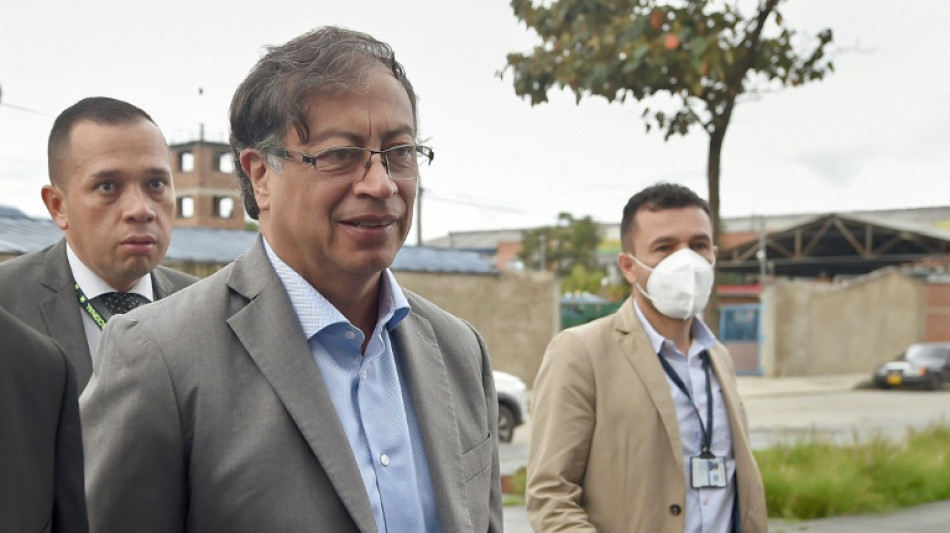
Left hopes for historic win in Colombia's 'change election' / Photo: DANIEL MUNOZ - AFP

 Nepali rescuers buoyed by miracle finds but tough conditions persist
 At last: Straight sets win over Tabilo puts Zverev in US Open last 16

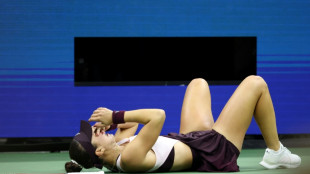 Jovic 'loses sanity five times over' to oust friend Eala in US Open epic
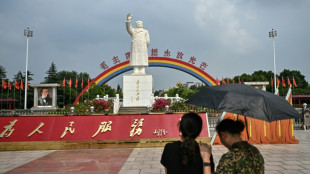 China's memories of Mao fade to nostalgia 50 years after his death

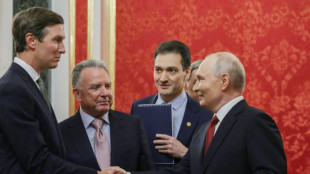 US envoys discuss with Putin 'substantive' plans for steps to end Ukraine war

 Zheng stuns Keys as US Open upsets dim American hopes
 Jovic 'loses sanity five times over' to oust Eala and book Gauff clash
 'Like a jewel': Japan's luxury ice revered by bars worldwide

 'The flood is coming': How a Nepal principal saved 900 students
 Kiss's winning run ends as Argentina hold Australia to draw

 Alcaraz excited to face 'dangerous' Paul for US Open quarter-final berth
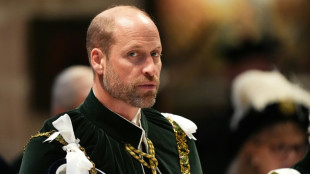 Prince William to represent King Charles III at Norway late King Harald's funeral

 Inter and Roma roar back to win thrillers and share top spot
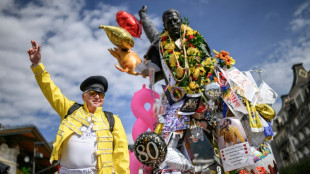 Don't stop them now: fans party for Freddie Mercury's 80th birthday

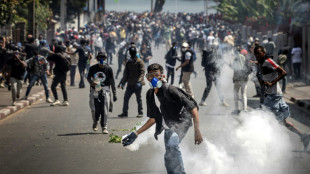 AFP photographer wins top prize for Madagascar protest coverage
 Keys: 'I felt like I couldn't play tennis'

 Simmonds stars as Pau upset Montpellier

 Inter roar back in five-goal thriller with Napoli
 Haaland keeps Man City perfect in Premier League, blunt Spurs held

 Hamilton worried by Ferrari pace while Antonelli prepares for a fight

 Vuelta stage 15 shortened due to extreme heat, Mas consolidates lead
 Putin meets US envoys for Ukraine war talks
 Modric available for Croatia in Nations League
 Potapova upsets 2025 US Open runner-up Anisimova

 Gasly a 'class act' says Alpine boss after Monza pole
Colombians go to the polls Sunday in a deeply polarized election that could see a leftist -- and ex-guerrilla -- become president for the first time in the history of the violence- and inequality-plagued country.
A year after a brutal security crackdown on street protests fueled by deepening socio-economic woes, many voters are pinning their hopes on former Bogota mayor Gustavo Petro to bring about much-needed change.
With promises of correcting a litany of social ills, Petro, 62, leads in opinion polls, with 47-year-old Federico Gutierrez, representing an alliance of right-wing parties, lagging in second place.
"This is a change election in Colombia," said Michael Shifter, a senior fellow at the Inter-American Dialogue think-tank.
"There is just a lot of frustration, a lot of anger and I think Petro has capitalized on that," he told AFP.
But in a country marked by a deep-rooted fear of the political left -- associated with guerrilla groups that sowed decades of misery -- the push-back against Petro has been fierce, with rivals seeking to paint him as a radical, Hugo Chavez-style populist.
In some quarters, "there is a profound, profound fear of a Petro and what he would represent... Colombians are terrified of becoming another Venezuela," said Shifter.
Even members of the military top brass have broken a constitutionally mandated political silence to lash out against a perceived leftist threat.
"The temperature is high in this election," Shifter said.
- 'Discontent and distrust' -
The campaign has been marred by suspicions of fraud following counting irregularities reported in a primary voting round in March.
Petro and Gutierrez have both received death threats, as has the leftist's running mate Francia Marquez, who could become Colombia's first ever black woman vice president.
Five presidential candidates were assassinated by opponents, drug traffickers or paramilitary groups in Colombia in the 20th century.
Incumbent President Ivan Duque -- who beat Petro in a runoff election in 2018 -- is leaving with record disapproval numbers. Colombian presidents serve only one term.
"The main (concern for voters) is just sort of bread and butter economic issues, access to education, services... inequality," said Elizabeth Dickinson, a senior analyst at the International Crisis Group.
There was also anger at a perceived "exclusionary elite class in Colombia that has wanted to maintain this system because it serves their interests but at the expense of the vast majority of the population," she told AFP.
Around 40 percent of Colombia's 50 million people live in poverty, and the country has one of the highest levels of income inequality in the world, according to the World Bank.
Indigenous and black Colombians are worst off.
The government's image was not helped by its internationally denounced response to weeks of anti-poverty protests last year that saw dozens of civilians killed.
For Jorge Restrepo, a professor at Javeriana University, the main sentiments driving voters this time are "discontent and distrust."
- Crime and violence -
Another key concern is violence that has flared up again despite a 2016 peace agreement that officially ended a near six-decade civil conflict.
Areas abandoned by the now-defunct FARC guerrilla group became battle grounds for control of drug and illegal mining resources between armed groups holding rural communities in a state of siege.
Petro, a former member of the M-19 urban rebel group which laid down arms in 1990, has vowed to pursue peace talks with the last remaining guerrilla group, the ELN, which were suspended under Duque.
Gutierrez, for his part, has vowed a "strong state" response to delinquency in the world's biggest cocaine producer.
Crime is a problem in the cities too, where residents complain of a rise in robberies and other violent property crimes they blame in large part on an influx of nearly two million migrants from neighboring Venezuela.
Whoever wins the election will have a long inbox of challenges, not least rebooting Latin America's fourth-largest economy in the wake of the coronavirus pandemic.
Petro has proposed a shift towards a greener economy by phasing out crude oil extraction, while Gutierrez wants to boost private investment.
Young people, who tend to favor Petro according to opinion polls, will be crucial to Sunday's outcome, analysts say.
But as a demographic, they tend to shirk the ballot box in a country where the overall abstention rate has hovered around 50 percent.
If no candidate receives half of the votes cast, a runoff between the top two candidates will take place June 19.
J.Gomez--AT