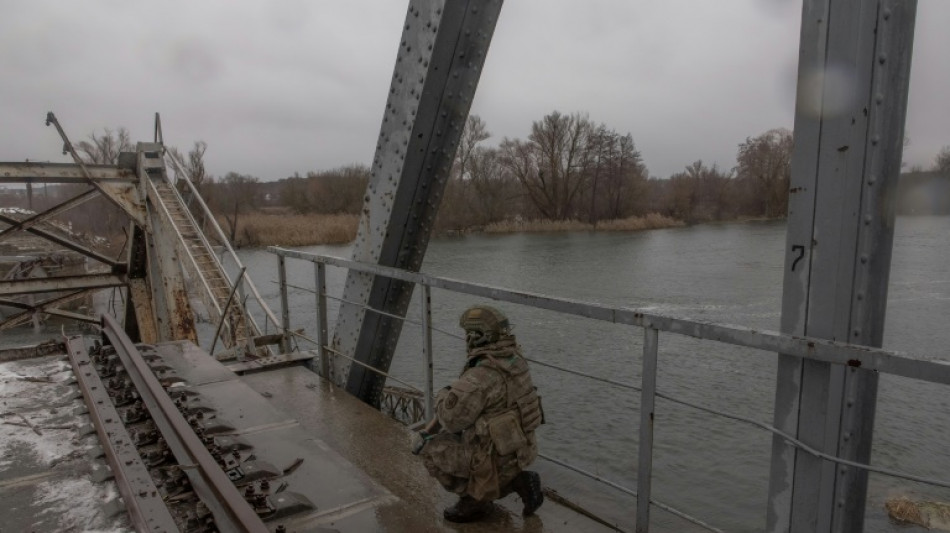
Ambushes and nostalgia on banks of frontline Ukraine river / Photo: Roman PILIPEY - AFP

 Russia seeks arrest of Telegram chief Durov

 South Korean stocks plunge as tech rout deepens, oil rises

 On London streets, homeless wary at PM's vow to end rough sleeping
 Bangladesh ex-premier Hasina vows to return despite fearing for life

 Senate confirms Clayton as Trump intelligence chief

 South Korean stocks collapse amid Asian tech rout

 Search for survivors after powerful Japan quake kills 13

 Shelton fends off Damm at Washington as veteran Venus ousted

 Indian hockey back on 'road to gold' after years in the wilderness
 Rescuers search for survivors after powerful Japan quake kills 13

 Five dead after powerful Japan quake, others missing

 Senate advances sweeping Russia sanctions bill

 Tocvan Announces Strategic Management Restructuring to Align Leadership with Growth and Production Objectives

 Annealsys Streamlines Scientific Product Evaluation with Customized Bioz Badges

 US government bans humanoid robots manufactured abroad
 Eseme, Hobbs shine in Glasgow rain to win 100m Commonwealth gold

 Netanyahu holds first White House talks with Trump since Iran war began

 Warriors re-sign Green after LeBron James shun

 Cameroon's Eseme storms to 100m Commonwealth gold

 AIDS activists slam 'pharma greed' over breakthrough drug

 France needs more Canadair water bombers but building them is painfully slow

 In devastated south Lebanon village, residents count on army deployment

 Keiko Fujimori sworn in as president of Peru

 GSJJ Launches ESG-Certified Custom Challenge Coins and Pin Badges
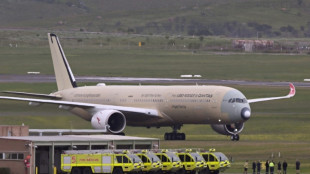 Airbus completes record 24-hour flight with plane to be used by Qantas

Lyubov Voronova still remembers a time before the war when the Oskil river flowing by her east Ukraine home was an idyll where families would swim, picnic and make memories.
Now, nearly three years into Russia's invasion, Kremlin forces have brought panic and destruction to its banks in a war of attrition that has pit invader and defender on opposing banks.
"It's the front line now. They're on one side, and we're on the other," the 72-year-old said in the emptied out village of Sadovod, her cottage's plastic-covered windows blown out by a recent strike.
Her neighbour lived his whole life in the nearby village of Dvorichna on the river, and wept on his knees recounting those killed there, and his granddaughter's death in a Russian strike nearby.
The Oskil, which winds into Ukraine's Kharkiv region from Russia, is swept by icy winds and surrounded by expansive snow-blanketed fields dotted with Ukrainian bunkers and zig-zagging trenches.
Russian forces crossed it quickly and easily when they invaded in 2022 but were beaten back months later in a rout that embarrassed the Kremlin.
But its forces are now sweeping back.
- 'If the Russians cross' -
Russian troops are either entrenched on its eastern bank, fighting furiously towards it, or making audacious breach attempts -- all at a precarious moment for Ukraine across the sprawling front line.
"It's a physical barrier that has military utility, but it's almost a psychological barrier now too," said Mick Ryan, a retired major general from the Australian army and analyst of the war.
"If the Russians get over the Oskil that means things are really bad," he told AFP.
Earlier this month, in a sleepy river bend near Dvorichne, Russian troops established a bridgehead on the Ukrainian-held side by sending infantry across in small boats. Kyiv said they were destroyed.
And in the war-battered town of Kupiansk -- one prize of Ukraine's successful 2022 counteroffensive that is divided by the Oskil -- Russian forces recently managed to re-enter by donning Ukrainian military uniforms before being beaten back, an official told AFP.
During a recent visit by AFP to Kupiansk, Ukrainian serviceman Igor was perched on a destroyed rail bridge extending over the Oskil, looking out over warring districts on the opposite side.
Smoke was billowing after an attack.
His unit with the 114th brigade has been using drones to re-supply troops on the far side and kill attacking Russian troops.
"It's hard, very hard. But basically, we're coping and holding out as long as we can," he told AFP.
- 'I want them to survive' -
Pointing to gradual Russian advances, Ukrainian authorities recently ordered families with children to evacuate from towns near the river in the Kremlin's sights.
In the village of Osynovo, just west of Kupiansk, where an overturned train car next to another destroyed bridge pointed to the fierce fighting of 2022, rail services ended this month.
Mykola, a resident who served in the Soviet army near Moscow, once fished and enjoyed a drink with friends along the Oskil to relax and calm his nerves.
The 80-year-old, who said Russian forces had captured his village "in the blink of an eye" before fleeing later in 2022, cannot approach the river any more and has new worries.
"Both my sons are fighting. I just want them to survive," he said tearfully to AFP with artillery fire echoing in the distance.
Whether Russian forces will attempt another large-scale crossing like in 2022 remains to be seen.
"You don't undertake these crossings unless you really have to," said Ryan, citing the huge military resources needed.
"Is there a significant objective on the other side of the river for the Russians that has operational, strategic or political importance for them? That's the real question," he added.
- 'Broke down in tears' -
Russia is persisting. Ukrainian military analysts said last week its forces had on a second recent attempt established a bridgehead near Dvorichne.
Further south in the village of Yatskivka in the Donetsk region where the Oskil ends, Inna Yurchenko is nervous.
When the 52-year-old shop owner returned home from Kyiv with her ageing mother after Ukrainian forces liberated it in 2022, she was distraught.
Her village and nearby holiday cabins used to be clogged with tourists -- including from towns still occupied by Russia -- relaxing by the river.
"I broke down in tears remembering how it used to be," she said, surrounded by tangles of snow-dusted metal and piled up bricks that were once her neighbours' homes.
Russia's advance in her industrial region is accelerating faster than at any time since the beginning of the Kremlin's invasion.
Ukrainian officials, including President Volodymyr Zelensky, have said publicly that their army lacks manpower and firepower to halt the Kremlin's march.
"I'm afraid of what's to come," Yurchenko said.
G.P.Martin--AT