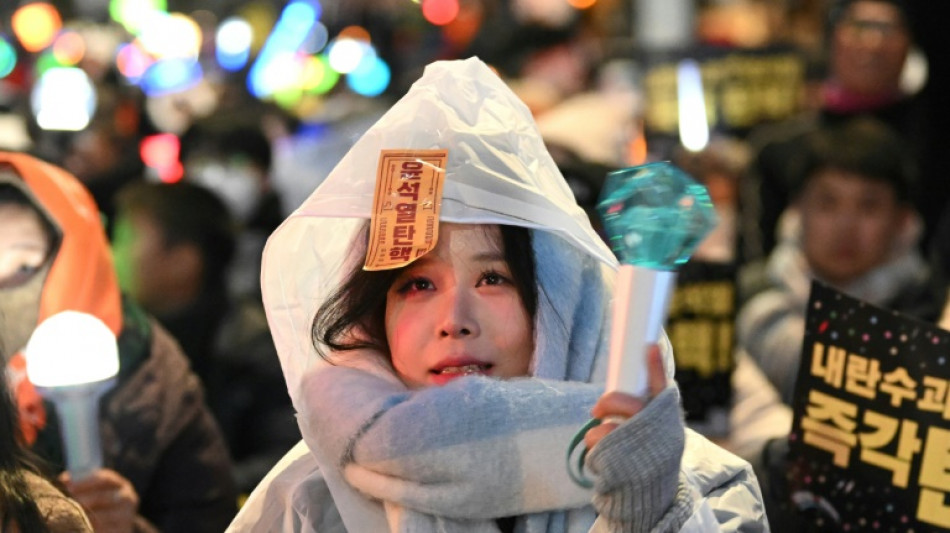
South Korean democracy holds firm against Yoon's martial law bid / Photo: Jung Yeon-je - AFP

 Chawinga sisters sparkle as Malawi stun WAFCON holders Nigeria

 India's youth protests puncture Modi's aura of invincibility
 UBS says second-quarter net profit up 17% to $2.8 billion
 Hong Kong independent bookstores to close after police raid

 US, Saudi forces strike Iran-backed groups in Iraq

 Crude jumps on fresh Mideast flare-up, tech rout deepens
 Japan coral protectors race to save reefs from heat 'bomb'

 US Fed expected to hold rates steady as inflation hawks circle

 SK hynix posts 1,200% net profit boost on AI chip boom

 'Very hungry' Joao Pedro impresses new Chelsea manager Alonso
 Hemogenyx Pharmaceuticals PLC Announces Collaboration and Company Update
 InterContinental Hotels Group PLC Announces Transaction in Own Shares - July 29

 US government bans humanoid robots manufactured abroad

 Eseme, Hobbs shine in Glasgow rain to win 100m Commonwealth gold

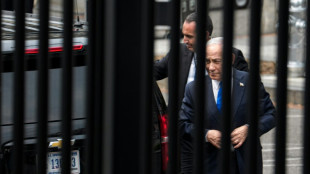 Netanyahu holds first White House talks with Trump since Iran war began

 Warriors re-sign Green after LeBron James shun

 Cameroon's Eseme storms to 100m Commonwealth gold

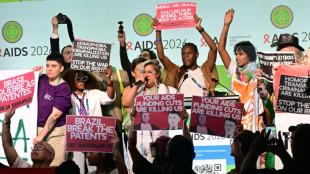 AIDS activists slam 'pharma greed' over breakthrough drug

 France needs more Canadair water bombers but building them is painfully slow
 In devastated south Lebanon village, residents count on army deployment

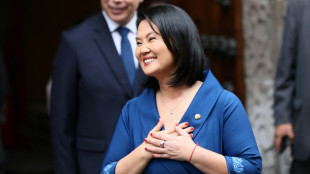
 Keiko Fujimori sworn in as president of Peru

 GSJJ Launches ESG-Certified Custom Challenge Coins and Pin Badges

 Airbus completes record 24-hour flight with plane to be used by Qantas
 FIFA says it hopes to sell $4.2bn stake in its tournaments
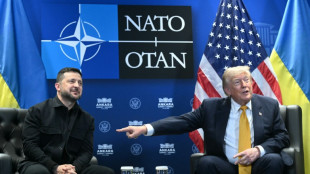 Zelensky hails 'good' Trump talks on Patriot air defenses

South Korea's swift rebuke of martial law and removal of President Yoon Suk Yeol from office have been hailed in the country as evidence of the strength of its young democratic institutions.
Yoon's bid to suspend civilian rule and claims of a communist conspiracy harkened back to the dark days of dictatorship in South Korea four decades ago, when human rights abuses by military and security forces were widespread.
But the fallout from the failed attempt was immediate and South Korea's institutions kicked in -- Yoon's inner circle were swiftly placed under police investigation and hauled before a parliament demanding answers.
Lawmakers rapidly launched impeachment proceedings against Yoon for his alleged "insurrection" and attempt to override the country's democratic constitution.
And on Saturday he was removed by a secret ballot in a tense vote in the ornate parliamentary chamber.
The vote sparked wild jubilation on the streets of Seoul -- opinion polls suggested more than 75 percent of the public supported impeachment.
"This situation has provided the Korean people with an invaluable lesson on what democracy truly entails and how our democratic republic can be protected," lawyer Yun Bok-nam, president of Lawyers for a Democratic Society, told AFP.
"For the people this has been a transforming experience in building a more powerful democratic consciousness among them."
- Red line drawn -
Bordering isolated, totalitarian North Korea and separated by a strip of sea from vast and authoritarian China, South Korea has for years been a posterchild for boisterous, democratic rule in East Asia.
Forged in the chaos and bloodshed of the 1980s anti-dictatorship movement -- from which many of the country's current crop of politicians emerged -- South Koreans have long sought to challenge their leaders in raucous street protests and vibrant displays of dissent.
And its strong rebuke of authoritarian rule this week again saw it buck a global trend towards autocratic politics, from the re-election this year of Donald Trump in the United States to a surge in right-wing populism in Europe.
That trend has seen UN Secretary-General Antonio Guterres warn that democratic values are "under assault" globally -- pointing to rising attacks and restrictions on media and human rights defenders.
But for many South Koreans, there was never any doubt that the country would turn back the clock.
"What we have witnessed over the past two weeks is a testament to the fact that it is now impossible to regress the country to its authoritarian past," said Bae Kang-hoon, co-founder of political think tank Valid.
"There is a red line drawn in the minds of the Korean people: that the country should never regress back to military rule," Bae told AFP.
"Yoon's martial law proclamation clearly crossed that line for many."
- Reform needed -
Should the Constitutional Court remove him from power, Yoon will gain the ignominious distinction of being only the second South Korean president to have been impeached.
Fellow conservative Park Geun-hye -- who Yoon, as chief prosecutor, played a key role in removing -- was also impeached under very similar circumstances.
But in the wake of that impeachment, South Korea "failed" to ensure the popular momentum that brought down Park translated into real change, Kim Jeong-min of analysis service Korea Pro told AFP.
"For this popular will to translate into better government will require a wholesale review of the constitution and the system," she said.
And Lim Ji-bong, constitutional law professor at Sogang University, stressed that "too much power" has been concentrated in the presidency.
Reforms could see the country "weaken the so-called 'imperial presidency' by getting rid of many of the president's powers and investing them in the legislature", he suggested.
Yoon has remained defiant throughout the turmoil that followed his martial law declaration.
He doubled down Thursday on allegations that "anti-state" forces were seeking to undermine South Korea's national security and electoral system.
"Yoon's speech was basically him sending out the impeachment invitation letter... like: 'Please impeach me'," Kang Won-taek, political science professor at Seoul National University, said.
"When the president said those things, it convinced lawmakers that he needed to be impeached."
E.Flores--AT