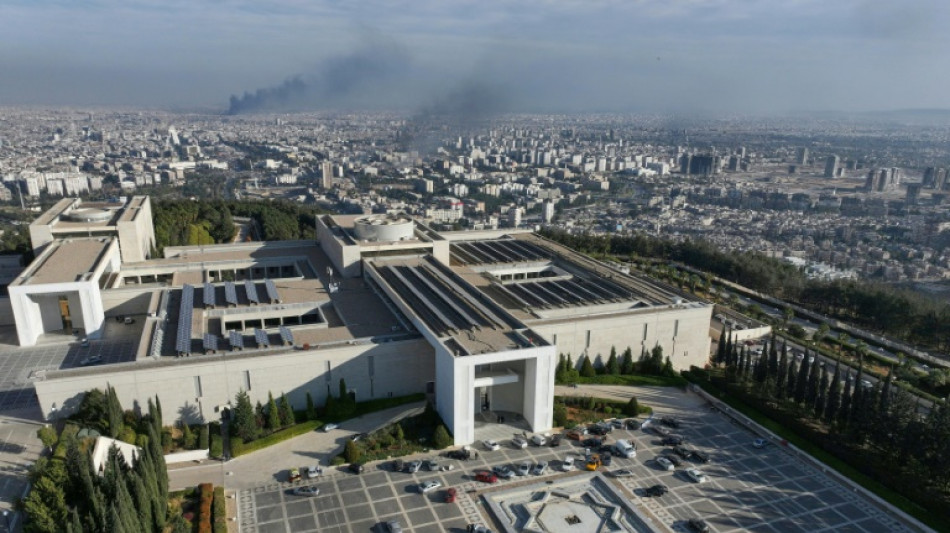
A palace in shock: Bashar al-Assad's final moments in Syria / Photo: Omar HAJ KADOUR - AFP/File

 Chawinga sisters sparkle as Malawi stun WAFCON holders Nigeria

 India's youth protests puncture Modi's aura of invincibility
 UBS says second-quarter net profit up 17% to $2.8 billion
 Hong Kong independent bookstores to close after police raid

 US, Saudi forces strike Iran-backed groups in Iraq
 Crude jumps on fresh Mideast flare-up, tech rout deepens

 Japan coral protectors race to save reefs from heat 'bomb'

 US Fed expected to hold rates steady as inflation hawks circle
 SK hynix posts 1,200% net profit boost on AI chip boom
 'Very hungry' Joao Pedro impresses new Chelsea manager Alonso
 Hemogenyx Pharmaceuticals PLC Announces Collaboration and Company Update

 InterContinental Hotels Group PLC Announces Transaction in Own Shares - July 29

 US government bans humanoid robots manufactured abroad
 Eseme, Hobbs shine in Glasgow rain to win 100m Commonwealth gold

 Netanyahu holds first White House talks with Trump since Iran war began

 Warriors re-sign Green after LeBron James shun

 Cameroon's Eseme storms to 100m Commonwealth gold
 AIDS activists slam 'pharma greed' over breakthrough drug

 France needs more Canadair water bombers but building them is painfully slow

 In devastated south Lebanon village, residents count on army deployment

 Keiko Fujimori sworn in as president of Peru

 GSJJ Launches ESG-Certified Custom Challenge Coins and Pin Badges
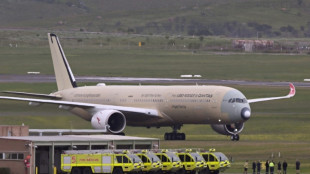 Airbus completes record 24-hour flight with plane to be used by Qantas

 FIFA says it hopes to sell $4.2bn stake in its tournaments
 Zelensky hails 'good' Trump talks on Patriot air defenses
Hours before rebel forces seized Damascus and toppled his government on Sunday, Syrian president Bashar al-Assad was already out of the country, telling hardly anyone, five former officials told AFP.
The night before, Assad had even asked his close adviser Buthaina Shaaban to prepare a speech -- which the ousted leader never gave -- before flying from Damascus airport to Russia's Hmeimim air base in Syria, and from there out of the country.
Assad left even "without telling... his close confidants in advance", a former aide told AFP, requesting anonymity for security reasons.
"From the Russian base, a plane took him to Moscow."
"His brother Maher," who commanded the Syrian army's feared Fourth Brigade, "heard about it by chance while he was with his soldiers defending Damascus. He decided to take a helicopter and leave, apparently to Baghdad," added the former aide.
Other top officials in Assad's government and sources told AFP what happened in the final hours of the iron-fisted leader's 24-year rule.
All spoke on condition of anonymity because of security concerns.
- Leaderless -
When Islamist-led rebel forces launched their offensive in Syria's north on November 27, Assad was in Moscow, where his wife Asma has been treated for cancer.
Two days later, when their son Hafez was defending his doctoral thesis at a Moscow university, the whole family were there, but not Bashar, according to a presidential palace official.
On November 30, when Assad returned from Moscow, Syria's second city of Aleppo was no longer under his government's control.
The following week, the rebels took Hama and Homs in quick succession, before eventually reaching the capital.
Another palace official said he did not see Assad the day before Damascus fell last Sunday.
"On Saturday Assad didn't meet with us. We knew he was there, but did not have a meeting with him," said the top official.
"We were at the palace, there was no explanation, and it caused great confusion at the senior levels and on the ground," he said.
"Actually, we had not seen him since the fall of Aleppo, which was very strange."
During that fateful week, Assad called a meeting of the heads of Syria's intelligence services to reassure them.
But the longtime leader did not show up, and "Aleppo's fall shocked us", said the same top palace official.
Hama was next to fall into rebel hands.
"On Thursday, I spoke at 11:30 am with troops in Hama who assured me the city was under lockdown and not even a mouse could make it in," an army colonel told AFP.
"Two hours later they received the order not to fight, and to redeploy in Homs to the south," added the officer of the next strategic city sought by the rebels on their way to Damascus.
"The soldiers were helpless, changing clothes, throwing away their weapons and trying to head home. Who gave the order? We don't know."
The governor of Homs told a journalist that he had asked the army to resist. But no government forces defended the city.
- Delay -
On Saturday morning, someone in the halls of power in Damascus brought up the idea of Assad making a speech.
"We started to set up the equipment. Everything was ready," said the first palace official.
According to him, top officials and aides were unaware that while this was happening, the Syrian army had already begun destroying its archives by setting them on fire.
Still on Saturday, at around 9:00 pm (1800 GMT), "the president calls his political adviser Buthaina Shaaban to ask her to prepare a speech for him, and to present it to the political committee which is meant to meet on Sunday morning", said a senior official close to Assad.
"At 10:00 pm she calls him back, but he no longer picks up the phone."
That evening, Assad's media director Kamel Sakr told journalists: "The president is going to deliver a statement very soon."
But then Sakr, too, stopped answering his phone, as did interior minister Mohammed al-Rahmoun.
The palace official said he stayed in his office until 2:30 am on Sunday. Within less than four hours, the rebels were to announce that Assad was gone.
"We were ready to receive a statement or a message from Assad at any moment," said the top palace official.
"We could have never imagined such a scenario. We didn't even know whether the president was still at the palace."
- 'Everything was lost' -
At around midnight, the palace official had been told that Assad needed a cameraman for Sunday morning.
"That reassured us that he was in fact still there," he said.
But just before 2:00 am, an intelligence officer called to say all government officials and forces had left their offices and positions.
"I was shocked. It was just the two of us in the office. The palace was almost empty, and we were totally confused," said the official.
At 2:30 am he left the palace.
In the city centre, "arriving at Umayyad Square, there were plenty of soldiers fleeing, looking for transportation," he said.
"There were thousands of them, coming from the security compound, the defence ministry and other security branches. We found out that their superiors had ordered them to flee."
The official said it was a "frightening" scene.
"Tens of thousands of cars leaving Damascus, and even more people marching on the road on foot. It was that moment I realised everything was lost and that Damascus had fallen."
E.Hall--AT