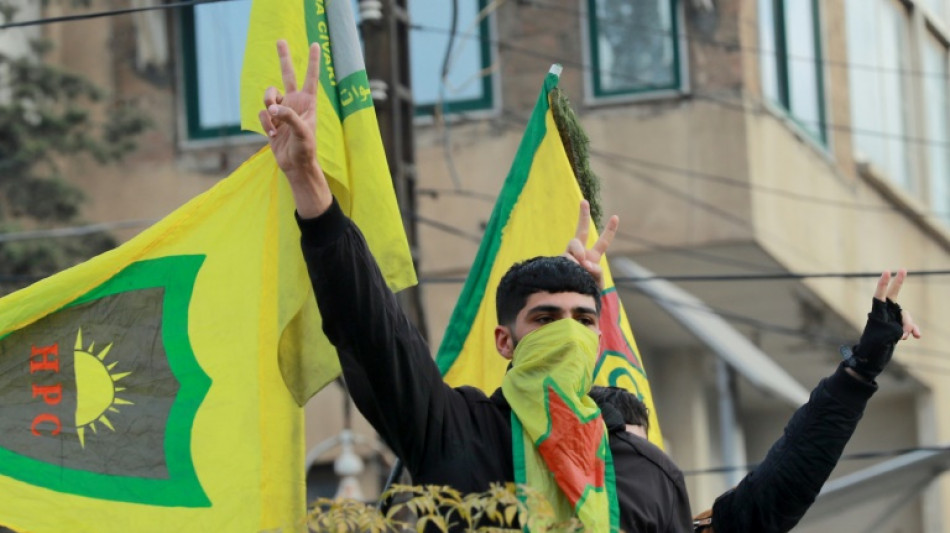
Syria Kurds warm up to new leaders but fear for hard-won gains / Photo: Delil SOULEIMAN - AFP

 US, Saudi forces strike Iran-backed groups in Iraq
 Crude jumps on fresh Mideast flare-up, tech rout deepens
 Japan coral protectors race to save reefs from heat 'bomb'

 US Fed expected to hold rates steady as inflation hawks circle
 SK hynix posts 1,200% net profit boost on AI chip boom
 'Very hungry' Joao Pedro impresses new Chelsea manager Alonso
 US government bans humanoid robots manufactured abroad
 Eseme, Hobbs shine in Glasgow rain to win 100m Commonwealth gold
 Netanyahu holds first White House talks with Trump since Iran war began

 Warriors re-sign Green after LeBron James shun

 Cameroon's Eseme storms to 100m Commonwealth gold
 AIDS activists slam 'pharma greed' over breakthrough drug
 France needs more Canadair water bombers but building them is painfully slow
 In devastated south Lebanon village, residents count on army deployment
 Keiko Fujimori sworn in as president of Peru

 GSJJ Launches ESG-Certified Custom Challenge Coins and Pin Badges
 Airbus completes record 24-hour flight with plane to be used by Qantas

 FIFA says it hopes to sell $4.2bn stake in its tournaments
 Zelensky hails 'good' Trump talks on Patriot air defenses
 Spain allows wildfire evacuees to return but France fears flames spreading

 'Not out of danger': Residents return to scorched French village
 Zelensky holds White House talks with Trump on Ukraine war

 US Fed begins meeting with markets expecting steady interest rates
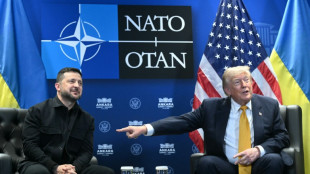 Ukraine's Zelensky arrives for Trump talks at White House
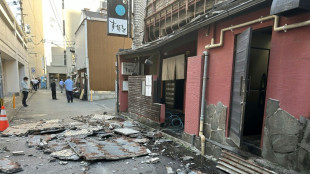 Dozens feared trapped in quake-hit Japan mall

Kurdish authorities have made overtures to Islamist-led rebels who seized power in Syria last week, but the long-oppressed community fears it could lose hard-won gains it made during the war, including limited self-rule.
The Kurds faced discrimination during more than 50 years of Assad family rule. They were barred, for example, from offering education in their own language.
As rebels led by Islamist group Hayat Tahrir al-Sham (HTS) seized power, ousting president Bashar al-Assad, the Kurdish authorities in northeastern Syria have multiplied overtures to the new leaders, like adopting the three-starred flag used by the opposition.
Mutlu Civiroglu, a Washington-based analyst and expert on the Kurds, said that the fate of Syria's Kurdish authorities "remains uncertain", noting "the rapidly shifting dynamics on the ground".
Syria's Kurds face "mounting pressure from the Turkish government and factions under its control", he said, as Ankara-backed fighters seized two Kurdish-held areas in the north during the rebel offensive.
Last week, Mazloum Abdi who heads the US-backed Kurdish-led Syrian Democratic Forces (SDF) welcomed "an opportunity to build a new Syria based on democracy and justice that guarantees the rights of all Syrians".
But many in the northeast are concerned about the future of their autonomous region.
"The factions in Damascus... don't recognise the Kurds, and now they want to whitewash their image in front of the international community," Ali Darwish, a Kurdish resident of the northeastern city of Qamishli told AFP.
"But we hope that we, as Kurds, will be able to preserve our areas and improve the economic situation," the 58-year-old said.
"We hope for positive solutions in the future."
- 'Undermining autonomy' -
Minority groups suffered during the civil war that borker out in 2011, particularly after the Islamic State (IS) group overran large parts of the country three years later.
HTS, the Islamist group that led the offensive that toppled Assad, is rooted in Syria's branch of Al-Qaeda and is proscribed as a terrorist organisation by many Western governments, though it has sought to moderate its rhetoric.
The SDF spearheaded the fight that defeated IS jihadists in Syria in 2019 with US backing -- putting Washington at odds with NATO ally Ankara, which has operated militarily against the Kurds.
On Thursday, US Secretary of State Antony Blinken said the SDF was "critical" to preventing a resurgence of IS jihadists in Syria following Assad's ouster.
On the same day, Turkish intelligence chief Ibrahim Kalin visited Damascus and Ankara named a new chief of mission for its long-closed embassy in Damascus, which it has pledged to reopen.
Civiroglu said that "Syrian Kurds face several significant challenges, the most pressing of which is Turkey's ongoing hostility towards them."
Since 2016, Turkey has staged multiple operations against the SDF.
Ankara views the People's Protection Units (YPG), a key part of the SDF, as an extension of the banned Kurdish militants who have fought a decades-long insurgency inside Turkey.
"All Turkish attacks and threats against the Kurds are seen as directly or indirectly aimed at undermining Kurdish autonomy and expanding Turkish control in northern Syria," Civiroglu said.
On the ground, fighters of Syria's new government have taken over the eastern city of Deir Ezzor from Kurdish-led forces, who had briefly moved in as government troops and their Iran-backed allies withdrew.
Syria's new leaders have said repeatedly that religious minorities will not be harmed under their rule, but they have not mentioned ethnic minorities like the Kurds.
In Qamishli, residents told AFP they were glad Assad was ousted, but had mounting concerns.
Kurds, who represent the largest ethnic minority in Syria, want a "democratic state that respects everyone's rights and religion," said Khorshed Abo Rasho, 68.
"We want a federal state, not a dictatorship," he added.
Fahd Dawoud, a 40-year-old lawyer, was hopeful that an inclusive government can be formed.
"We hope that the new government will represent all Syrians and won't exclude any party," he said.
A.Taylor--AT